Products
SentimenTrader Trading Tools
‍
Backtest Engine
My Trading Toolkit
Correlation Analysis
Seasonality
Market Prediction
Indicators & Data API
‍
Proprietary Indicators & Charts
Market Data API
Strategies & Scanner
‍
50+ Trading Strategies
Smart Stock Scanner
Smart Option Scanner
Research Reports
‍
Research Solutions
Reports Library
Free Resources
Simple Backtest Calculator
Simple Seasonality Calculator
The Kelly Criterion Calculator
Sentiment Geo Map
Public Research Reports
Education
Sentiment Indicators
Technical Indicators
Pricing
Company
About
In the News
Testimonials
Client Success Stories
Contact
Log inLoginSign up
< BACK TO ALL REPORTS

Once more unto the breach

Jason Goepfert
2022-09-12
At the end of last week, buyers showed a sense of eagerness that had only been witnessed one other time in 5 years, at the end of the March 2020 bear market. Historically, 3-day runs like we saw last week have preceded long-term gains every time, or close to it. The same goes for when there is a quick cycle in stocks trading above their 10-day moving average.

Key points:

  • Over the past 3 sessions, a historic number of S&P 500 stocks advanced
  • Similar bouts of eager buying preceded long-term gains every time (or close to it)
  • This follows what had been a prior thrust and reset

A historic level of buying interest

Once again, investors just can't get enough of stocks.

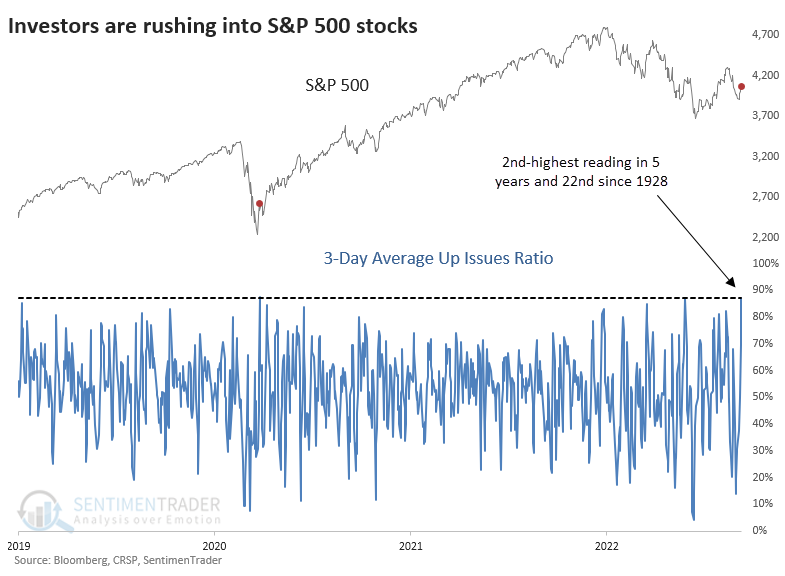
Over the past three sessions, an average of more than 87% of S&P 500 stocks have advanced. That's the 2nd-highest rate in six years, barely eked out by March 26, 2020.

Even going back to 1928, the current reading ranks 22nd, or in the top 0.1% of all days.
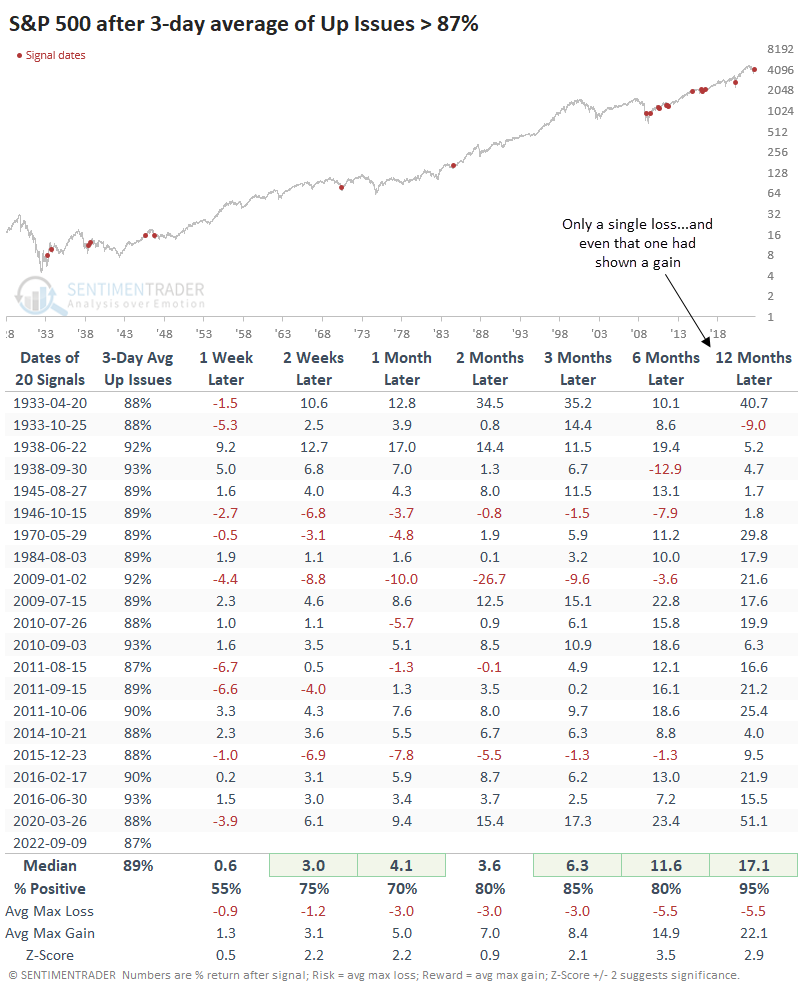
Since inception, there have been twenty unique times when the 3-day ratio of Up Issues in the S&P exceeded 87%. All but one of those dates witnessed the S&P rising over the next year. Even that one, in 1933, had shown a double-digit gain in the months prior.
Thrusts with no selling in between

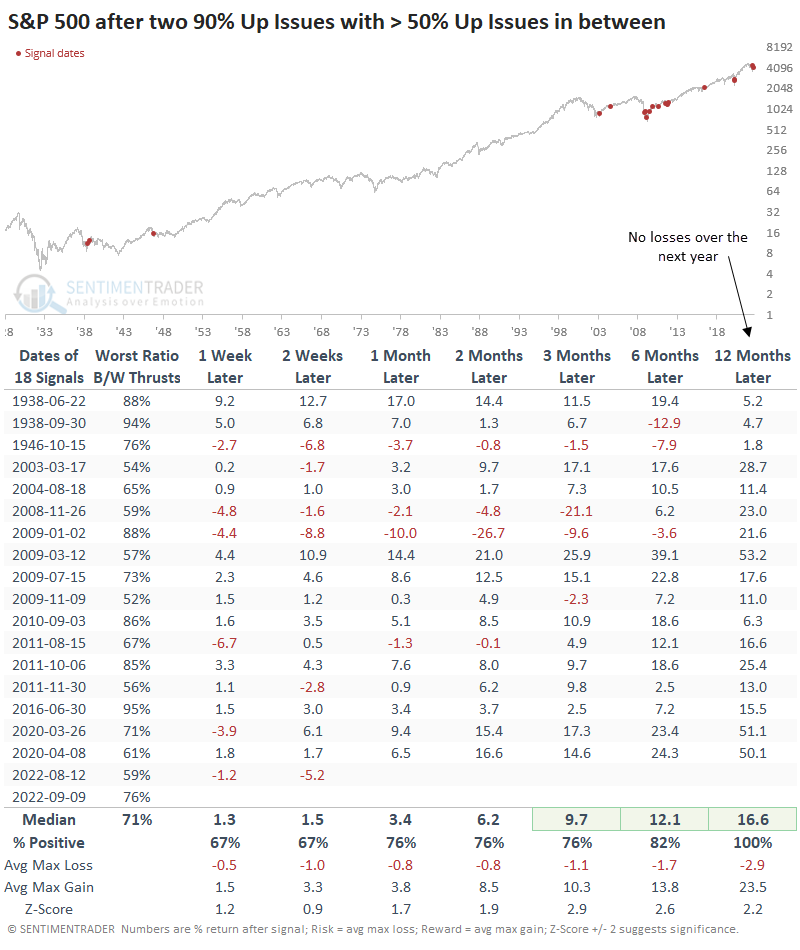
Perhaps even more remarkable is that more than 90% of stocks rose during two out of the past three sessions, and the intervening session on Thursday didn't see net selling pressure. Meaning that even when investors took a break, more stocks advanced than declined.

After similar behavior, the S&P never declined during the following year. As we've discussed many times, breadth statistics have become more volatile over the past twenty years, so most of the instances have occurred recently.
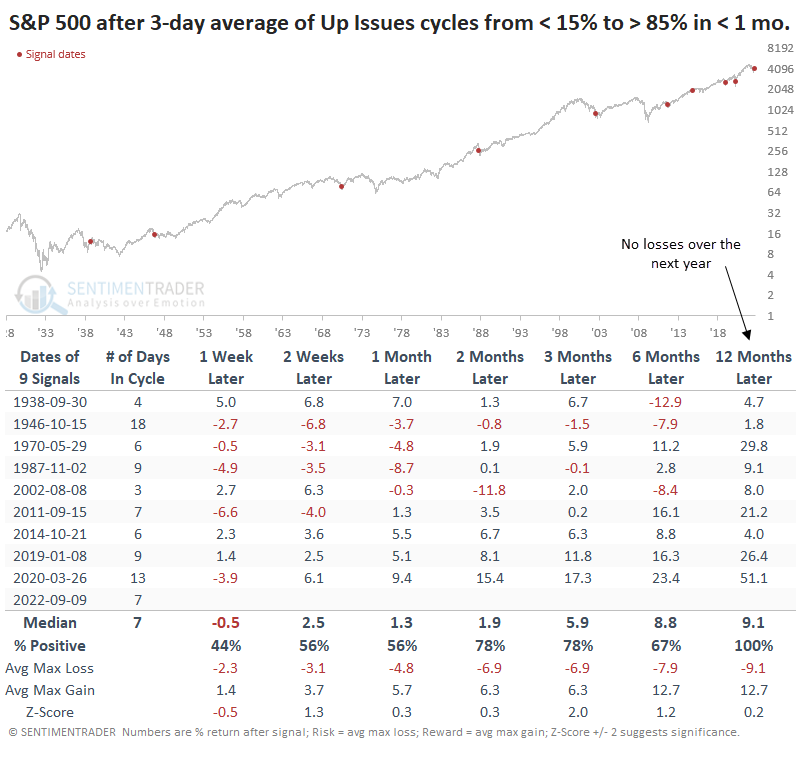
Also notable is the quick cycle between extreme selling and buying pressure. In less than a month, the 3-day Up Issues Ratio for the S&P cycled from below 15% to above 85%. Again, that preceded gains over the next year.
Short-term uptrends have surged again

Thanks to the frenetic buying pressure, the percentage of S&P 500 stocks trading above their 10-day moving average has cycled from fewer than 10% to more than 90%. It took less than a week to do so, just like in June.
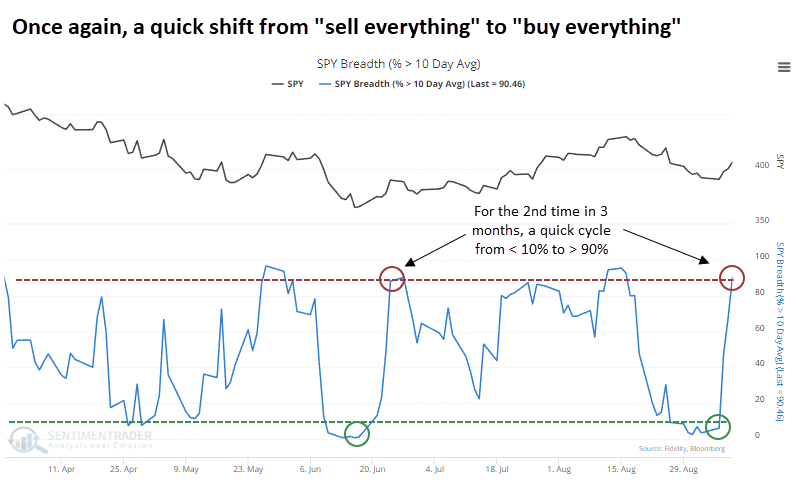
It's relatively rare to see such a quick shift in mentality. Again, it has become much more common since the global financial crisis, but since 1928, there have been only 17 times when the shift happened within a week.

All but two of the signals preceded gains in the S&P over the next year. The two losses were tiny, and one of them occurred when the index was trading near an all-time high, not coming off a significant and protracted loss like now.
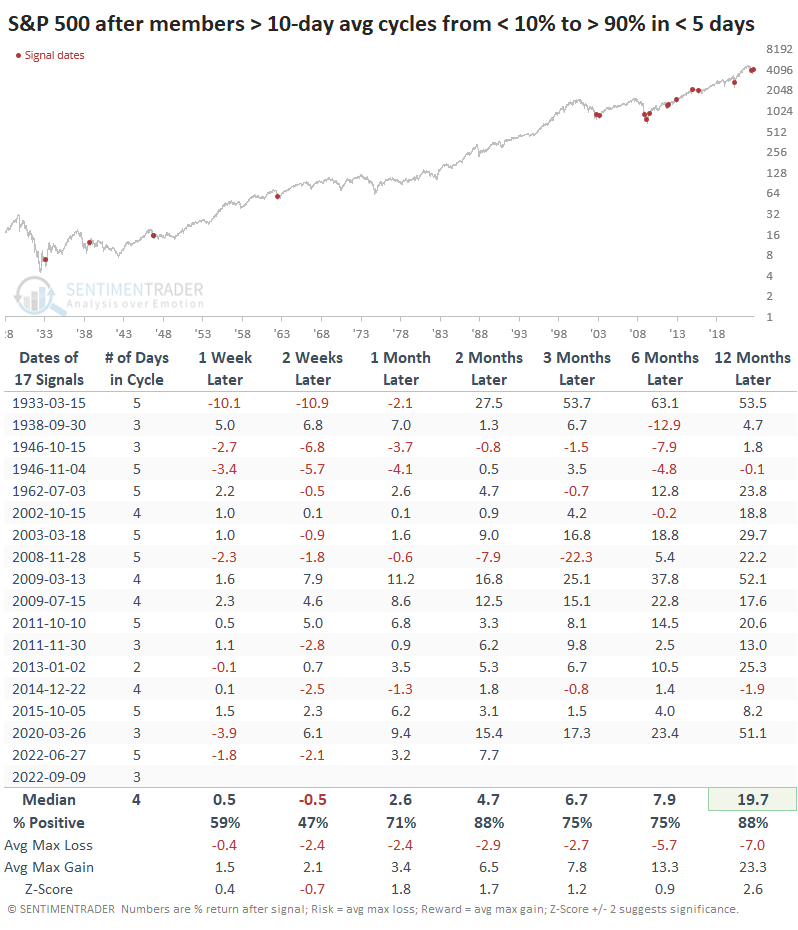
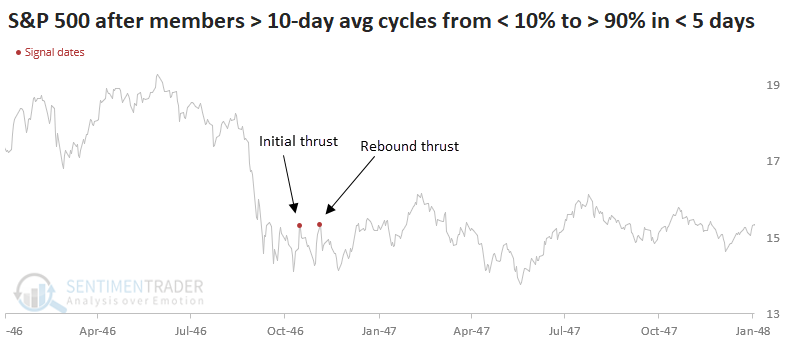
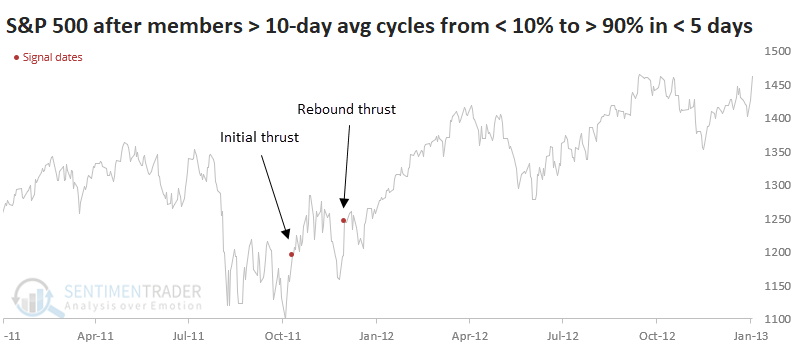
Out of all that history, and all those signals, only two time periods witnessed two thrusts within three months. It just happened again, for the third time.

The first one, in 1946, witnessed a short-term decline in the S&P 500 and choppy behavior for months (years, actually) following that.
The other one, in 2011, also preceded a short-term drop, but much more persistent and impressive upside afterward.
What the research tells us...

When buyers emerged after the extreme pessimism in June, it triggered breadth thrusts from several different angles. Those were just some reasons we likely weren't experiencing a bear market rally. It seems worrying that those failed, but that kind of reaction isn't necessarily a death knell for a longer-term recovery. Now that we saw another dip in sentiment and a subsequent thrust from buyers, we're seeing behavior that has always, or at least almost always, preceded medium- to long-term gains for stocks.

PRODUCTS
SentimenTrader
Trading Tools
Indicators & Data API
‍
Strategies & Scanner
‍
Research Reports
FREE
RESOUrCES
Simple Backtest
Calculator
Simple Seasonality
Calculator
The Kelly Criterion
Calculator
Sentiment Geo Map
‍
Public Research Reports
‍
Education
Sentiment Indicators
‍
Technical Indicators
‍
Pricing
Bundle pricing
‍
FAQ
‍
Announcements
‍
COMPANY
‍
About
‍
In the News
‍
Testimonials
‍
Client Success Stories
CONTACT
‍
General Inquiries
‍
Media Inquiries
‍
Financial Professionals Inquiries
‍
© 2026 Sundial Capital Research Inc. All rights reserved.
Setsail Marketing
TermsPrivacyAffiliate Program
Risk Disclosure: The information and tools provided are for research and analytical purposes only and are not intended as investment advice. Market analysis involves uncertainty, and outcomes may differ from expectations. Users should conduct their own due diligence and consider their individual circumstances before making any financial decisions. Past performance is not necessarily indicative of future results.

Hypothetical Performance Disclosure: Hypothetical performance results have many inherent limitations, some of which are described below. No representation is being made that any account will or is likely to achieve profits or losses similar to those shown; in fact, there are frequently sharp differences between hypothetical performance results and the actual results subsequently achieved by any particular trading program. One of the limitations of hypothetical performance results is that they are generally prepared with the benefit of hindsight. In addition, hypothetical trading does not involve financial risk, and no hypothetical trading record can completely account for the impact of financial risk of actual trading. for example, the ability to withstand losses or to adhere to a particular trading program in spite of trading losses are material points which can also adversely affect actual trading results. There are numerous other factors related to the markets in general or to the implementation of any specific trading program which cannot be fully accounted for in the preparation of hypothetical performance results and all which can adversely affect trading results.

Testimonial Disclosure: Testimonials appearing on this website may not be representative of other clients or customers and is not a guarantee of future performance or success.