Products
SentimenTrader Trading Tools
‍
Backtest Engine
My Trading Toolkit
Correlation Analysis
Seasonality
Market Prediction
Indicators & Data API
‍
Proprietary Indicators & Charts
Market Data API
Strategies & Scanner
‍
50+ Trading Strategies
Smart Stock Scanner
Smart Option Scanner
Research Reports
‍
Research Solutions
Reports Library
Free Resources
Simple Backtest Calculator
Simple Seasonality Calculator
The Kelly Criterion Calculator
Sentiment Geo Map
Public Research Reports
Education
Sentiment Indicators
Technical Indicators
Pricing
Company
About
In the News
Testimonials
Client Success Stories
Contact
Log inLoginSign up
< BACK TO ALL REPORTS

Bond sentiment is starting to recover

Jason Goepfert
2022-05-24
Over the past few months, pessimism toward the bond market reached extreme levels. That has started to ease as the selling pressure let up in recent weeks. Similar behavior typically led to multi-month gains in Treasuries, but with the biggest caveat being limited data under what may be the most comparable market environments.

Key points:

  • Most indicators on the bond market are showing that extreme pessimism is starting to reverse
  • Similar behavior tended to lead to multi-month gains
  • The biggest caveat is limited data under what may be a vastly changed market environment

Embedded pessimism is finally starting to thaw

While the S&P 500 is the most important equity index in the world, the most important market is U.S. Treasuries. And sentiment there is finally starting to turn a bit more optimistic.

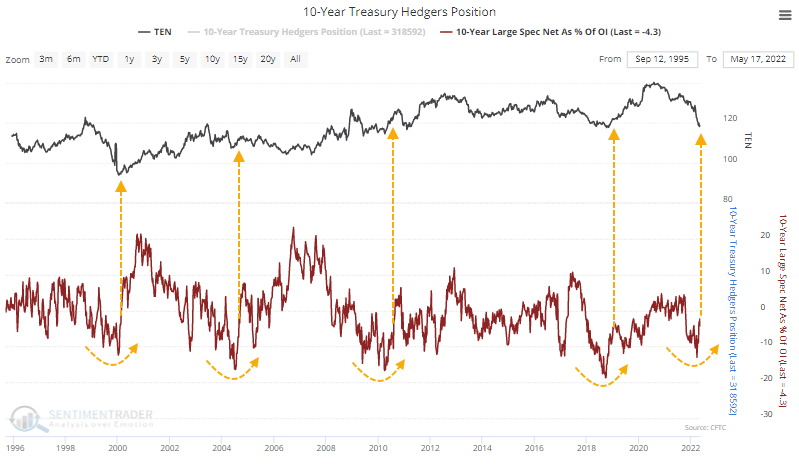
For the first time this year, large speculators are starting to cover their shorts in earnest and are on the cusp of going net long. While this is somewhat subjective, when they'd been heavily short and then started to cover in earnest, it was mostly a good sign for 10-year Treasury prices (meaning lower yields).
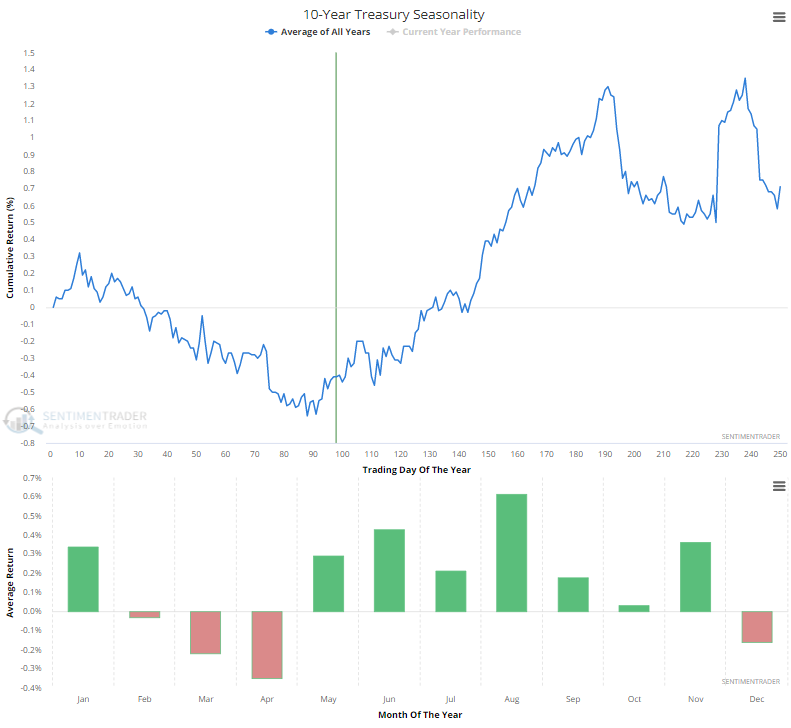
It's right on time as the seasonal window has turned positive. When we looked at this in April, we saw that the market had a bit more to go before the window turned positive, and while it's almost certainly just a coincidence, the selling started to stop right on time.
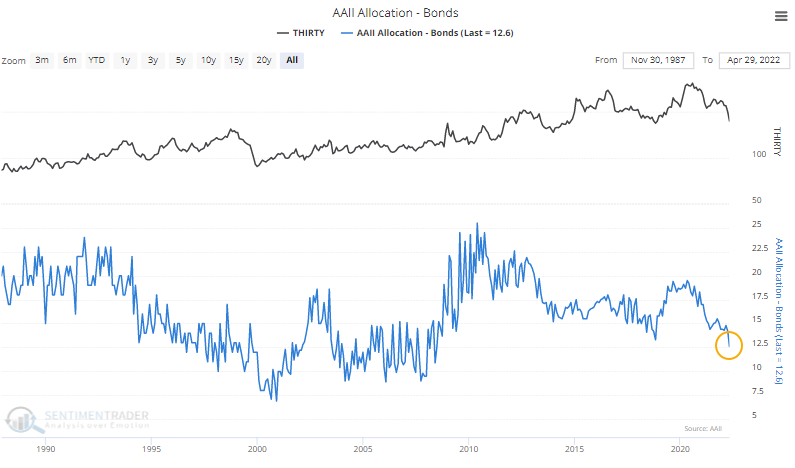
Individual investors remain wary as their allocation to bonds ticked lower again in the latest survey. They now have the lowest percentage of their assets in bonds since June 2008.
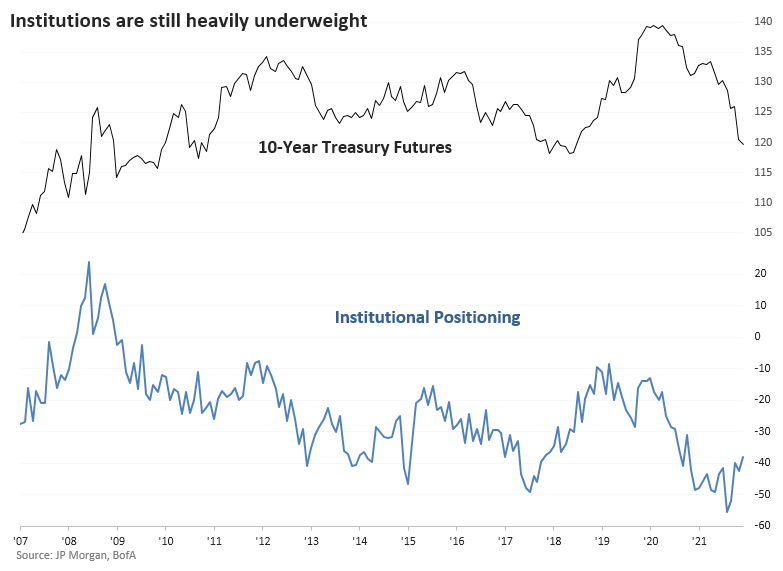
Professional investors seem to be even less inclined to be exposed to bonds, but that's starting to change. According to client positioning surveys from JP Morgan and BofA, client allocations to bonds are just picking up from at least 15-year lows. 
The persistently poor sentiment has resulted in persistent outflows from bond funds over the past 20 weeks, closing in on the records from October 2013 and April 2020.
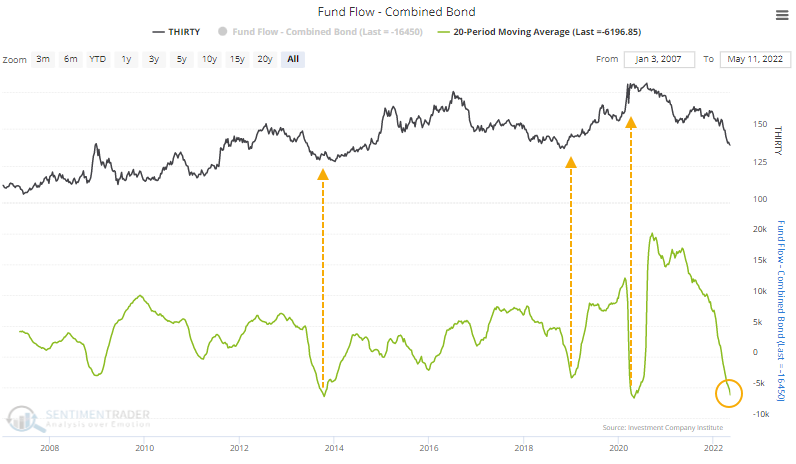
Taken altogether, the Bond Optix is finally starting to trough from near-record pessimism. As noted in April, this has tended to curl up ahead of the ultimate price low, at least from what we can see from a sample size of two and during what could be a completely new environment.
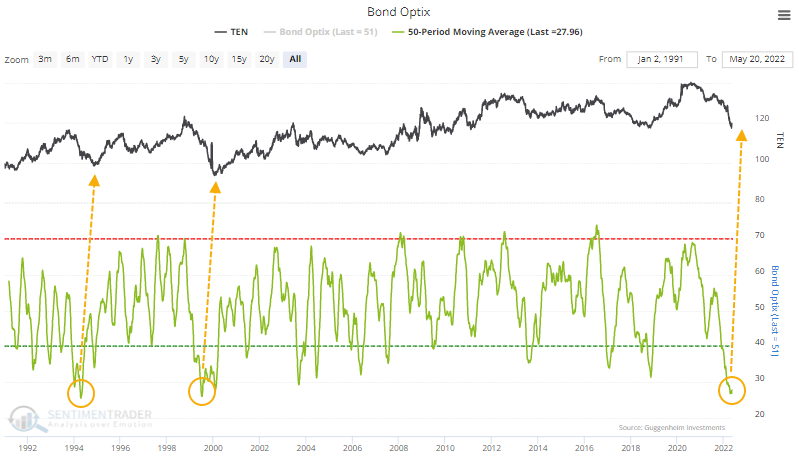
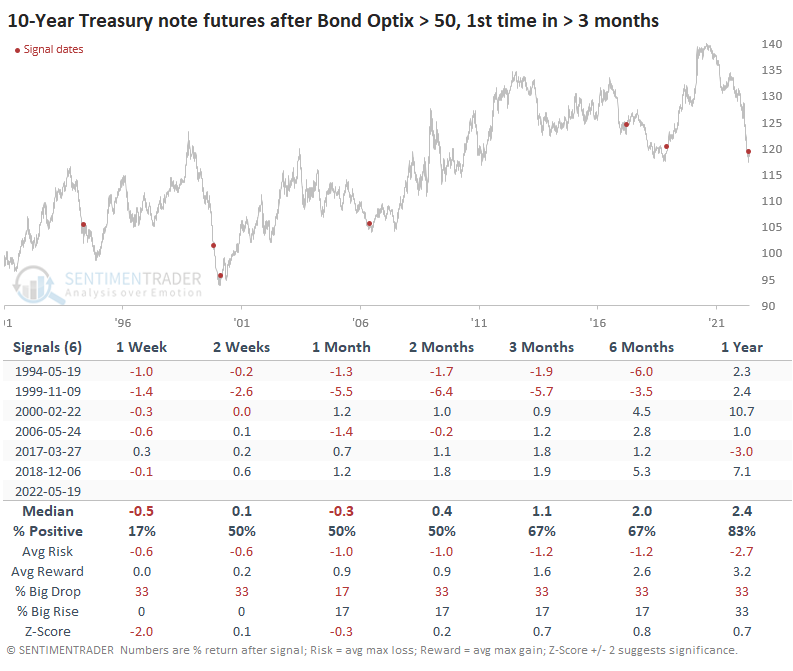
Over the past 30 years, when the Bond Optix finally exceeded 50% for the first time in months, it has mostly been a good sign, but the 1994 and 1999 signals were too early to capitalize on medium-term rallies.
What the research tells us...

The tricky part with gauging extremes in the bond market is the high likelihood that we've entered an environment that we haven't seen since before most of the data we have now was available. That makes trying to rely on extremes more fraught with "this time is different" danger than usual. From the data that we have over the past 30 years, the extreme pessimism that had built up over the past few months, and is now being relieved a bit, should indicate that further losses should be limited and temporary over a medium-term time frame.

PRODUCTS
SentimenTrader
Trading Tools
Indicators & Data API
‍
Strategies & Scanner
‍
Research Reports
FREE
RESOUrCES
Simple Backtest
Calculator
Simple Seasonality
Calculator
The Kelly Criterion
Calculator
Sentiment Geo Map
‍
Public Research Reports
‍
Education
Sentiment Indicators
‍
Technical Indicators
‍
Pricing
Bundle pricing
‍
FAQ
‍
Announcements
‍
COMPANY
‍
About
‍
In the News
‍
Testimonials
‍
Client Success Stories
CONTACT
‍
General Inquiries
‍
Media Inquiries
‍
Financial Professionals Inquiries
‍
© 2026 Sundial Capital Research Inc. All rights reserved.
Setsail Marketing
TermsPrivacyAffiliate Program
Risk Disclosure: The information and tools provided are for research and analytical purposes only and are not intended as investment advice. Market analysis involves uncertainty, and outcomes may differ from expectations. Users should conduct their own due diligence and consider their individual circumstances before making any financial decisions. Past performance is not necessarily indicative of future results.

Hypothetical Performance Disclosure: Hypothetical performance results have many inherent limitations, some of which are described below. No representation is being made that any account will or is likely to achieve profits or losses similar to those shown; in fact, there are frequently sharp differences between hypothetical performance results and the actual results subsequently achieved by any particular trading program. One of the limitations of hypothetical performance results is that they are generally prepared with the benefit of hindsight. In addition, hypothetical trading does not involve financial risk, and no hypothetical trading record can completely account for the impact of financial risk of actual trading. for example, the ability to withstand losses or to adhere to a particular trading program in spite of trading losses are material points which can also adversely affect actual trading results. There are numerous other factors related to the markets in general or to the implementation of any specific trading program which cannot be fully accounted for in the preparation of hypothetical performance results and all which can adversely affect trading results.

Testimonial Disclosure: Testimonials appearing on this website may not be representative of other clients or customers and is not a guarantee of future performance or success.