Products
SentimenTrader Trading Tools
‍
Backtest Engine
My Trading Toolkit
Correlation Analysis
Seasonality
Market Prediction
Indicators & Data API
‍
Proprietary Indicators & Charts
Market Data API
Strategies & Scanner
‍
50+ Trading Strategies
Smart Stock Scanner
Smart Option Scanner
Research Reports
‍
Research Solutions
Reports Library
Free Resources
Simple Backtest Calculator
Simple Seasonality Calculator
The Kelly Criterion Calculator
Sentiment Geo Map
Public Research Reports
Education
Sentiment Indicators
Technical Indicators
Pricing
Company
About
In the News
Testimonials
Client Success Stories
Contact
Log inLoginSign up
< BACK TO ALL REPORTS

Years most like 2022 did this almost without fail

Jason Goepfert
2022-03-24
Years most like 2022 through mid-March showed a consistent tendency to rally into late June. More S&P 500 stocks are giving MACD buy signals.

Years just like 2022

The seasonal trends for many equity ETFs and indexes are about to turn from poor or neutral to positive as we enter the spring months. Seasonality alone, especially in stock indexes, is a shaky leg to stand on, but combined with other factors can be a helpful tool.

If we look at the year-to-date loss in the S&P 500 and compare it to other years, we can objectively find periods when poor returns and seasonality combined forces. We found 14 other years with more than a +0.7 correlation to this year (on a scale from -1.0 to +1.0).

Many of them bottomed right about where we did this year and typically carried higher into early summer. The 4 most recent years with high correlations are below. Out of all the precedents, only 1976 suffered an immediate rejection and lower lows.
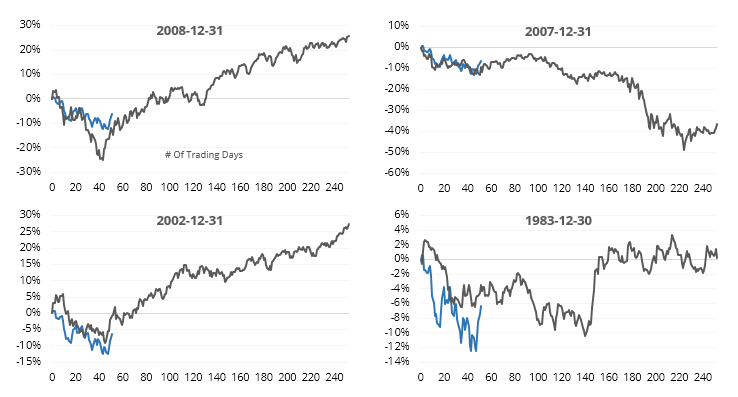
Years most closely correlated to 2022

As always, we're more concerned with where we may be going instead of where we've been. Out of the 13 years with a YTD correlation greater than +0.70, 11 of them showed gains during the next 6 months. Median returns were significantly above random over the next 1-6 months.

A jump in technical buy signals

The number of S&P 500 members with a MACD indicator above zero has reversed higher. Dean noted that the reversal comes after a period where most stocks exhibited weak trend momentum.

The MACD indicator model identifies when the number of members with a MACD indicator above zero reverses from oversold to neutral in 15 sessions or fewer. The same model, with slightly different parameters, triggered a buy signal for the energy sector in early January. 
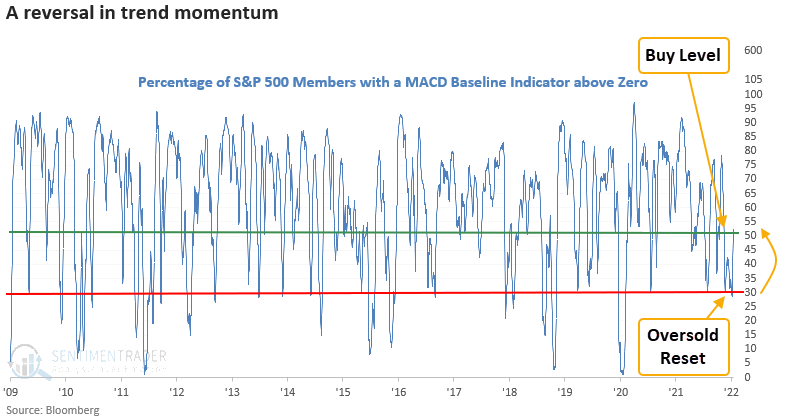
S&P 500 members with a MACD buy signal

This signal triggered 46 other times over the past 32 years. After the others, S&P 500 future returns, win rates, and risk/reward profiles were solid across all time frames.

PRODUCTS
SentimenTrader
Trading Tools
Indicators & Data API
‍
Strategies & Scanner
‍
Research Reports
FREE
RESOUrCES
Simple Backtest
Calculator
Simple Seasonality
Calculator
The Kelly Criterion
Calculator
Sentiment Geo Map
‍
Public Research Reports
‍
Education
Sentiment Indicators
‍
Technical Indicators
‍
Pricing
Bundle pricing
‍
FAQ
‍
Announcements
‍
COMPANY
‍
About
‍
In the News
‍
Testimonials
‍
Client Success Stories
CONTACT
‍
General Inquiries
‍
Media Inquiries
‍
Financial Professionals Inquiries
‍
© 2026 Sundial Capital Research Inc. All rights reserved.
Setsail Marketing
TermsPrivacyAffiliate Program
Risk Disclosure: The information and tools provided are for research and analytical purposes only and are not intended as investment advice. Market analysis involves uncertainty, and outcomes may differ from expectations. Users should conduct their own due diligence and consider their individual circumstances before making any financial decisions. Past performance is not necessarily indicative of future results.

Hypothetical Performance Disclosure: Hypothetical performance results have many inherent limitations, some of which are described below. No representation is being made that any account will or is likely to achieve profits or losses similar to those shown; in fact, there are frequently sharp differences between hypothetical performance results and the actual results subsequently achieved by any particular trading program. One of the limitations of hypothetical performance results is that they are generally prepared with the benefit of hindsight. In addition, hypothetical trading does not involve financial risk, and no hypothetical trading record can completely account for the impact of financial risk of actual trading. for example, the ability to withstand losses or to adhere to a particular trading program in spite of trading losses are material points which can also adversely affect actual trading results. There are numerous other factors related to the markets in general or to the implementation of any specific trading program which cannot be fully accounted for in the preparation of hypothetical performance results and all which can adversely affect trading results.

Testimonial Disclosure: Testimonials appearing on this website may not be representative of other clients or customers and is not a guarantee of future performance or success.