
Wheat is nearing a period of potential weakness

Key points
- Due to the recurring nature of the planting cycle, wheat is a highly cyclical market
- Wheat is entering one of the most unfavorable seasonal periods
- The most straightforward play for a speculator is to sell short wheat futures - however, this entails a high degree of risk
- An options play may offer a lower dollar risk opportunity - but has unique risks of its own
The annual seasonal trend for wheat futures
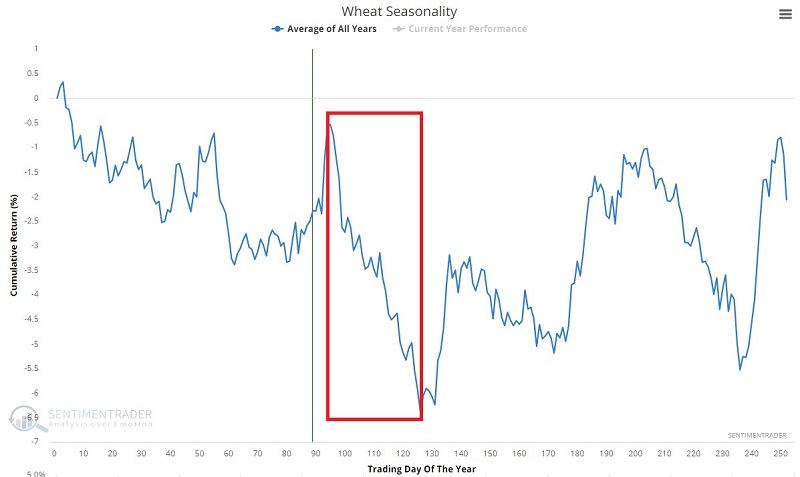
The chart below displays the annual seasonal trend for wheat futures. The upcoming unfavorable period is marked with a red box. The unfavorable period extends from the close of Trading Day of Year (TDY) #95 through TDY #126. For 2023, this period extends from the close on 2023-05-18 through 2023-07-03.
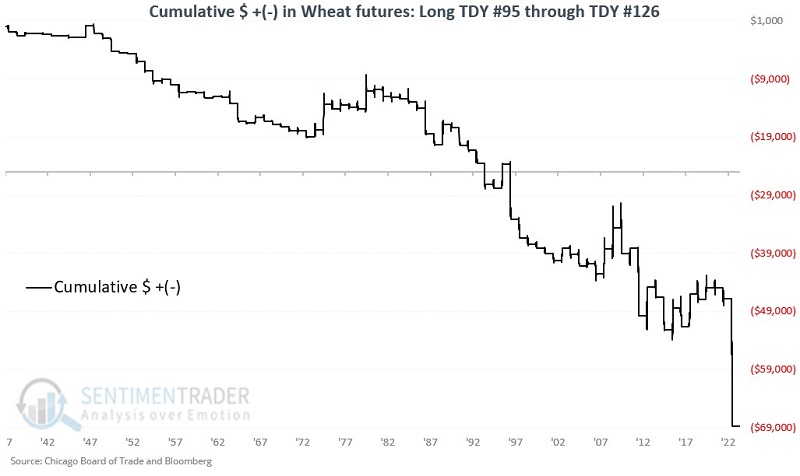
The chart below displays the hypothetical cumulative $ +(-) from holding a long position in wheat futures only from the close of TDY #95 through TDY #126 since 1937.
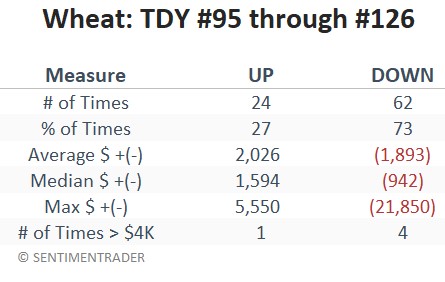
The table below summarizes wheat performance only during this unfavorable period.
The most straightforward play regarding this bias would be to sell short wheat futures during the period above. Before doing so, a trader must carefully assess their willingness and ability to assume the risks involved (most notably the unlimited risk) in selling short futures contracts. Based on one's risk tolerance and account size, a trader should also consider where to place stop-loss order in case wheat rallies instead of declining.
An example option play for non-futures traders
The Teucrium Wheat Fund (ticker WEAT) is an ETF intended to track the price of wheat futures. Options are offered on WEAT. However, it must be emphasized that trading volume is exceedingly thin. For a trader who did not want to assume the risk of shorting wheat futures, one example WEAT options play might be to:
- Buy the WEAT July21 2023 8 put @ $1.65
(Note that this is an example of a deep-in-the-money long put trade and that by the time the close on 2023-05-18 rolls around, the price of this particular option could be quite different.)
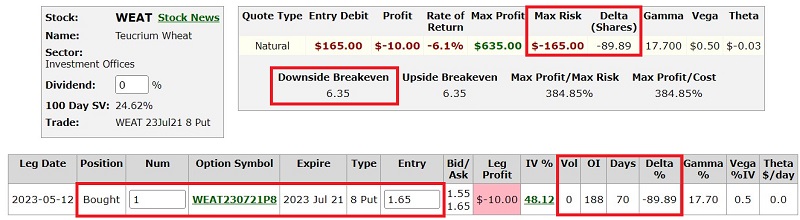
This trade's particulars and risk curves are shown below (courtesy of Optionsanalysis).
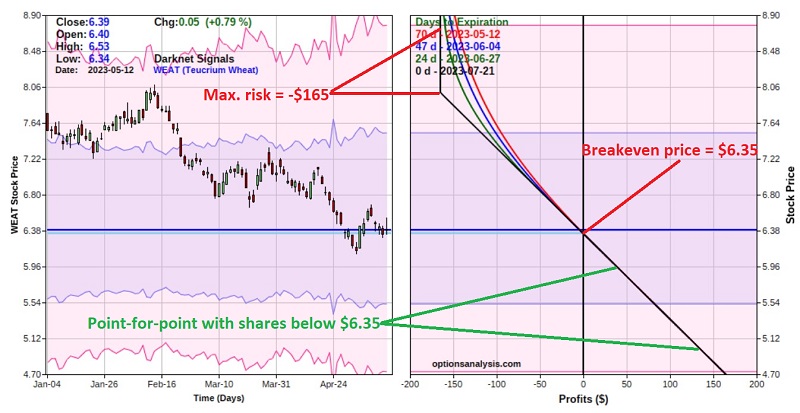
Things to note:
- The cost to enter a 1-lot - and the maximum risk - is $165. A trader with a 25K trading account who is willing to risk 2% could trade a 3-lot
- The position has a Greek "Delta" value of -89.89. This means that the position will behave like a position holding short roughly 90 shares of WEAT (but without the unlimited risk and margin requirement associated with selling short shares)
- Below the breakeven price of $6.35, the option position will move point for point with WEAT shares
Theoretically, the profit potential is unlimited. More practically, if WEAT declines one standard deviation to $5.50 a share, the option trade will have an open profit of roughly $84. If WEAT falls two standard deviations, the open profit would be approximately $160.
The primary caveat to this example is that open interest for this option is very low, and trading volume is often non-existent. This can sometimes create problems in getting decent fills, particularly if you try to trade in any size. It is highly recommended that a trader use limit orders if they choose to trade in this type of situation.
What the research tells us…
As always, seasonality is climate, not weather. While the long-term bias during the period highlighted above is clearly to the downside, there is no guarantee that that bias will appear in any given year. Ultimately, trading comes down to a) spotting opportunity and b) exploiting opportunity. The long-term seasonally unfavorable bias for wheat creates a potential opportunity. Selling short wheat futures and/or buying a put option on ticker WEAT are possible ways to exploit this opportunity. Just remember that each has its own unique risks.