
What you need to know about the year-end rally

Key points
- The fourth quarter tends to be favorable for the stock market
- Specific periods within the fourth quarter have shown to be pretty consistent
- One such period includes the pre-Thanksgiving to early New Year period
Defining the period
The period we will consider here:
- Starts at the close of the Monday before Thanksgiving
- Ends at the close of the third trading day of the following year
For 2024-25, this period extends from the close on 2024-11-25 through 2025-01-06.
Measuring historical results
The chart below displays the hypothetical growth of $1 invested in the S&P 500 Index only during this period every year starting in 1942.
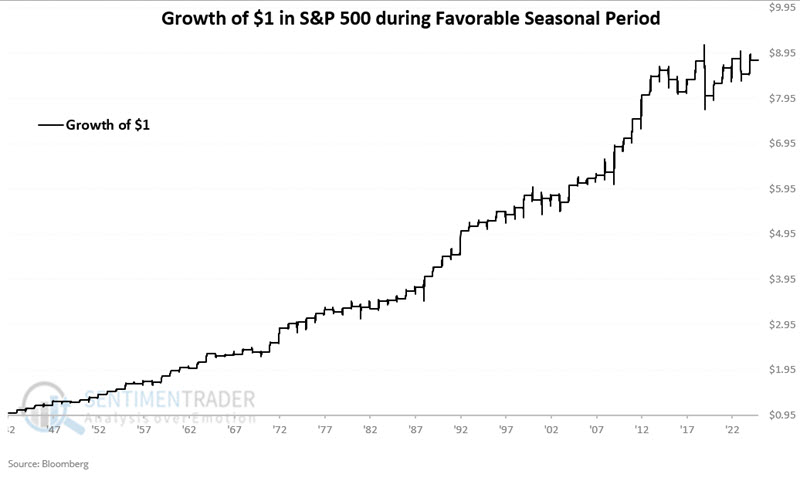
The chart below displays the same results on a logarithmic scale.
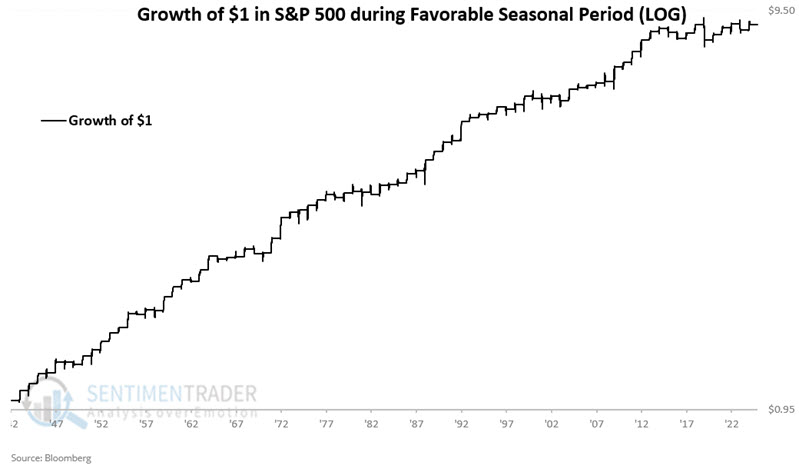
The table below displays year-by-year results.

The table below summarizes S&P 500 performance during this nine-trading day period. 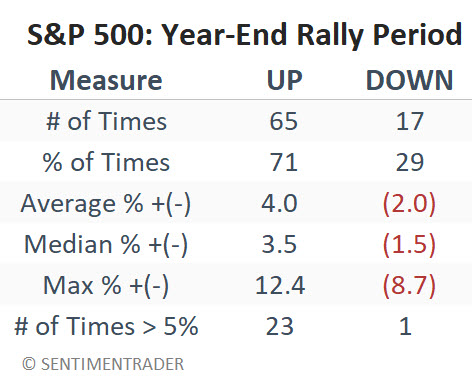
The positives are several. A 71% win rate and a median gain of 3.5% versus a median loss of -1.5% suggests a reasonable "edge." Note also that 5% or more moves skew a lopsided 23-to-1 to the positive side.
One word of caution
The good news is that the S&P 500 has tended to perform well during the year-end rally period. Also comforting is the lack of large losses. The 2018-2019 period showed a sizeable loss of -8.7%. The second worst performing period was 2022-2023, but the loss was a manageable -3.8%. There is a concern worth mentioning. No seasonal pattern is guaranteed to last forever. The chart below displays the 10-year rolling return for the year-end rally period detailed above.
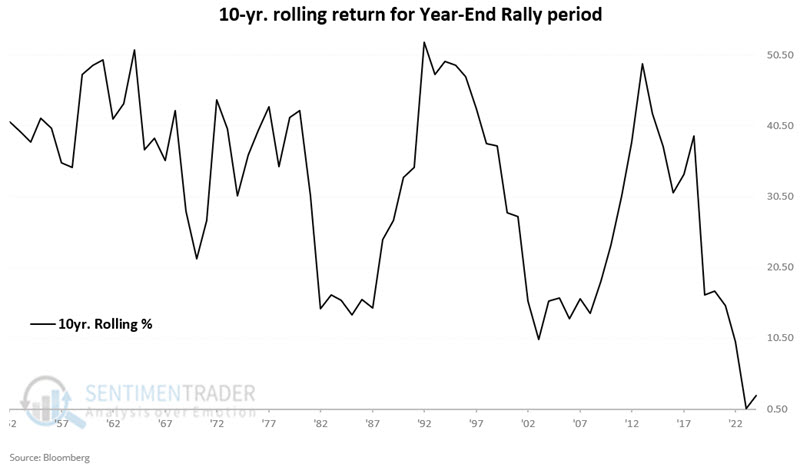
This seasonal pattern has not been nearly as effective in the last ten years as it was previously. So, has it lost its usefulness? Or is it about to re-emerge as a useful pattern? The reality is that this can only be known in hindsight. For now - particularly given the strength of the market this year - it seems reasonable to give the year-end rally the benefit of the doubt.
What the research tells us…
The good news is that the S&P 500 has tended to perform well during the late November/early January period. The bad news is that there is no guarantee that things will follow suit in 2024-2025.