
What to do when things go right - the currency edition

Key points
- This article, dated 2023-01-25, highlighted an unfavorable seasonal tendency for foreign currencies
- An example trade discussed in the original article shows a gain
- In this piece, we detail one approach to adjusting a profitable options trade to lock in a profit while still allowing for additional profit potential
A similar unfavorable trend for the Euro
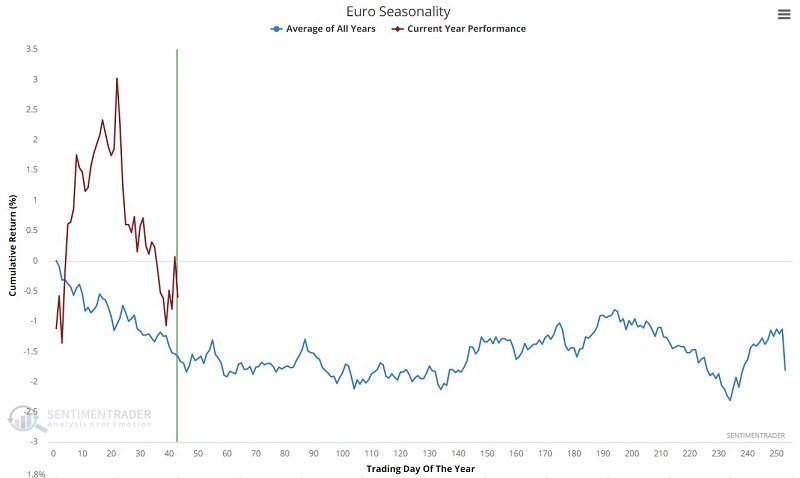
The chart below displays the annual seasonal trend for the Euro. This currency has historically shown weakness from New Year's Day into mid to late March. In 2023, the euro rallied hard in January, then collapsed in February.
The example trade we highlighted in the original article involved buying a put option on the Invesco CurrencyShares Euro Trust ETF (ticker FXE). At the time, we noted that trading in these options can be extremely thin. The example trade involved:
- Buying 1 Mar17 2023 FXE 101 strike price put option @ $1.40
The screenshots below (courtesy of Optionsanalysis) highlight the current particulars and risk curves for the position above (risk curves display the expected P/L for a given option position at a given price for the underlying security as of a given date).
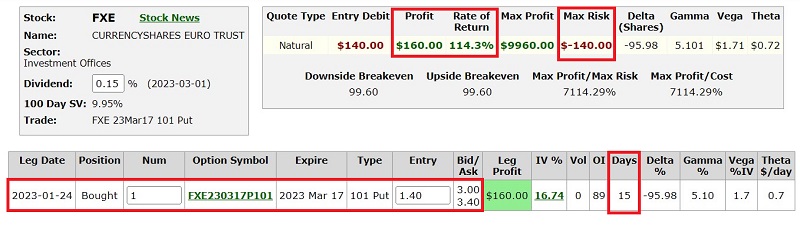
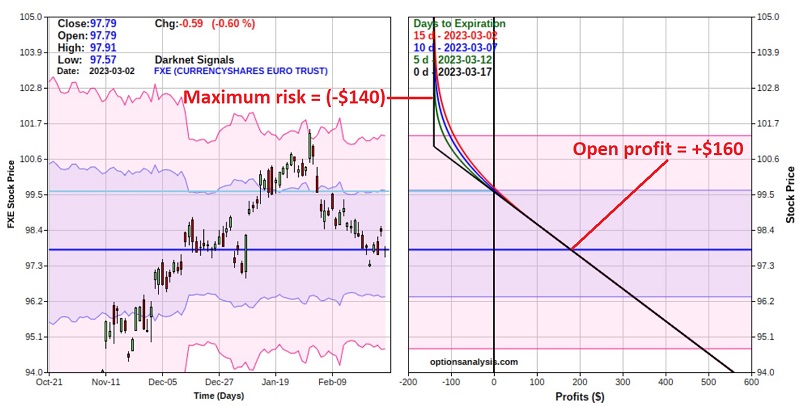
The good news is that the option has more than doubled in price, thus generating a significant percentage open profit. The bad news is that if FXE turns and rallies, this trade could quickly become a loss. So, let's highlight one potential course of action to deal with a situation when "things go right," as they have so far for this example trade.
Adjusting an open profit
One of the great potential benefits of trading options is the opportunity to "adjust" an existing position rather than merely "exiting" an existing position. If you buy or sell short shares of an ETF, the only way to lock in profit is to sell (or buy back if short) your shares. This locks in profit but also eliminates additional profit potential. So, let's discuss a potential action plan for a profitable options trade.
The steps below assume that you have previously purchased a call or put option and that that position now has a profit of at least +30%.
- Step 1: Sell your existing open position
- Step 2: Use half of your open profit to buy an at-the-money option in the next monthly expiration
- Step 3: Sell an option two strikes out-of-the-money in the next monthly expiration
Each step intends to:
- Step 1: Lock in a profit on the trade and start playing with "house money"
- Step 2: Add additional time for the trade to continue and allow for further profit potential
- Step 3: Sell out-of-the-money options to help reduce the cost of the new options purchased
Adjusting the FXE position
Following the plan highlighted above, the steps would be to:
- Step 1: Sell the Mar17 FXE 101 put @ $3.00 (a profit of $160)
- Step 2: Buy the Apr21 FXE 97 put @ $0.80 (using ½ of open profit)
- Step 3: Sell the Apr21 FXE 95 put @ $0.30 (to reduce the cost of the option purchased)
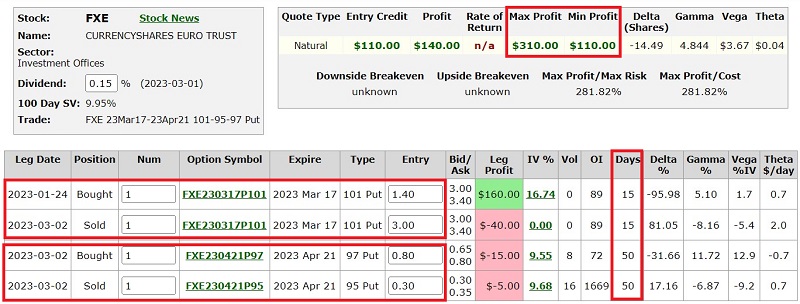
The particulars and risk curves for this adjusted position appear below.
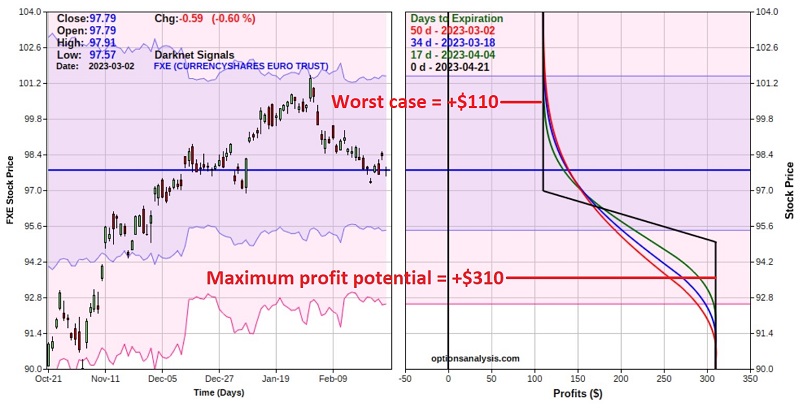
Things to note:
- The worst-case scenario for the newly adjusted position is that we hold the position until the April expiration and FXE is at or above $97 a share at the time
- If the above happens, the worst-case is a net profit of $110 (or 79% on the $140 risked when the original trade was entered)
- If FXE continues to decline, our maximum profit potential is +$310 (or +121% on the initial $140 risk) if FXE is below $95 a share by the April expiration
What the research tells us…
Options trading has inherent risks (the potential loss of 100% of invested capital if the underlying security does not move in the anticipated direction stands out). However, two critical potential benefits are 1) the ability to choose a specific maximum amount of dollar risk and 2) the potential to "adjust" an open position to lock in profit and still enjoy additional time and profit potential is unique to options trading.