
What to do when things go right (an MSFT options example)

Key Points
- Options offer the opportunity to craft a position to play a specific scenario at an affordable cost with limited risk
- Ironically, one of the biggest potential conundrums can arise when "things go right," and a quick profit accumulates
- Adjusting a profitable option position may eliminate the risk of loss while still allowing for more potential upside
A quick review of the MSFT example
On 2023-11-07, I posted a piece highlighting the following example of a "bull calendar spread" involving options on Microsoft (MSFT):
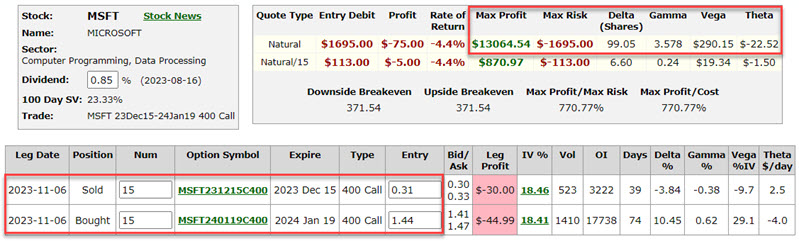
- Long 15 Jan19 2024 400 calls @ $1.44
- Short 15 Dec15 2023 400 calls @ $0.31
The purpose of this trade was to allow for decent profit potential if MSFT rallied in the month ahead while also costing only a fraction ($1,695) of what it would cost to buy 100 shares of MSFT stock ($35,653).
The particulars and risk curves for this example trade at the time of entry appear below (all charts in this piece are courtesy of www.Optionsanalysis.com).
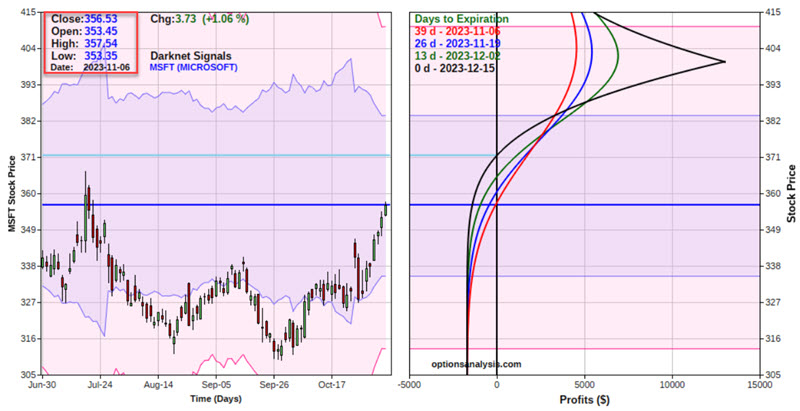
In the last week, MSFT rallied 3.7% - breaking out to a new all-time high in the process - which was the hoped-for outcome when entering the trade initially. By way of comparison:
- A trader who bought 100 shares of MSFT stocks paid $35,653 and presently has an open profit of $1,314 (+3.7%)
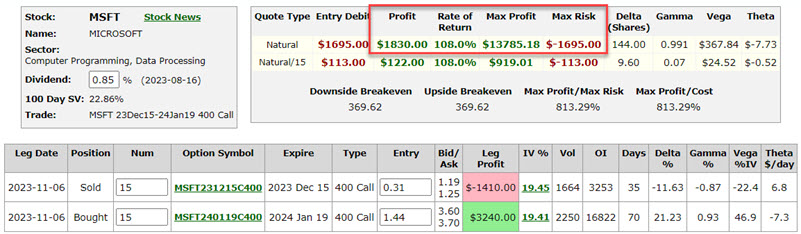
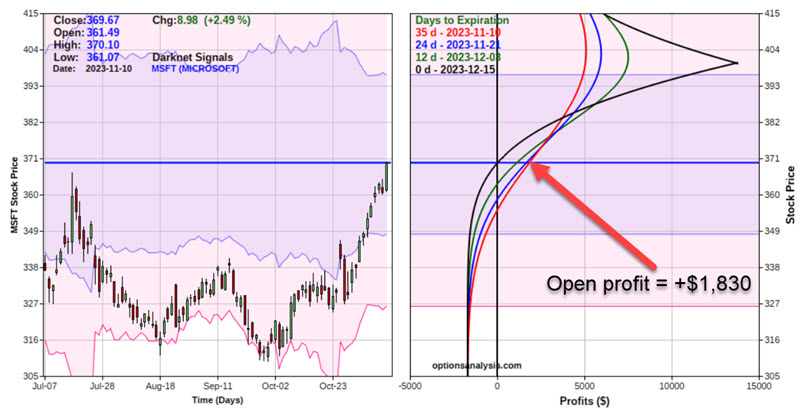
- The buyer of the bull calendar spread above paid $1,695 and presently has an open profit of $1,830 (+108.0%)
The status of the call calendar option position is shown below in the updated screenshots.
This is obviously a welcome turn of events - but it does raise something of a conundrum. Should a trader "let it ride," "take the money and run," or something in between? The thing to note about options trading is that substantial profits can disappear as quickly as they appeared. So when the opportunity arises, it can make sense to adjust an existing position to try to lock in a profit while still allowing for greater profit. But in most cases, there are tradeoffs to consider.
The trader must decide their priorities
If a trader holding the position above thinks MSFT will continue to run higher, it can make sense to hold on and let the hoped-for profits accumulate. The danger is that if MSFT turns back down, the current profit can evaporate quickly and still turn into a sizeable loss. So let's consider adjusting the position above to try to achieve both objectives - a) locking in a profit and b) leaving room for further profits to accumulate.
Adjusting the MSFT bull calendar spread
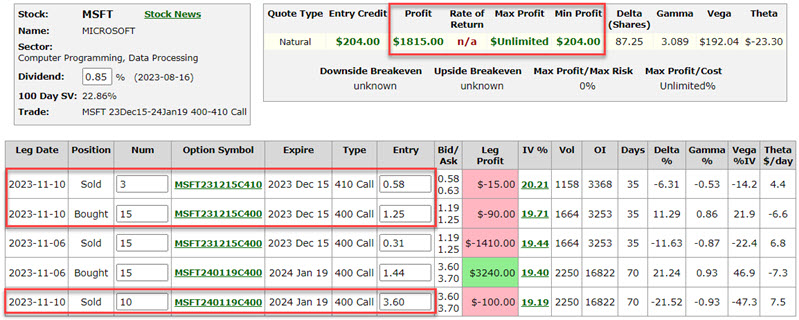
Let's assume we take the following action using closing prices for Friday 2023-11-10:
- Buy 15 MSFT Dec15 2023 400 calls @ $1.25 (completely closing short option portion of original trade)
- Sell 3 MSFT Dec15 2023 410 calls @ $0.58 (a new short position using three contracts instead of 10)
- Sell 10 MSFT Jan19 2024 400 calls @ $3.60 (closing 2/3rds of original long option portion of original trade)
Essentially, we are taking profits on 2/3rds of the original long call position and "rolling out" the short position at a smaller size.
After all of this, the new position is:
- Long 5 MSFT Jan19 2024 calls
- Short 3 MSFT Dec15 2023 calls
Because we are now long more calls than we are short, the trade now has unlimited profit potential - and a locked-in profit. The net results of these actions - and the new risk/reward profile for the adjusted position - appear in the figures below.
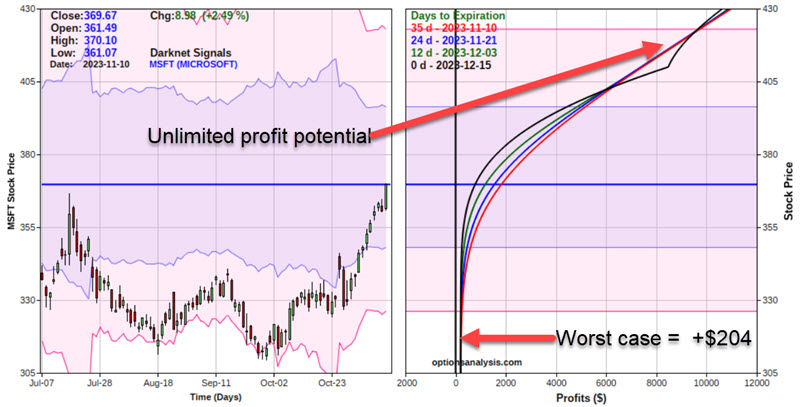
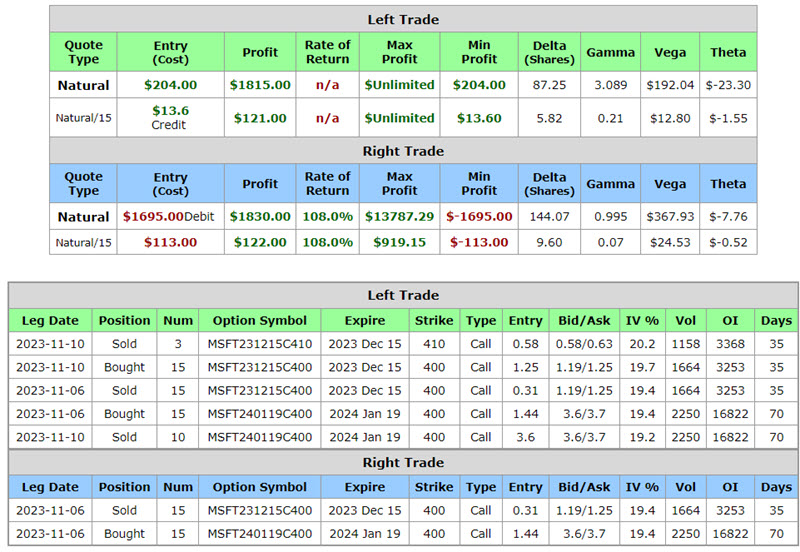
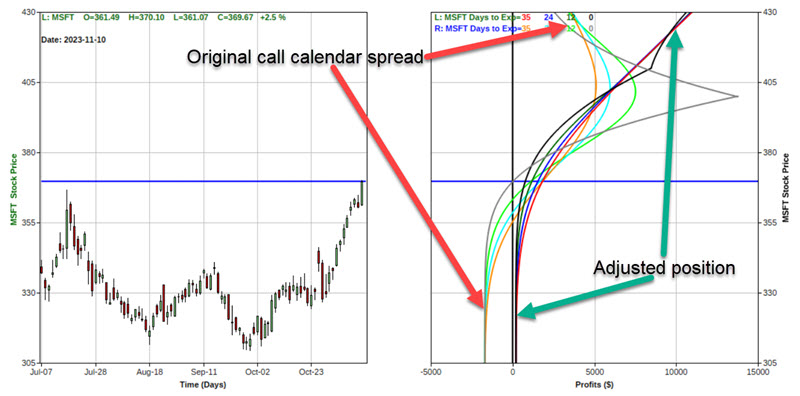
This newly adjusted position now has a worst-case scenario of a gain of $204, even if MSFT were to collapse from here. On the upside, this position now enjoys unlimited profit potential. To fully appreciate the effect of this adjustment, the chart below overlays the risk curves for the adjusted position over those of the original position. The "Left Trade" is the new adjusted position, and the "Right Trade" is the original trade.
There are notable tradeoffs:
- The adjusted position has a locked-in minimum profit of +$204; the original position still has a maximum risk of -$1,695
- If MSFT soars above roughly $400, the adjusted position enjoys unlimited profit potential while the risk curves for the original position will "roll over"
- If MSFT ends up somewhere between roughly $382 and $410 a share as of December 15th, the original position could still generate significantly more profit than the adjusted trade.
The example adjustment above offers a tradeoff - eliminating the risk of loss in return for a potentially lower return under a particular set of circumstances.
What the research tells us…
Options trading offers great flexibility in crafting a position to play a particular scenario or achieving a specific set of objectives and adjusting a position. The tradeoff is that with that flexibility comes many potential scenarios and decisions. Often, these decisions made during the life of a trade can be influenced by emotion. The keys for a trader are to analyze the tradeoffs involved, decide where their priorities lie, and act accordingly - and, just as importantly, to not beat oneself up too much when a decision turns out to be less than optimum. Making option adjustment trading decisions in the heat of battle is an art form and not a science. The goal is not to always achieve optimum results but to make intelligent decisions based on realistic objectives and expectations while attempting to maximize the tradeoff between reward and risk.