
What the Breakdown in XLF Breadth Means - and Does Not Mean

Key points
- The action within the financial sector can often have a ripple effect across the broader market
- The XLF Breadth 50-day Avg indicator recently dropped all the way to zero; This action has tended to presage impressive rebounds in the broader market and some specific sectors - but not always immediately
- This signal definitely falls under the category of "weight-of-the-evidence" and should not be considered an outright "buy" signal on its own
All S&P 500 Financial Sector stocks fell below their 50-day moving average
In a very rare instance, every constituent stock in the S&P 500 Financials Sector Index was recently trading below its 50-day moving average. This obviously highlights a period of significant price weakness in that sector. The obvious question, of course, is "what happens from here?" To answer this question, we first look at the past.
The chart below highlights all dates when the XLF Breadth 50-day Avg indicator was equal to zero, including all overlapping dates. The most recent signal occurred on March 27th.
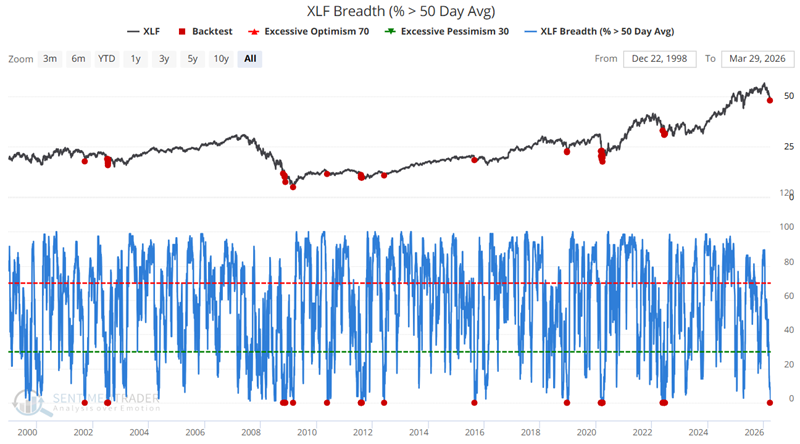
The table below summarizes future XLF performance across all signals.

At first blush, a 1 Year 94% Win Rate with a 22.70% median return is compelling. But note that results are somewhat skewed by the fact that there were several 0 reading days in 2002, 2008, 2011, 2020, and 2022.
For the sake of example, let's assume that a trader were to act (i.e., buy ticker XLF) each time the XLF Breadth 50-day Avg indicator dropped to zero for the first time in a year. This will greatly reduce the number of signals. The chart below shows the signal dates, and the table beneath it summarizes XLF performance following only the first signal in the past year.
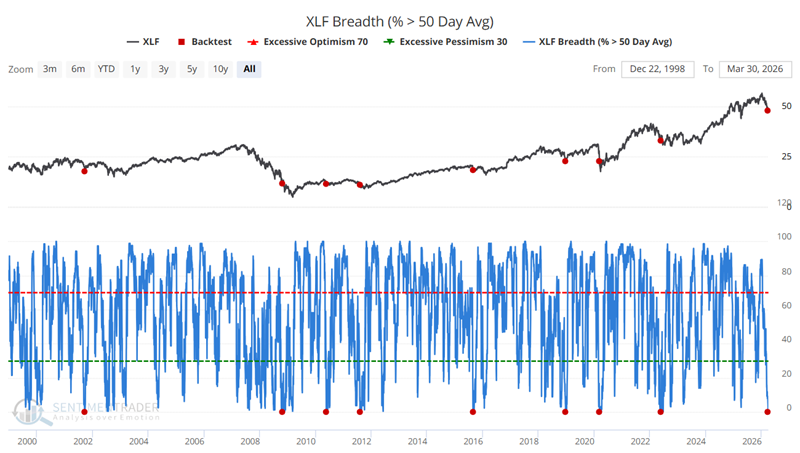
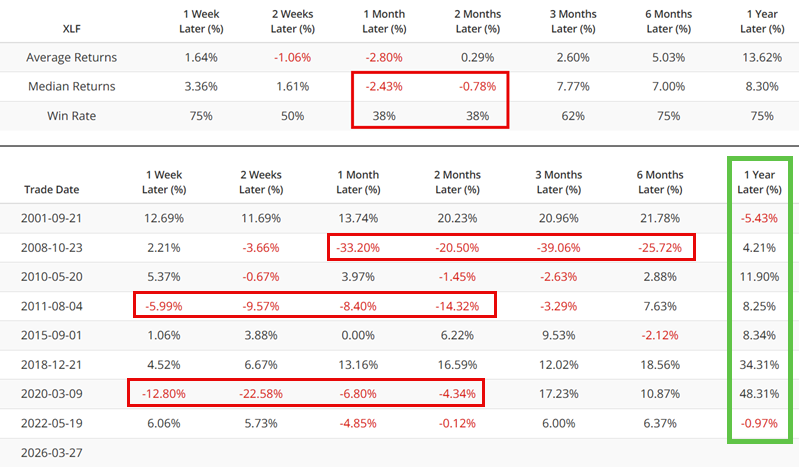
As you can see, the results for XLF are not nearly as impressive, with 1 and 2-month returns actually skewing to the negative side. Likewise, even one-year returns are much less impressive. So, should we write this signal off? Not necessarily. The key is that what happens in the financial sector often matters a great deal to the rest of the market. Let's take a closer look.
A look at broader indexes: S&P 500 Index and Equal-Weight S&P 500 (ticker RSP)
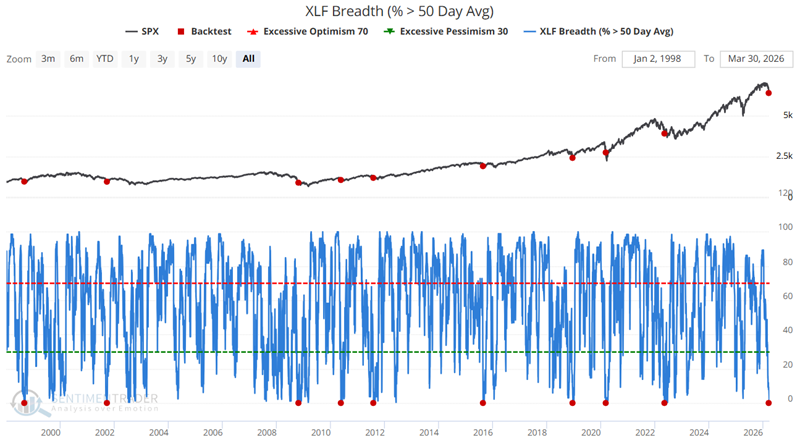
The chart below highlights all dates when the XLF Breadth 50-day Avg indicator was equal to zero, including all overlapping dates versus the S&P 500 Index.
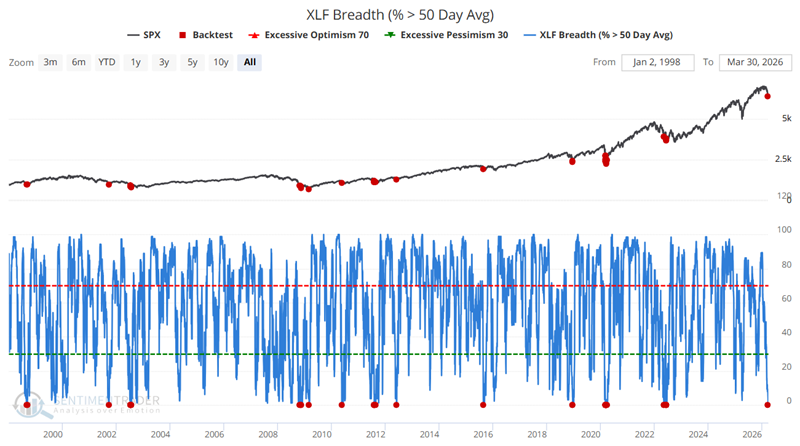
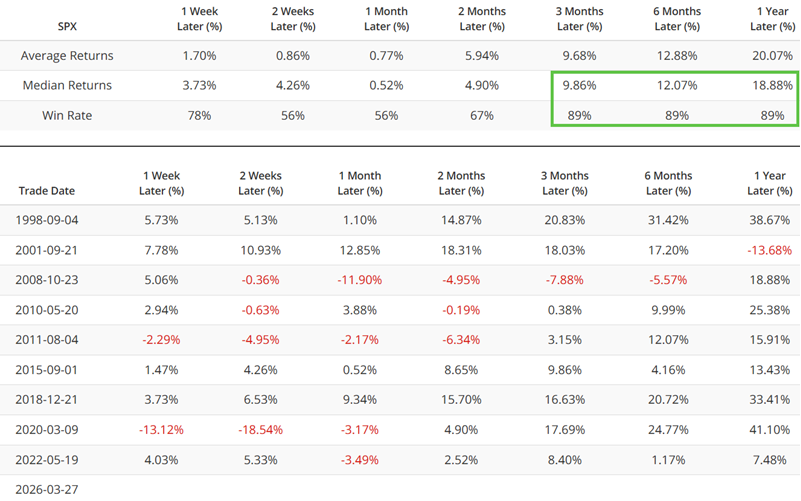
The table below summarizes future SPX performance following all signals. As with XLF, the initial results appear compelling.

But what happens when we limit results to just one signal every 12 months? The chart and table show SPX results. In this case, the results hold up quite well, with 89% win rates across 3-, 6-, and 12-month holding periods.
Now let's look at the Equal-Weight S&P 500 Index (ticker RSP). The chart below highlights all dates when the XLF Breadth 50-day Avg indicator was equal to zero, including all overlapping dates versus the RSP.
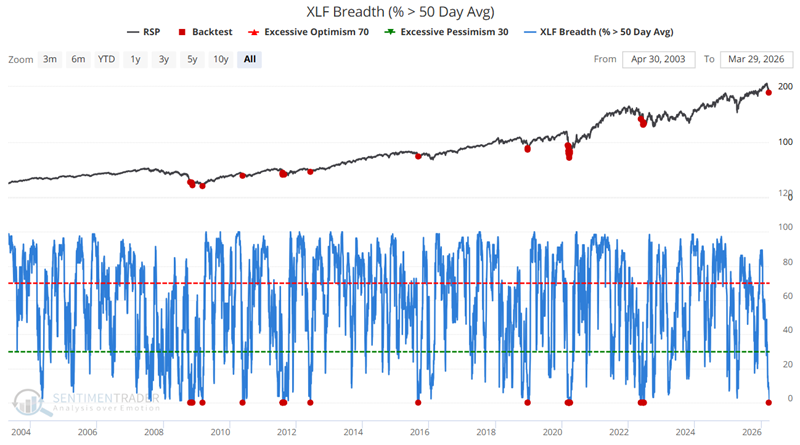
The table below summarizes future RSP performance for all signals. The initial RSP results are significantly better than those for SPX.

The chart and table show RSP results for the first XLF Breadth signal over the last 12 months. In this case, the results hold up quite well, with 89% win rates across 3-, 6-, and 12-month holding periods.
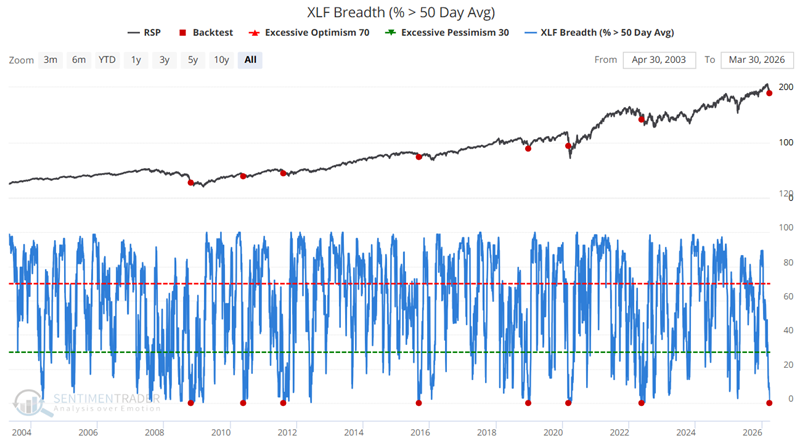
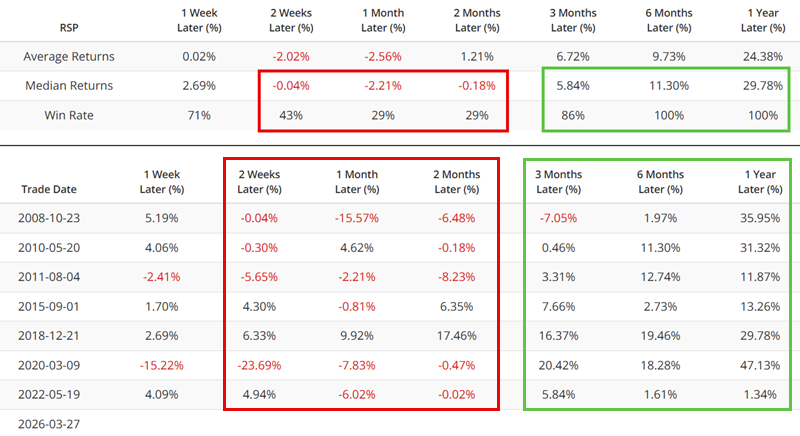
Note that RSP results for the first two months after a "first in a year" signal were subpar overall. But the 3, 6, and 12-month results remained extremely positive. This history - while representing a relatively small sample size - argues for putting RSP on a "Watch List" and looking for a buying opportunity a few weeks or a few months down the road.
Let's look at a few other notable performers.
Homebuilders have an interesting relationship with Financials
The chart below highlights all dates when the XLF Breadth 50-day Avg indicator was equal to zero, including all overlapping dates versus the State Street SPDR S&P Homebuilders ETF (XHB).
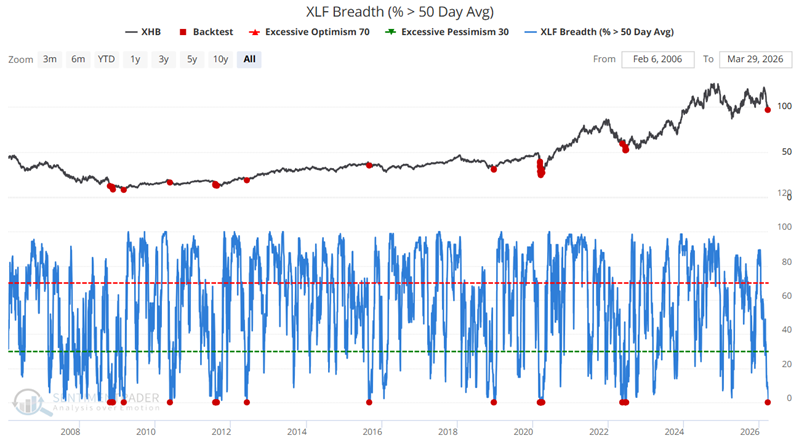
The table below summarizes future XHB performance across all signals. A 1-year median return of 62.35% and a 100% Win Rate certainly commands attention.

But again, what happens if we treat the first instance in a year as an actual "buy" signal for homebuilders? The chart and table show XHB results when we use only the first XLF Breadth signal over the last 12 months. In this case, the results are ultimately decent one year after each signal, but intervening results look much different. This is because, in several cases, the homebuilders sector continued to fall hard after a signal before ultimately bottoming out at a lower level. Note that 5 of the 7 signals saw XHB drop at least another 10% before bottoming.
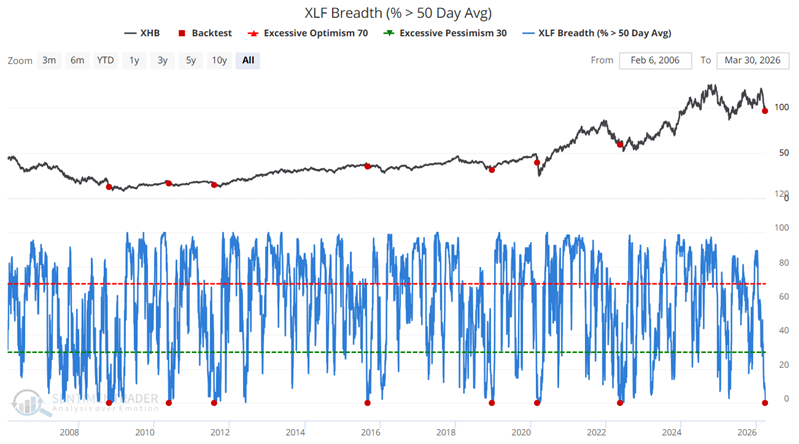
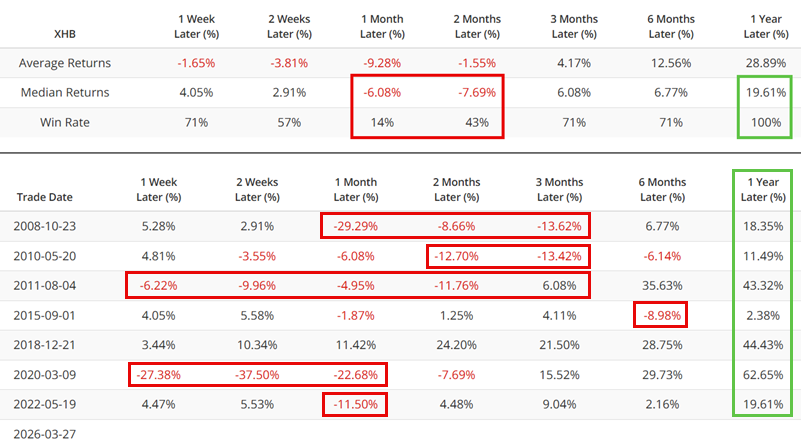
Like RSP, XHB may deserve a place on a Watch List for an opportunity down the road, rather than an immediate allocation of investment capital.
Semiconductors for the most aggressive traders
The ticker USD belongs to the ProShares Ultra Semiconductors ETF. This fund is a leveraged ETF designed to provide daily investment results that correspond to two times (2x) the daily performance of the Dow Jones U.S. Semiconductors SM Index. It is typically recommended as a short-term tactical instrument, not for long-term holding.
The chart below highlights all dates when the XLF Breadth 50-day Avg indicator was equal to zero, including all overlapping dates versus ticker USD.
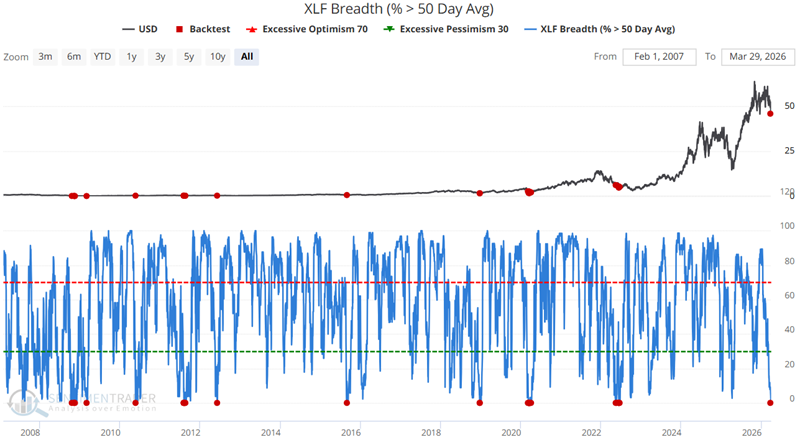
The table below summarizes future USD performance for all signals. Median returns across the board are impressive at first blush, as are the 82% and 100% win rates for 6- and 12-month holding periods, respectively.

But given the highly volatile nature of a 2x semiconductor-concentrated fund, can we use it as a trading vehicle if we only take the first signal in a year? The chart and table below show the historical results. Interpretation is clearly in the eye of the beholder.
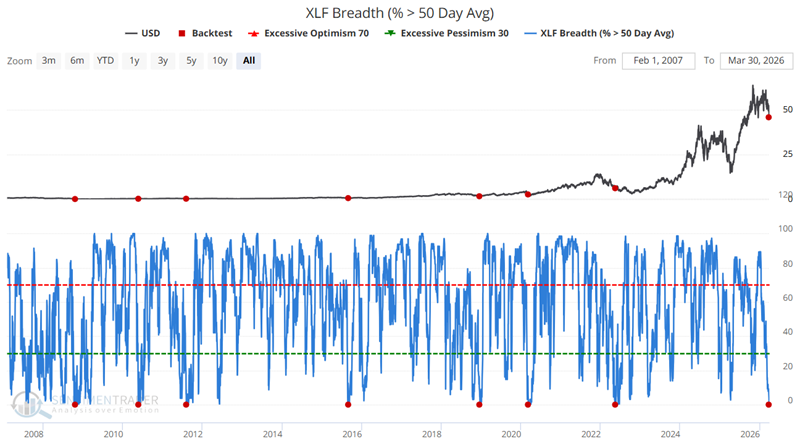
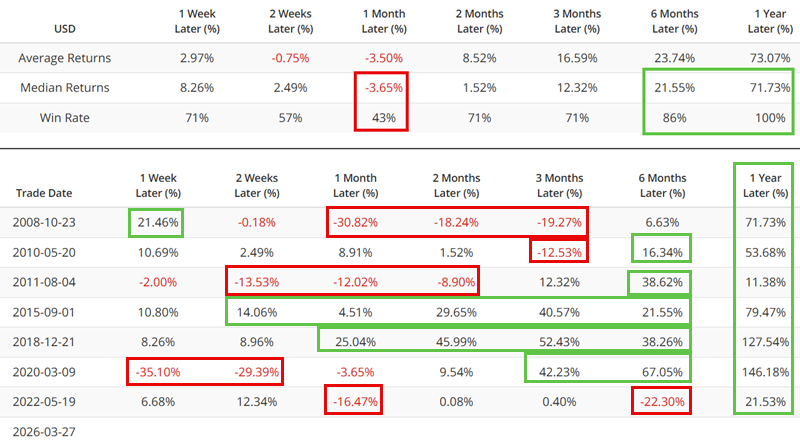
- The good news is that every previous signal witnessed an open profit of 20% or more at some point during the year after the first XLF Breadth signal in a year
- The bad news - as noted in the red boxes in the summary table above - is that extreme volatility is to be expected, and massive intermediate drawdowns are common
Aggressive traders who have an entry signal and a risk control measure they trust should look for opportunities to score large gains in USD in the year ahead. All others should likely steer clear of this rocket ship. Another extreme alternative: Wait for a drawdown of x% (user defines the value of x), allocate only the amount of capital you are willing to risk, and sell 1 year after the initial signal date. This approach amounts to sheer speculation, but it does offer a way to a) participate while b) limiting risk and minimizing the effects of extreme volatility.
Speaking of Volatility…
The ProShares Ultra VIX Short-Term Futures ETF (ticker UVXY) provides leveraged exposure to the S&P 500 VIX Short-Term Futures Index, which measures the returns of a portfolio of monthly VIX futures contracts with a weighted average of one month to expiration.
This ETF is benchmarked to an Index of VIX futures contracts. The ETF is not benchmarked to the widely referenced Cboe Volatility Index, commonly known as the "VIX". VIX futures contracts can be expected to perform very differently from the VIX, and as such, the ETF can be expected to perform very differently from 1.5x the VIX (on a daily basis and over time).
This ProShares ETF seeks daily investment results that correspond, before fees and expenses, to 1.5x the daily performance of its underlying benchmark (the "Daily Target").
The chart below highlights all dates when the XLF Breadth 50-day Avg indicator was equal to zero, including all overlapping dates versus ticker UVXY.
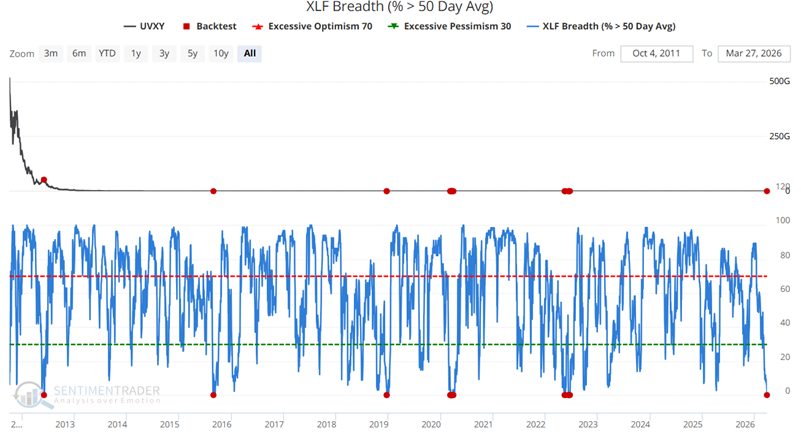
The table below summarizes future UVXY performance for all signals. The results speak for themselves.

Can a trader profit from shorting UVXY if we only take the first signal in a year? The chart and table below show the historical results.
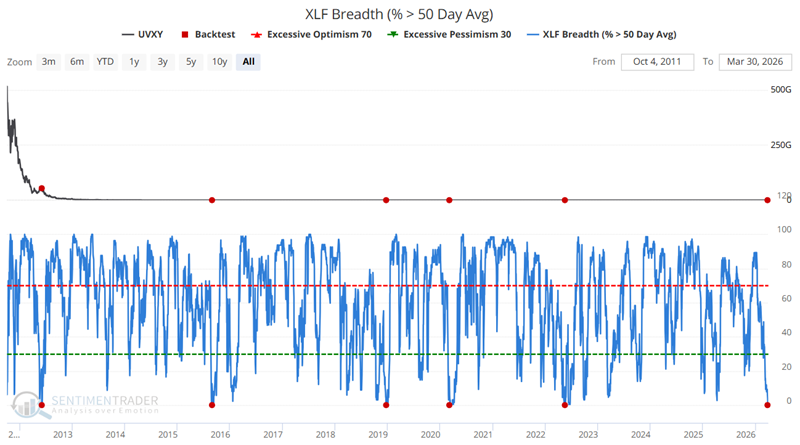
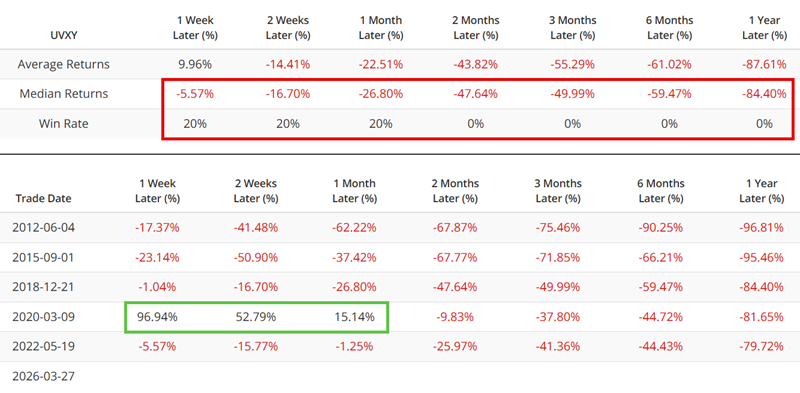
Overall, the results are mostly an ocean of red - BUT - the massive spike that occurred after the March 9, 2020 signal is something that a trader must be prepared to defend themselves against every time they take a trade if they choose to take this tiger by the tail.
What the research tells us…
"Money makes the world go around," economically speaking. Likewise, "Money moves the markets." What happens within the financial stock sector can have a significant ripple effect across the economy and the broader stock market. As detailed above, the recent sell-off in financial stocks is significant and has tended to be followed, eventually, by higher stock prices across much of the broader market. However, as we also saw, the recent action should not be considered a "buy it and forget it" buy signal. The first signal in a year typically occurs when the market is experiencing a significant decline. This often takes time to play out, and initial signals are often followed by further downside before a meaningful rebound. Investors and traders should add the recent signal to the favorable side of the weight-of-the-evidence ledger and view it not as a "buy" signal, but as a "be prepared to buy" signal.