
What Five Straight Down Weeks Means - and Does Not Mean

Key points:
- The week ending March 27th marked the fifth consecutive weekly decline for the S&P 500 Index
- While bullish momentum has a history of portending more upside, unfavorable momentum's message is much less clear
- At the very least, this recent extended decline should cause investors to moderate their expectations for stocks in the months ahead
The S&P 500 closes lower for the 5th straight week
On March 27th, the S&P 500 registered its fifth consecutive lower weekly close. Such extended declines often trigger talk of the market being "oversold" and "due for a bounce." And in some cases, that proves to be accurate. But the full history is much muddier.
The chart below marks in green all the times since 1921 when the S&P 500 first registered its fifth consecutive down week.
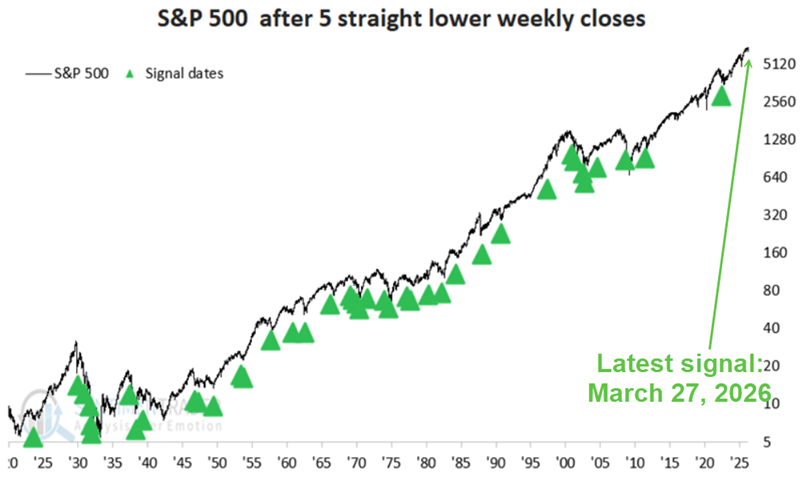
So how has the S&P 500 performed following previous 5-week declines? It's a mixed bag, and results have varied widely from instance to instance. But overall, the results have been uninspiring and well below average. The table below summarizes S&P 500 performance following each of the previous 5-week declines.
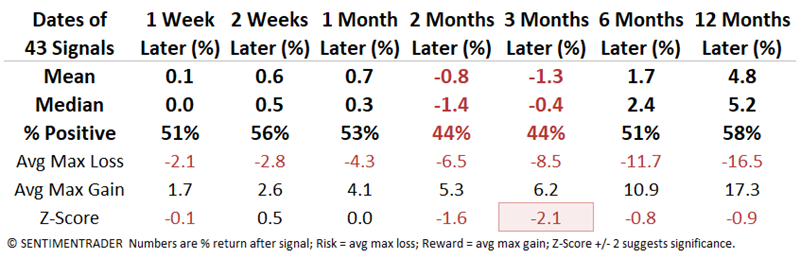
Win Rates (% Positive) are well below average, with no timeframe exceeding 58%. The two- and three-month median returns are negative, and the win rates are below 50% (44% and 44%, respectively).
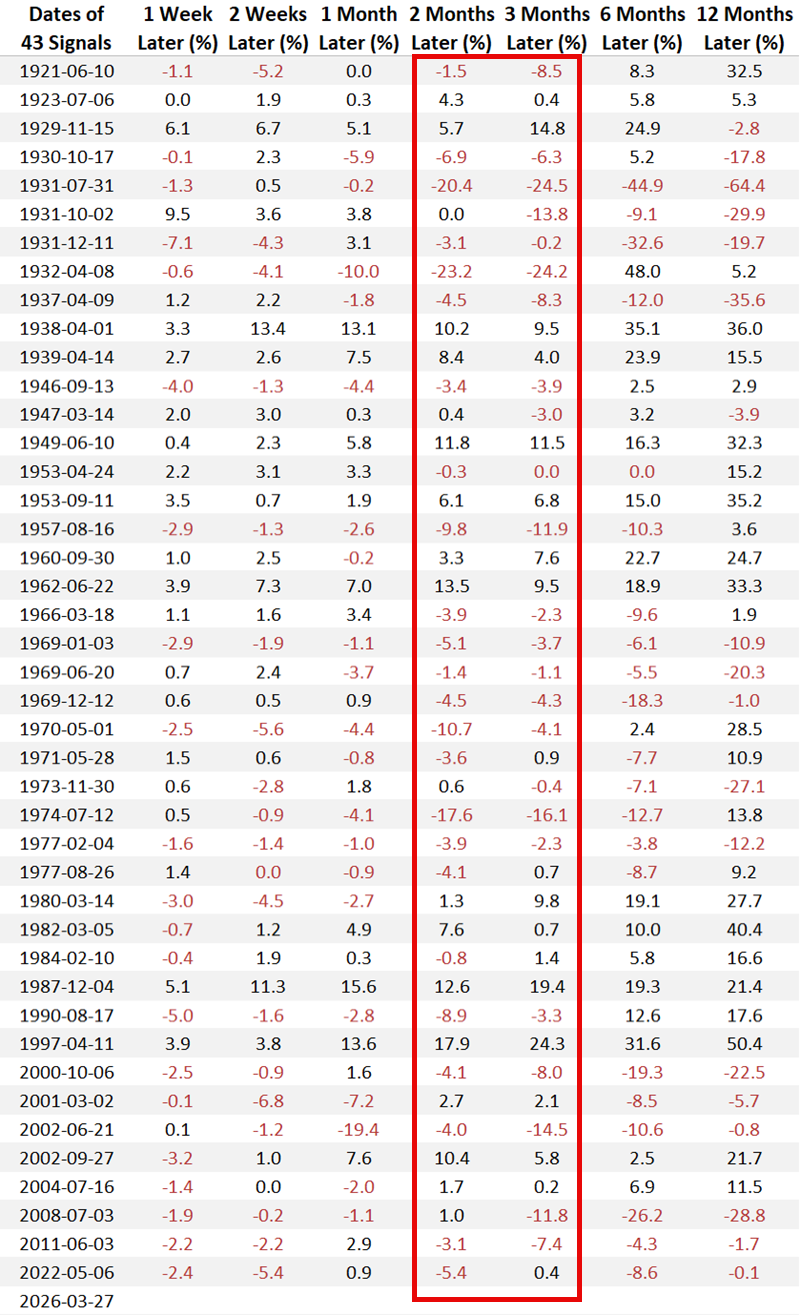
The table below displays results for all timeframes, instance-by-instance. Two- and three-month returns are highlighted.
Zeroing in on a two-month holding period
Let's assume an investor buys and holds the S&P 500 for two months each time the index closes lower for five straight weeks. The chart below displays the hypothetical growth of $1 achieved by employing this strategy.
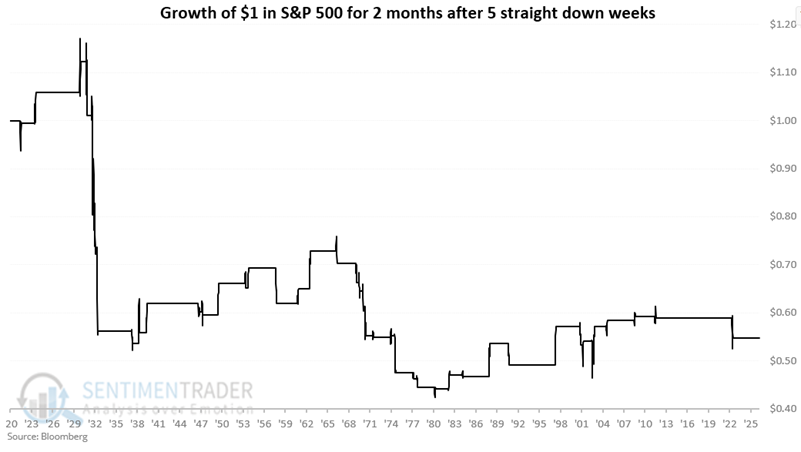
Overall, $1 sank in value to just $0.44. It is fair to note that the bulk of the overall decline occurred following the July 31st, 1931, signal (-20.4%) and the April 8th, 1932, signal (-23.2%). Nevertheless, even after removing these two unfavorable outliers, the average results remain unremarkable.
If we remove the July 1931 and April 1932 signals, the summary of results is shown below. Note that two- and three-month holding periods still show negative median returns and a Win Rate below 50%.
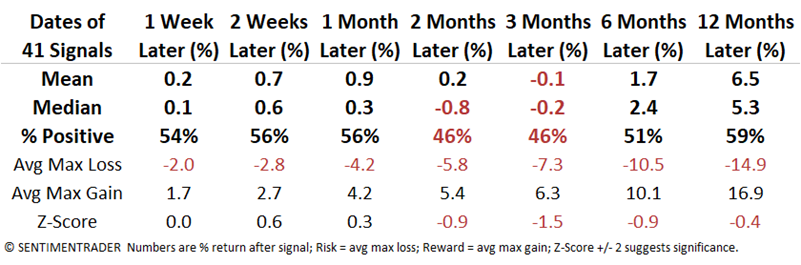
Now let's skip the 1920s and 1930s altogether. The chart below shows the hypothetical growth of $1 held in the S&P 500 for two months after five straight down weeks starting in 1940. Even without the two big declines in the early 1930s, the results are still less than inspiring.
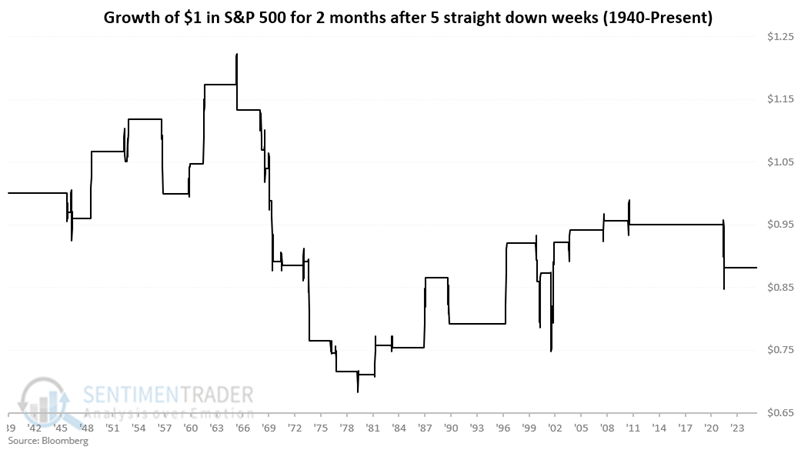
What the research tells us…
In reality, it is difficult to draw any firm conclusions from the data above. We certainly cannot deem the results as favorable for the stock market. However, while a 44% Win Rate (for two- and three-month periods) is not good, it reminds us that stocks are not doomed to fall over the next two to three months. Perhaps more than being a "call to action," this signal is a call to "assess - and possibly adjust - one's expectations" regarding their stock holdings in the months ahead. While we can "hope for the best" (as 19 of the 43 previous signals showed a two-month gain, and six showed a gain above +10%), we should also "prepare for the worst" (24 signals showed a loss for the S&P 500 two months later, with four showing a decline of -10% or more). The market appears to be at a crossroads. This is a good time to ensure your trading/investment plan has adequate risk controls to protect you if things go wrong.