Products
SentimenTrader Trading Tools
‍
Backtest Engine
My Trading Toolkit
Correlation Analysis
Seasonality
Market Prediction
Indicators & Data API
‍
Proprietary Indicators & Charts
Market Data API
Strategies & Scanner
‍
50+ Trading Strategies
Smart Stock Scanner
Smart Option Scanner
Research Reports
‍
Research Solutions
Reports Library
Free Resources
Simple Backtest Calculator
Simple Seasonality Calculator
The Kelly Criterion Calculator
Sentiment Geo Map
Public Research Reports
Education
Sentiment Indicators
Technical Indicators
Pricing
Company
About
In the News
Testimonials
Client Success Stories
Contact
Log inLoginSign up
< BACK TO ALL REPORTS

What 120 years tells us about interest rates and the stock market

Jay Kaeppel
2026-08-27
We conducted a test regarding the impact of interest rate changes on stock prices over the past 120+ years. The good news and the bad news are detailed herein.

Key points:

  • Interest rates are one of nine primary factors that influence stock prices (the others are Valuation, Price Action, Inflation, the Economy, Breadth, Sentiment, Seasonality, and Insider activity) 
  • At times, rate trends can have a significant and direct impact on the market, often for long periods of time
  • However, at other times interest rates are a secondary consideration and may not have nearly as much bullish or bearish impact as many individuals have been led to believe
  • We studied the relationship between Treasury yields and stock prices over the past 120+ years and the details of the results below

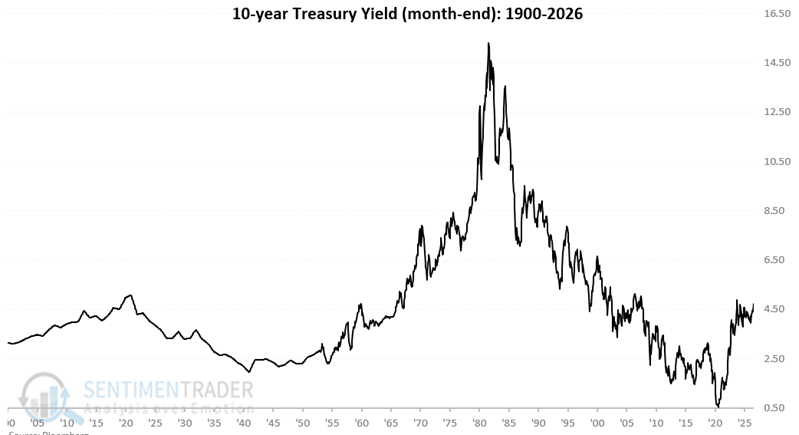
Using 10-year Treasury yield as a proxy for interest rates

For the record, there are lots of "interest rates." There are Treasury bill yields, Treasury Note yields, Long-term Treasury bond yields, various government agency yields, commercial paper yields, corporate bond yields (with various ratings from AAA to junk status), municipal bond yields, and a host of other rates related to various forms of debt. 

To make things as straightforward as possible, for this study, we will consider only two measures:

  • The month-end yield on a 10-year Treasury note ($TNX)
  • The month-end closing price for the Dow Jones Industrial Average

We will focus on these two because data is available going back to the begi

Sorry, you don't have access to this report

Upgrade your subscription plan to get access
Go to Dasboard
PRODUCTS
SentimenTrader
Trading Tools
Indicators & Data API
‍
Strategies & Scanner
‍
Research Reports
FREE
RESOUrCES
Simple Backtest
Calculator
Simple Seasonality
Calculator
The Kelly Criterion
Calculator
Sentiment Geo Map
‍
Public Research Reports
‍
Education
Sentiment Indicators
‍
Technical Indicators
‍
Pricing
Bundle pricing
‍
FAQ
‍
Announcements
‍
COMPANY
‍
About
‍
In the News
‍
Testimonials
‍
Client Success Stories
CONTACT
‍
General Inquiries
‍
Media Inquiries
‍
Financial Professionals Inquiries
‍
© 2026 Sundial Capital Research Inc. All rights reserved.
Setsail Marketing
TermsPrivacyAffiliate Program
Risk Disclosure: The information and tools provided are for research and analytical purposes only and are not intended as investment advice. Market analysis involves uncertainty, and outcomes may differ from expectations. Users should conduct their own due diligence and consider their individual circumstances before making any financial decisions. Past performance is not necessarily indicative of future results.

Hypothetical Performance Disclosure: Hypothetical performance results have many inherent limitations, some of which are described below. No representation is being made that any account will or is likely to achieve profits or losses similar to those shown; in fact, there are frequently sharp differences between hypothetical performance results and the actual results subsequently achieved by any particular trading program. One of the limitations of hypothetical performance results is that they are generally prepared with the benefit of hindsight. In addition, hypothetical trading does not involve financial risk, and no hypothetical trading record can completely account for the impact of financial risk of actual trading. for example, the ability to withstand losses or to adhere to a particular trading program in spite of trading losses are material points which can also adversely affect actual trading results. There are numerous other factors related to the markets in general or to the implementation of any specific trading program which cannot be fully accounted for in the preparation of hypothetical performance results and all which can adversely affect trading results.

Testimonial Disclosure: Testimonials appearing on this website may not be representative of other clients or customers and is not a guarantee of future performance or success.