
Utilities trigger a risk-on buy signal for the broad market

Key points:
- Utility stocks experienced a notable surge in outperformance, followed by a sudden and sharp collapse
- Similar shifts in relative performance produced solid returns for the S&P 500 over most time horizons
- The S&P 500 Utility sector struggled on an absolute and relative basis across all time frames
Utility stocks as a gauge of stock market sentiment
During market upheavals, investors often turn to utilities as a go-to sector, strategically allocating their portfolios defensively to mitigate potential losses. Once market anxiety diminishes, participants shift away from the perceived safety of utilities, opting for sectors with a more aggressive stance.
To capture this shift in investor sentiment, I calculate the difference between the percentage of Utility sector members outperforming the S&P 500 Index and the percentage of overall S&P 500 members outperforming the Index on a rolling one-month basis.
When the spread increases above 48%, indicating significant outperformance by utility stocks, and reverses below 0%, the model triggers a buy signal for the S&P 500.
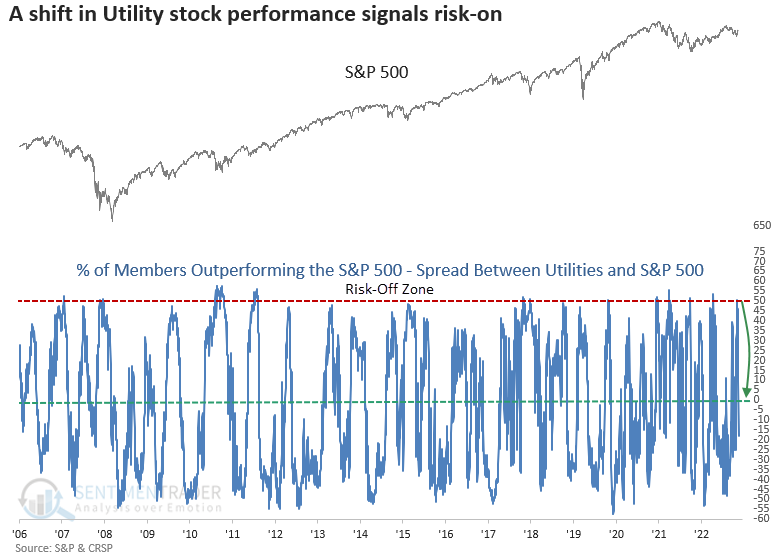
Similar shifts from risk-off to risk-on preceded positive returns
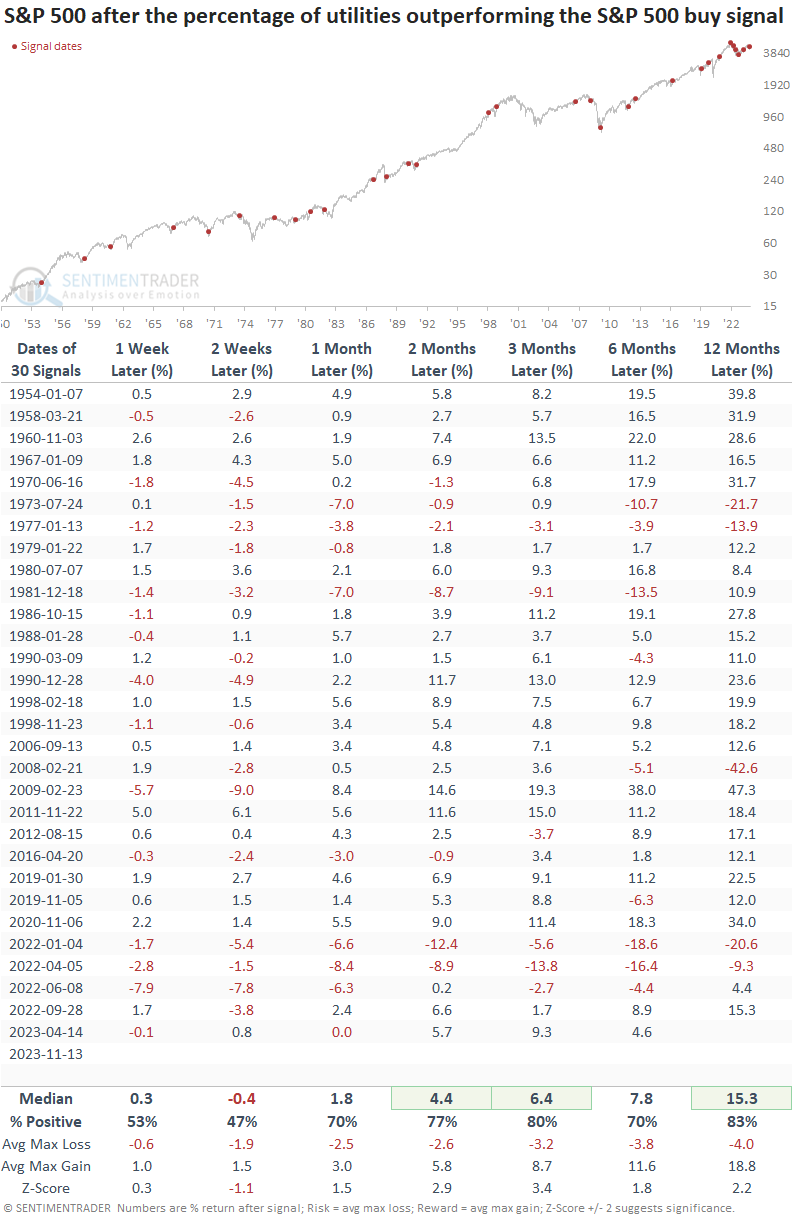
Whenever the spread between Utility sector stocks outperforming the S&P 500 and all S&P 500 stocks outperforming the benchmark cycled from greater than 48% to less than 0%, the S&P 500 showed a solid tendency to rally over medium and long-term horizons.
While the concept of measuring defensive utility stocks relative to the broad market to gauge investor sentiment has a solid long-term track record, the signal did struggle in 2022 as the FOMC embarked on an aggressive tightening cycle, which is why it's always important to remember that no indicator is infallible and sometimes trading systems don't work in specific environments.
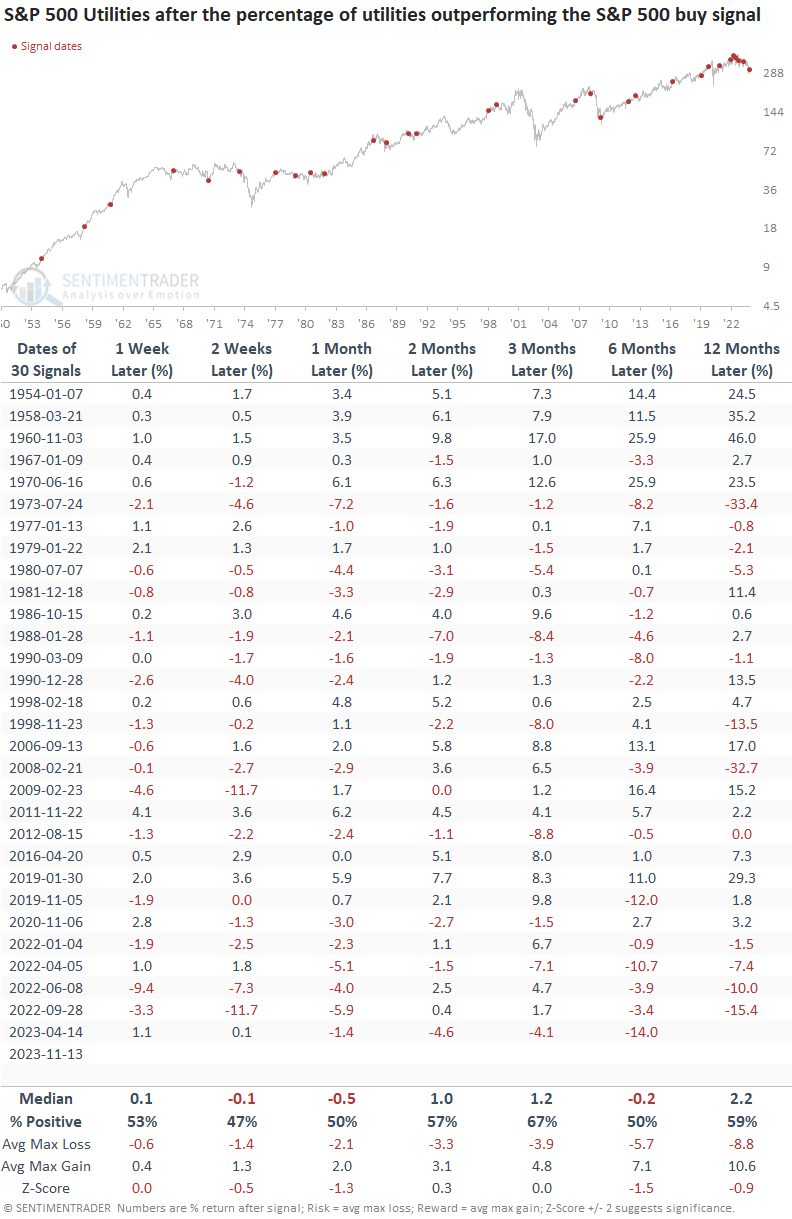
The S&P 500 Utility sector tends to struggle after relative performance trends between utilities and the S&P 500 shift in favor of the broad market, indicating an increased appetite for more offensive groups.
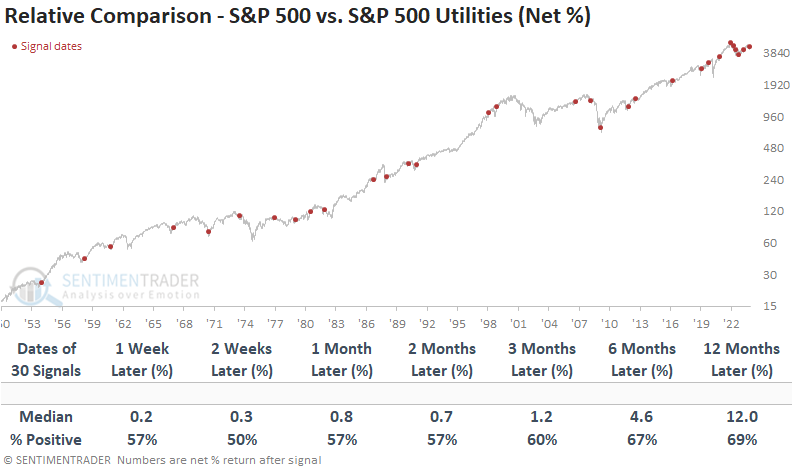
Suppose I compare the returns of the S&P 500 to those of the S&P 500 Utility sector. In that case, the outlook table shows a clear bias, suggesting an investor would be better off with an allocation to the broad market, especially over long-term horizons.
What the research tells us...
While utilities have been a massive laggard over the last year, the traditionally defensive sector caught a bid in early October as the broad market swooned to a 10% drawdown. As is typically the case in a correction, utility sector performance outpaced the S&P 500. A trading model that measures the one-month rolling return spread between utility stocks and all S&P 500 stocks increased to a historical level and subsequently collapsed, triggering a risk-on signal for the S&P 500. Similar shifts in investor sentiment produced excellent medium and long-term returns for the world's most benchmarked index. From a relative perspective, Utilities tended to underperform the S&P 500.