Products
SentimenTrader Trading Tools
‍
Backtest Engine
My Trading Toolkit
Correlation Analysis
Seasonality
Market Prediction
Indicators & Data API
‍
Proprietary Indicators & Charts
Market Data API
Strategies & Scanner
‍
50+ Trading Strategies
Smart Stock Scanner
Smart Option Scanner
Research Reports
‍
Research Solutions
Reports Library
Free Resources
Simple Backtest Calculator
Simple Seasonality Calculator
The Kelly Criterion Calculator
Sentiment Geo Map
Public Research Reports
Education
Sentiment Indicators
Technical Indicators
Pricing
Company
About
In the News
Testimonials
Client Success Stories
Contact
Log inLoginSign up
< BACK TO ALL REPORTS

Utilities stocks have come back after a sudden surge

Jason Goepfert
2020-06-22
Earlier in June, utilities stocks enjoyed a surge that pushed all of them above their 50-day moving averages. That has since cooled and now less than a third of them are above average. The entire time, no more than 60% of them managed to climb above their 200-day averages. A similar surge-then-pause is seen in the McClellan Oscillator for the sector.

At various points this year, utilities stocks were market darlings, especially in January. 

That shine has worn off. As the Wall Street Journal recently noted,

"That is because of concerns about falling power demand and the spike in unemployment following the lockdowns put in place to curb the outbreak, analysts said. Millions of people have lost their jobs in recent months, prompting concerns that they may stop paying their bills. As dozens of companies cut or suspended their dividends to preserve their cash piles, some investors wondered if the major utilities could be next."

Over the past few sessions, more and more utilities have declined, and now less than a third of them are trading above their 50-day moving averages. This comes quickly on the heels of a surge when all of them had been above their averages. Like we saw last week, though, all of this is in the context of what so far has been an unhealthy market. Less than 60% of utilities were able to move above their long-term 200-day moving averages, even during the medium-term surge.
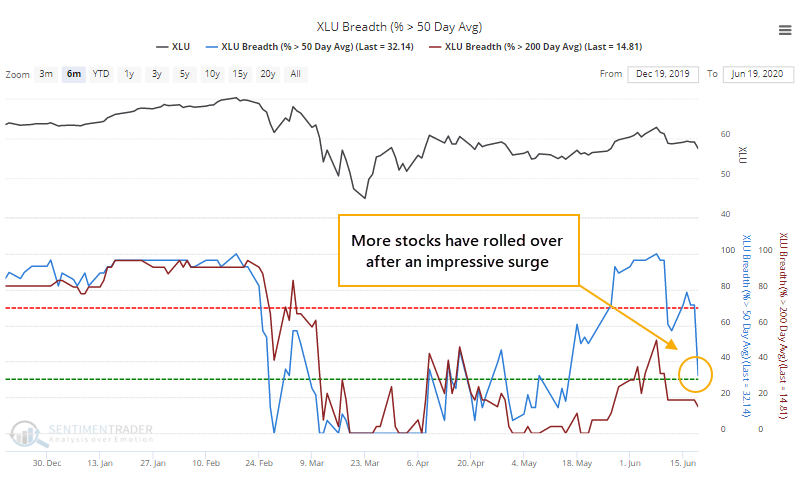
Below, we can see every time when more than 85% of these stocks traded above their 50-day average, then there was a selloff so that fewer than 35% of them were above that average. The entire time, no more than 60% of them traded above their 200-day averages.
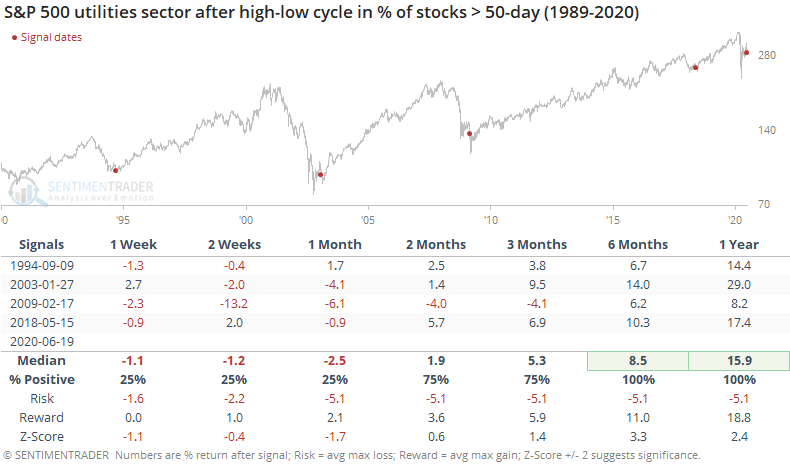
All four prior occurrences triggered during times of upheaval for utilities, and short-term returns were volatile, with a downside bias. But they were all excellent longer-term opportunities, as the sector gained consistently over the next 6-12 months.

There has been a similar reflection of this surge-then-pause when looking at the sector's McClellan Oscillator, an indication of the momentum in underlying breadth. It recently jumped above +150, the highest since 2013, and on Friday declined enough to become oversold.
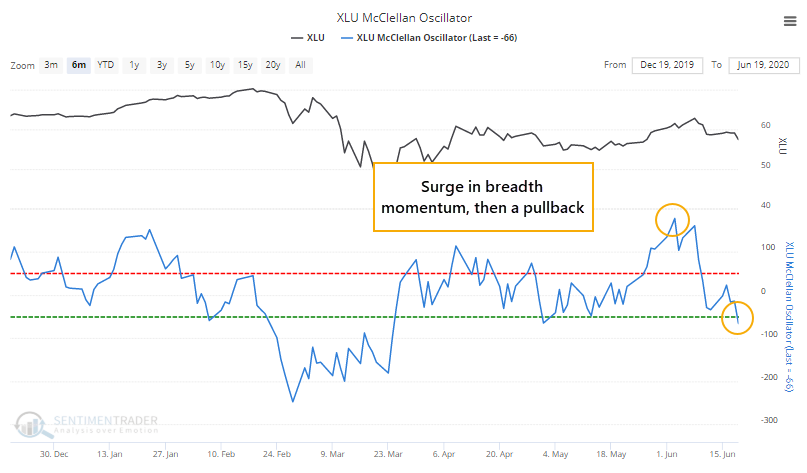
Like we saw above, when there has been a surge-then-pause, all within an "unhealthy" market where less than 60% of the stocks can move above their 200-day averages, it has preceded some rocky short-term returns, but positive longer-term ones.
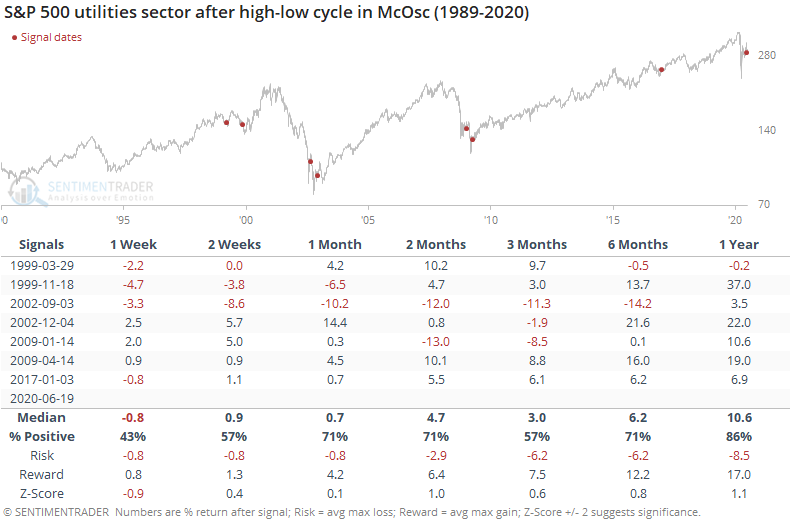
This kind of activity hasn't been enjoyable for investors in the short-term, with highly volatile swings in utilities. For those that held out, though, the sector tended to recover strongly.

PRODUCTS
SentimenTrader
Trading Tools
Indicators & Data API
‍
Strategies & Scanner
‍
Research Reports
FREE
RESOUrCES
Simple Backtest
Calculator
Simple Seasonality
Calculator
The Kelly Criterion
Calculator
Sentiment Geo Map
‍
Public Research Reports
‍
Education
Sentiment Indicators
‍
Technical Indicators
‍
Pricing
Bundle pricing
‍
FAQ
‍
Announcements
‍
COMPANY
‍
About
‍
In the News
‍
Testimonials
‍
Client Success Stories
CONTACT
‍
General Inquiries
‍
Media Inquiries
‍
Financial Professionals Inquiries
‍
© 2026 Sundial Capital Research Inc. All rights reserved.
Setsail Marketing
TermsPrivacyAffiliate Program
Risk Disclosure: The information and tools provided are for research and analytical purposes only and are not intended as investment advice. Market analysis involves uncertainty, and outcomes may differ from expectations. Users should conduct their own due diligence and consider their individual circumstances before making any financial decisions. Past performance is not necessarily indicative of future results.

Hypothetical Performance Disclosure: Hypothetical performance results have many inherent limitations, some of which are described below. No representation is being made that any account will or is likely to achieve profits or losses similar to those shown; in fact, there are frequently sharp differences between hypothetical performance results and the actual results subsequently achieved by any particular trading program. One of the limitations of hypothetical performance results is that they are generally prepared with the benefit of hindsight. In addition, hypothetical trading does not involve financial risk, and no hypothetical trading record can completely account for the impact of financial risk of actual trading. for example, the ability to withstand losses or to adhere to a particular trading program in spite of trading losses are material points which can also adversely affect actual trading results. There are numerous other factors related to the markets in general or to the implementation of any specific trading program which cannot be fully accounted for in the preparation of hypothetical performance results and all which can adversely affect trading results.

Testimonial Disclosure: Testimonials appearing on this website may not be representative of other clients or customers and is not a guarantee of future performance or success.