
TLT options update - what to do when things go right

Key points
- T-bonds have fallen hard in recent weeks
- A previous article detailed a bearish example trade using options on TLT
- In this piece, we look at one way to adjust the original trade to lock in profit
Resistance and seasonality hit bonds
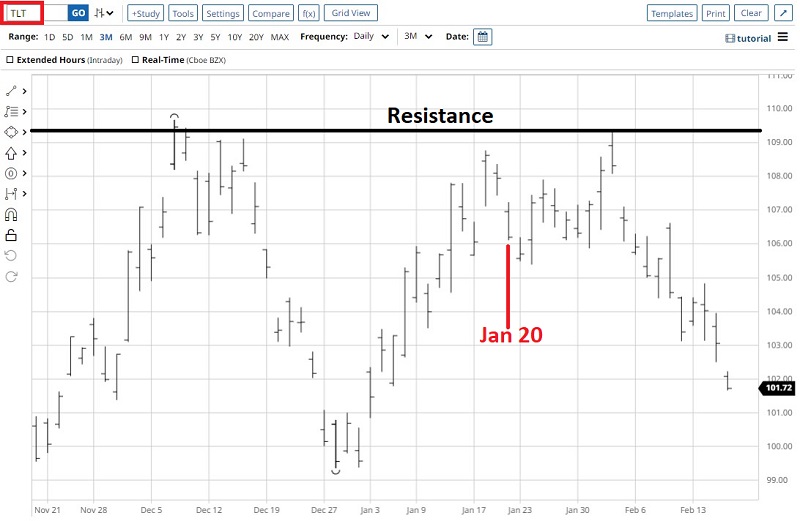
In this article titled "Bonds not out of the woods yet" on 2023-01-20, I highlighted the possibility that interest rates may have entered into a new long-term rising trend. I also noted that resistance and seasonality looked like potential negatives for long-term treasury bonds at that time. The article also highligted an example bearish trade using put options on the iShares 20+ Year Treasury Bond ETF (ticker TLT). The chart below (courtesy of Barchart.com) highlights the recent action for TLT and the aforementioned resistance level that it failed to penetrate.
The chart below displays the annual seasonal trend for 30-year treasuries. They will remain in an unfavorable seasonal window until late March/early April.
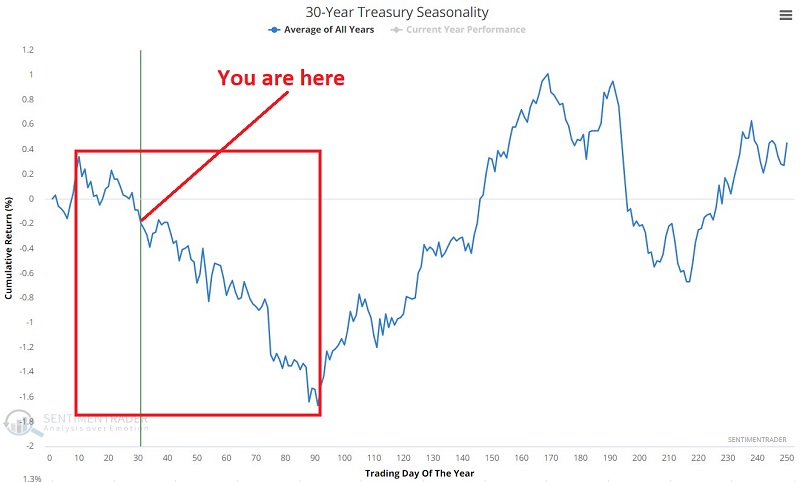
There remains reason to believe that bonds could continue to trade lower. However, given their current oversold status, a bounce is also possible.
The original example bearish trade
The figures below highlight the recent state of the example trade highlighted in the original article. Since this piece was written, TLT had fallen from $106.20 a share to $102.02. The TLT Mar17 2023 113 strike price put option had increased from $6.18 per contract to $11.05. At that point, the option trade showed an open profit of $487 per 1-lot, or 78.8% on capital.
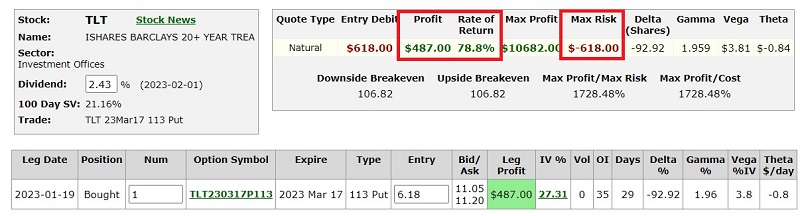
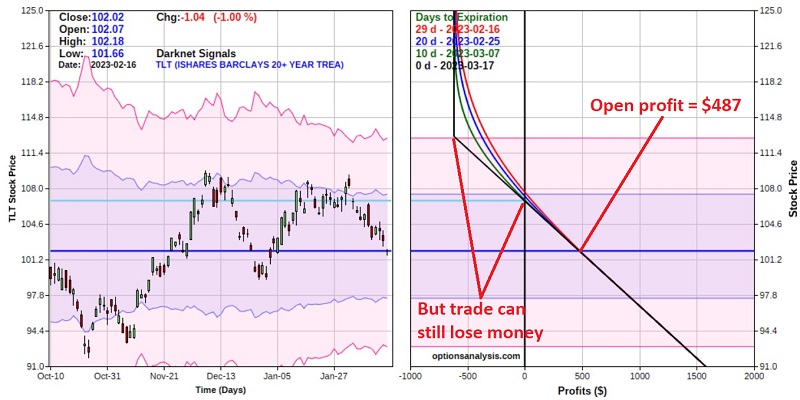
The good news is that the trade has built up a significant percentage profit and can continue to make more if bonds decline further. The bad news is that if bonds reverse and rally in the weeks ahead, a good portion of the open profit can vanish. Additionally, if TLT rallies back over $106.82, this currently profitable trade can still turn into a loss.
Adjusting to lock in profit and retain more profit potential
So let's assume that a trader holding this open position thinks that bonds could fall further but is nervous about the prospect of watching a good winner potentially turn into a loss. In this case, adjusting the trade can make great sense. Let's consider one possibility.
The adjustment involves:
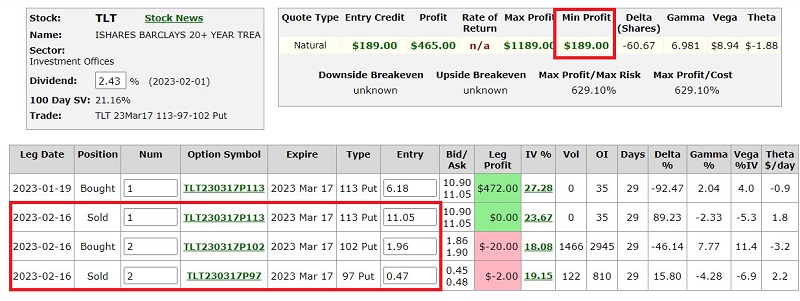
- Selling 1 TLT Mar17 2023 113 put @ $11.05
- Buying 2 TLT Mar172 023 102 puts @ $1.96
- Selling 2 TLT Mar17 2023 97 puts @ $0.47
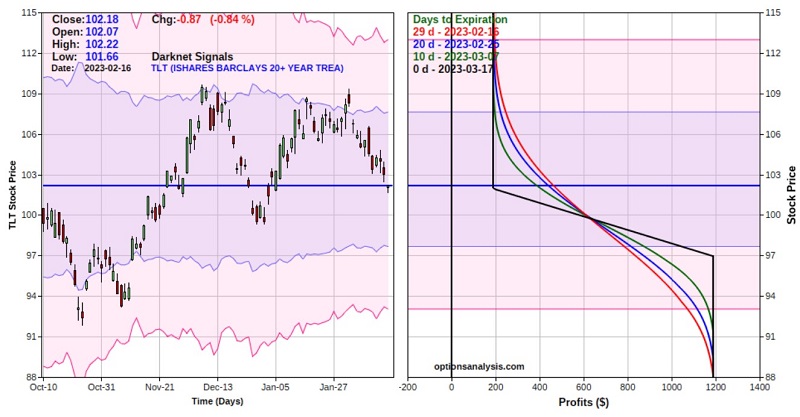
Selling the 113 put allows us to take a profit of $487 (11.05-6.18 x 100) on the initial cost of $618. Entering the March 17 102-97 bear put spread (in a 2-lot) allows us to accrue more profit if TLT continues to decline. Regardless of what happens to the price of TLT from here, the worst-case outcome is a profit of $189, or 31%, on the original $618 investment.
The screenshot below displays the particulars of the new trade, and the chart shows the risk curves (i.e., the expected P/L as of a given date based on the price of TLT shares at that time).
What the research tells us…
The example above highlights one of the potential advantages of trading options, i.e., the ability to adjust an existing position to lock in a profit while still leaving the possibility for more profit potential. Had we sold short shares of TLT instead, we would have had a much greater capital commitment to cover the margin required. Likewise, a naked short position entails unlimited risk. Lastly, we would have to buy back the short TLT shares to take a profit, leaving no possibility to accrue further profits.