
The venerable ARMS Index flashes green

Key points
- The ARMS Index measures buying and selling pressure in the broader stock market
- Oversold signals often highlight decent buying opportunities
- Signals are typically best acted upon when the market is already in an established uptrend
The NYSE ARMS Index
Technician Richard Arms developed the TRIN (TRading INdex) which has become a staple of almost all technicians' cadre of indicators. It is more appropriately referred to as the Arms Index.
It is calculated as follows:
(Advancing Issues / Declining Issues) / (Up Volume / Down Volume)
For example, say we have 1500 issues that closed a given day higher, and there was a total of 1.2 billion shares traded in those issues. Also, 700 issues closed lower on a total of 500 million shares. The Arms Index would be:
(1500 / 700) / (1,200,000,000 / 500,000,000) = 2.14 / 2.40 = .89
A reading of 1.0 typically shows that there is even pressure between buying and selling. As selling pressure increases, the Arms Index increases. As buying pressure takes over, the Arms Index drops. Therefore, one usually sees very high readings near market lows and extended bouts of low readings near market peaks.
There have been many interpretations and twists on the Arms Index over the years. We have found that using the 10-day average of daily readings provides an effective counter-trend indication of probable turning points.
The index is most effective when giving counter-trend signals - overbought in the context of a longer-term downtrend or oversold within an uptrend. Like most contrary indicators, oversold readings during a declining market can continue to become more oversold as the trend persists.
10-day ARMS Index average crosses above 1.40
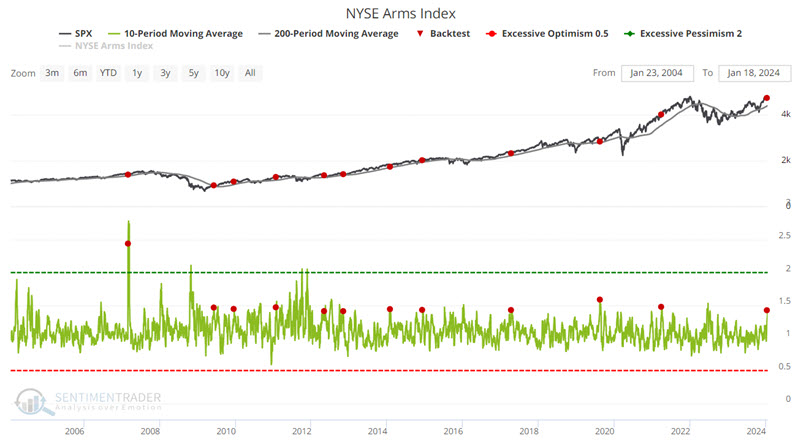
The chart below highlights all dates in the last 20 years when - for the first time in six months - the 10-day average of the ARMs Index crossed above 1.40 while the S&P 500 Index was above its 200-day moving average. The intention is to highlight a potentially oversold situation in the context of an established uptrend. The most recent signal occurred on 2024-01-17.
The tables below highlight the S&P 500 Index performance following previous signals and signal-by-signal results.

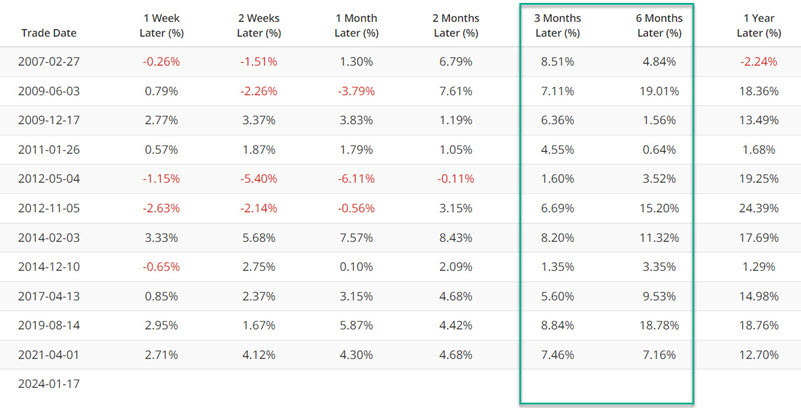
The critical thing to note is the 100% Win Rates for 3-month and 6-month periods. 2-month and 1-Year periods show a Win Rate above 90%, and the 1-Year Median Return has been 14.98%.
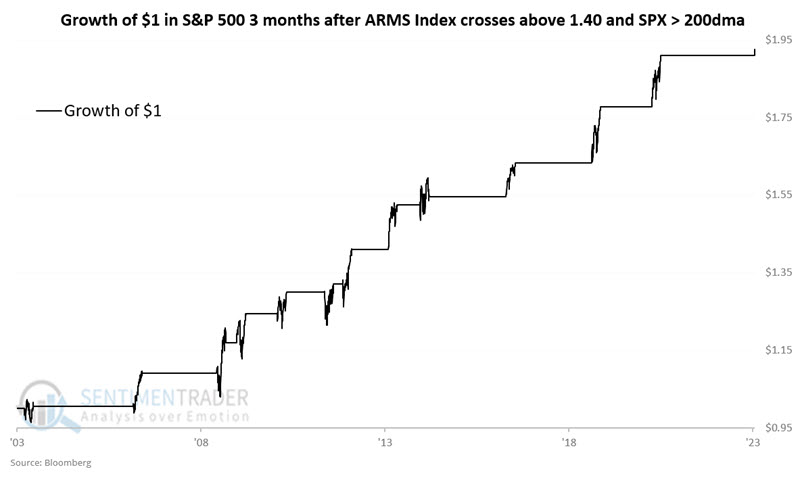
To put results into another perspective, the chart below displays the hypothetical growth of $1 invested in the S&P 500 Index for three months after each signal date listed in the table above. The "lower left to upper right" nature of the equity curve is evident.
What the research tells us…
As always, no one indicator serves as the be-all, end-all of trading. Likewise, high historical Win Rates never guarantee future success. As such, the recent signal from the NYSE ARMS Index should be viewed as a favorable weight of the evidence arguing for a continuation of the bull market in the months ahead.