
The S&P 500 formed a two-day bullish reversal pattern

Key points:
- The S&P 500 closed at a 5-month low on Thursday before rebounding on Friday, finishing up 2%
- Following similar price patterns, the S&P 500 advanced 88% of the time over the next three months
Did Friday's reversal signal that the S&P 500 has found a bottom?
In my report last Friday, I outlined the typical path for the S&P 500 after a 10% correction, which indicated a relief rally followed by a retest of the lows. In today's report, I'll examine the price action from the last two sessions to determine if it strengthens the case for a bounce.
After closing at a 5-month low and in the bottom 20% of its daily range on Thursday, the S&P 500 staged a strong rebound on Friday, finishing above the 90th percentile of its range with a gain of over 2%.
Although this appears to be a bullish reversal setup, it's essential to remain objective and let the data guide our outlook rather than relying on the eye test.
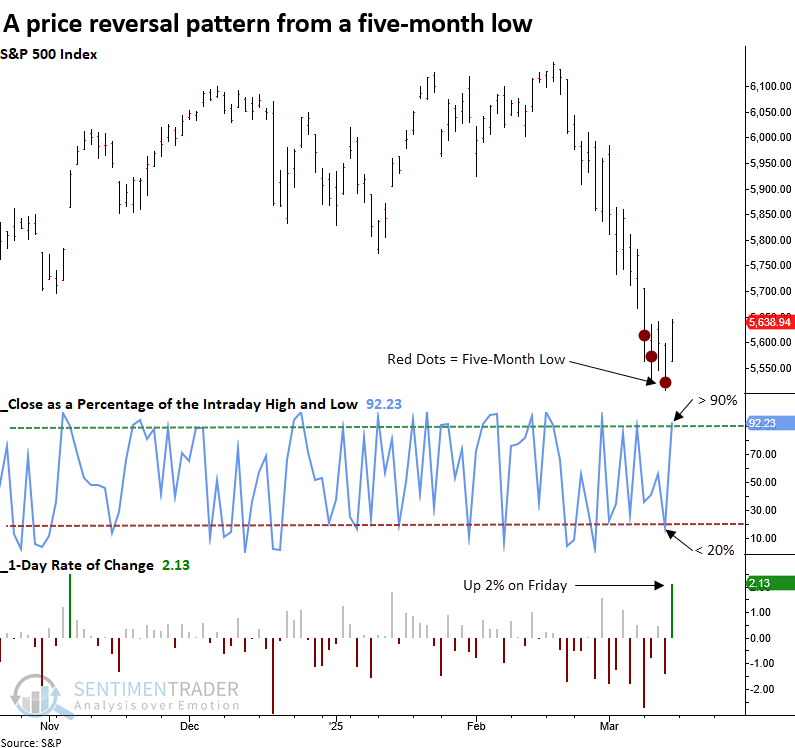
Keep in mind that intraday high and low data for the S&P 500 started being collected in 1957, which limits this price pattern study from the typical starting point of 1928 when daily closing data for the index became available.
Similar price patterns suggest the S&P 500 could bounce
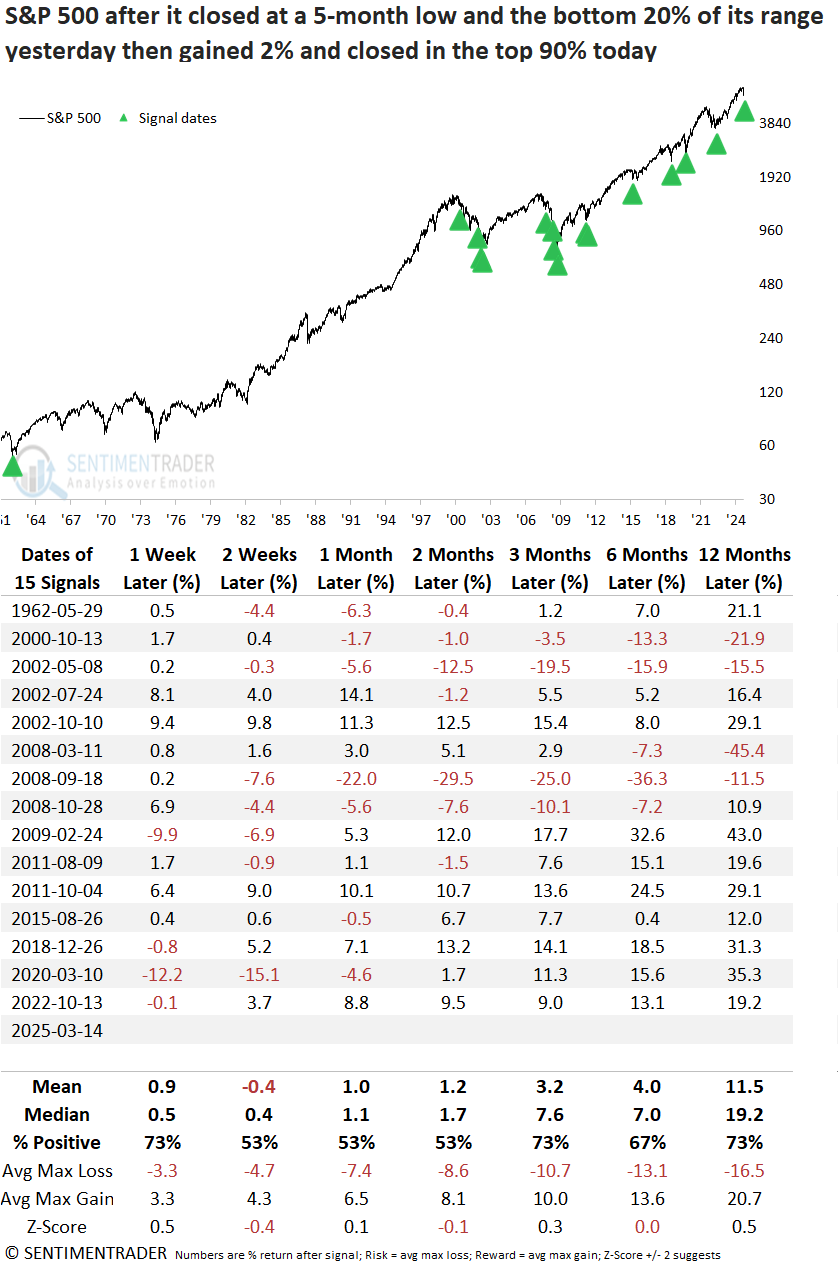
Whenever the S&P 500 experienced a two-day reversal pattern, as outlined above, the world's most benchmarked index tended to increase over the subsequent week, rallying 73% of the time. However, it lost momentum between two and eight weeks later, showing a 53% win rate before resuming its rally, indicating a typical bottoming pattern
Several precedents occurred in 2002 and 2008, the depths of severe bear markets, a scenario vastly different from now.
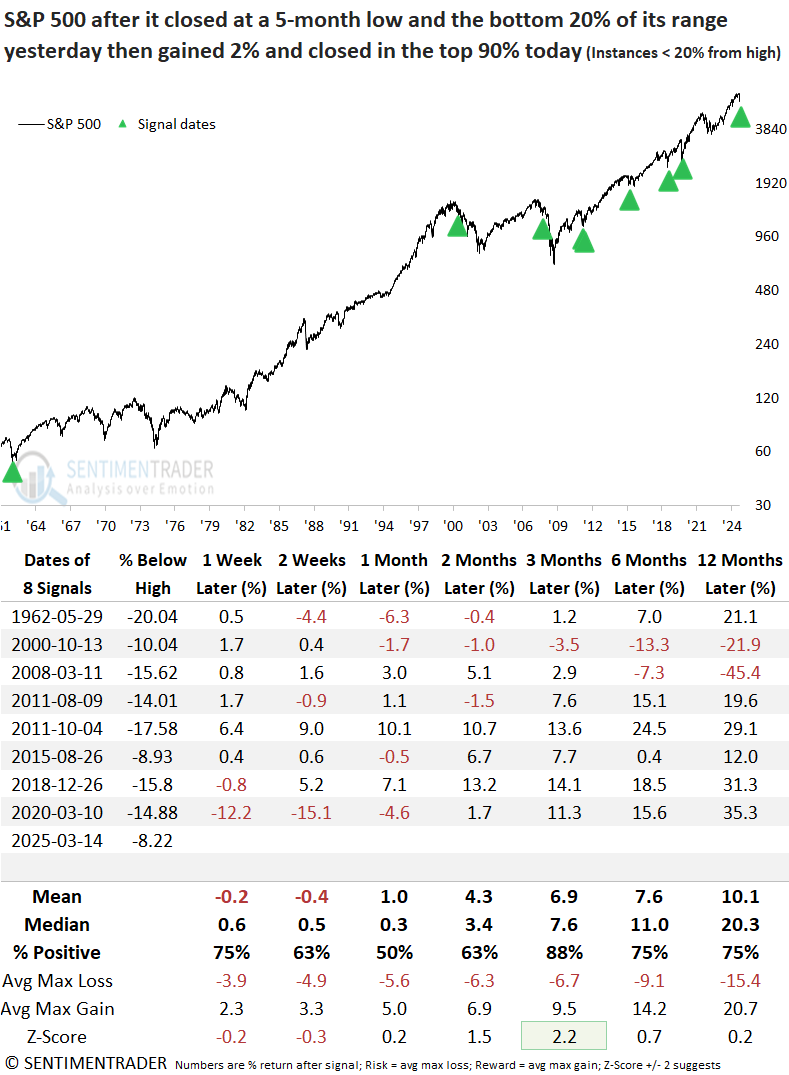
While the sample size is smaller, when the reversal pattern appears with the S&P 500 less than 20% below a high-correction territory - a similar pattern emerges: an initial bounce, a stall, and another rally. The three-month outlook improved notably, with gains in all but one instance.
Even in the most challenging scenarios, such as 2000 and 2008, the S&P 500 closed higher at some point during the first three months, allowing traders to adjust their positions.
A potential path
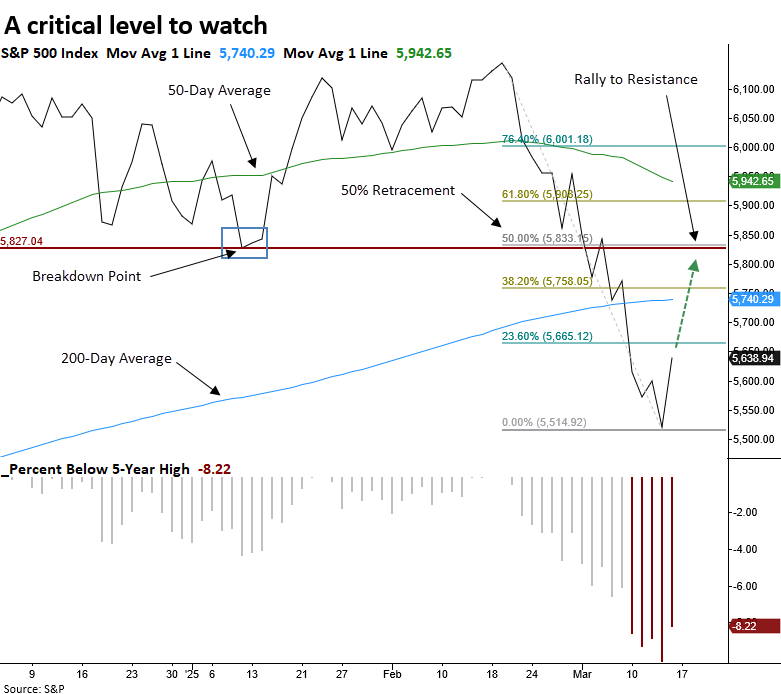
There are several resistance points for the S&P 500, with the 200-day moving average at approximately 5740 as the initial hurdle. Still, I would expect the breakdown level from January 10, 2025, and the 50% retracement of the February-March decline, both around 5830, to serve as the most pivotal area.
What the research tells us...
The S&P 500 endured a quick correction, falling 10% over 16 sessions. Such rapid sell-offs often lead to a relief rally. The two-day reversal pattern seen in the large-cap index late last week suggests that a bounce is underway, potentially reaching the 5830 breakdown point, which coincides with the 50% retracement of the 10% decline. Nevertheless, traders should prepare for a potential retest of the lows, as V-shaped bottoms are exceedingly rare without a significant catalyst.