
The Santa Rally usually delivers for gold miners

Key points:
- Most investors have heard reference to the "Santa Claus Rally" in stocks
- Gold-related stocks have also enjoyed a boost during a specific late-year seasonal window
- One of the critical questions is, "which vehicle to trade?"
The Santa Claus miner rally
Most of us know that stocks have a seasonal tailwind around this time of year. Less known is that gold-related stocks have enjoyed consistent gains, as well.
As I define it, the Santa Claus Gold Miner Rally period begins on the close of the 11th trading day of December and extends through the close on the first trading day of January in the New Year. For 2022 this period extends from the close on December 15 through the close on January 3 of next year.
The data we will use
We will analyze historical results based on the performance of three separate but related securities, each holding a basket of precious metals-related mining stocks.
Our first security is the Fidelity Select Gold fund (ticker FSAGX). Per Fidelity, this actively managed mutual fund:
Invests primarily in companies engaged in the exploration, mining, processing, or dealing in gold, or to a lesser degree, in silver, platinum, diamonds, or other precious metals and minerals. Normally investing at least 80% of assets in securities of companies principally engaged in gold-related activities and gold bullion or coins.
Our second security is another mutual fund. The ProFunds Precious Metals UltraSector ProFund; Investor Class (PMPIX) began trading in 2002. This fund tracks a specific index and is leveraged 1.5-to-1. Per ProFunds:
The Fund seeks daily investment results, before fees and expenses, that correspond to one and one-half times (1.5x) the return of the Dow Jones Precious Metals Index for a single day, not for any other period. The index seeks to measure the performance of certain companies in the precious metals sector.
Our third and final security is an ETF that tracks a different index. The Vaneck Gold Miners ETF (ticker GDX) began trading in 2006. Per Vaneck:
GDX seeks to replicate as closely as possible, before fees and expenses, the price and yield performance of the NYSE Arca Gold Miners Index (GDMNTR), which is intended to track the overall performance of companies involved in the gold mining industry.
So, we have three unique slices of the gold miner sector. Two (FSAGX and PMPIX) are traditional open-ended mutual funds, one (PMPIX) is leveraged 1.5x, and one (GDX) is an ETF that trades like shares of stocks. Two (PMPIX and GDX) track an index, and one is actively managed (FSAGX). For the record, there are plenty of other mining-related mutual funds and ETFs from which to choose.
A closer look at year-by-year results
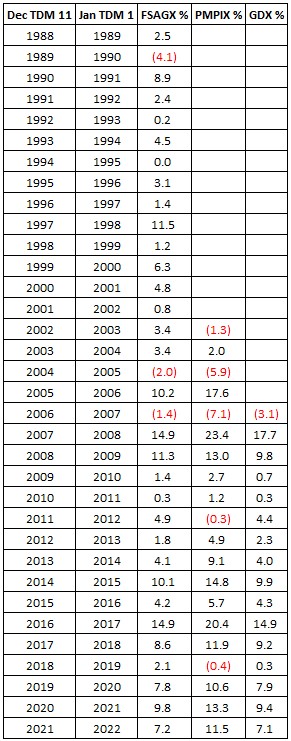
The table below shows year-by-year results for each security during these seasonal windows, with PMPIX and GDX starting in their year of trading inception.
The charts below display each security's cumulative percentage gain from its starting date.
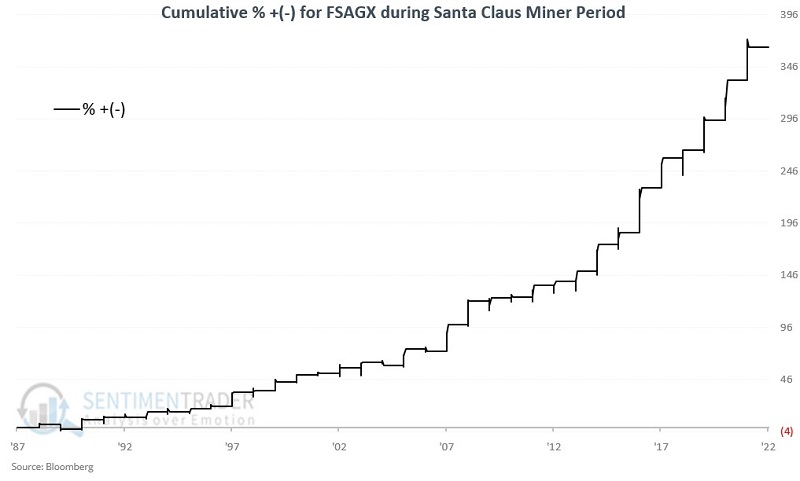
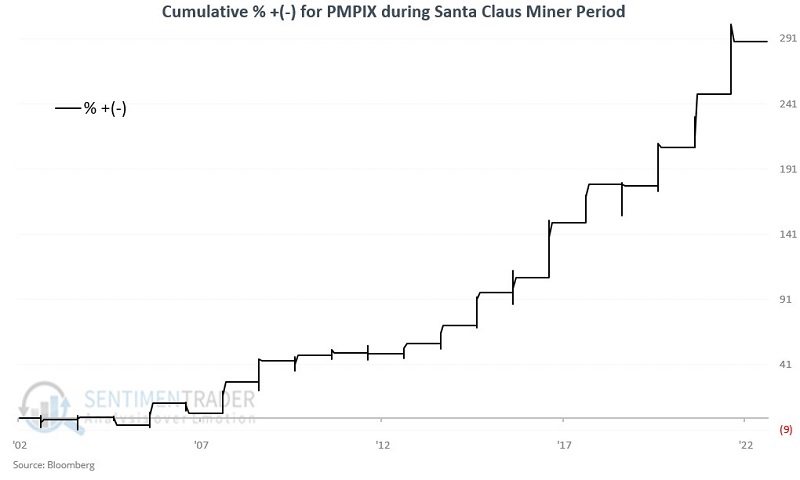
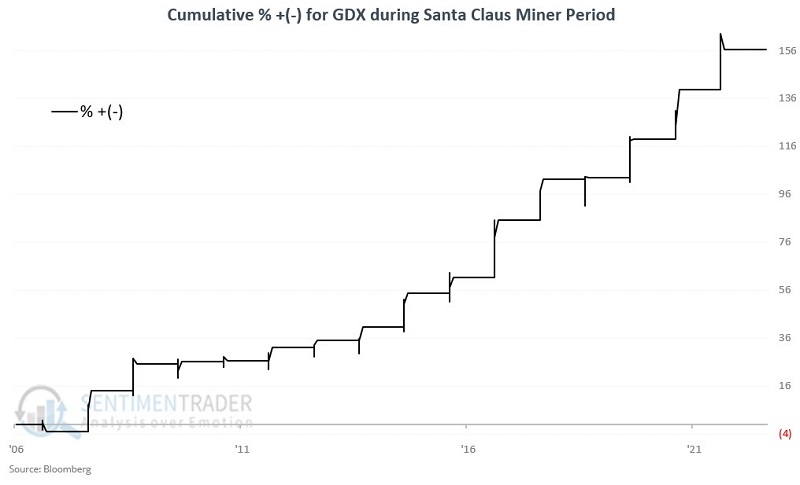
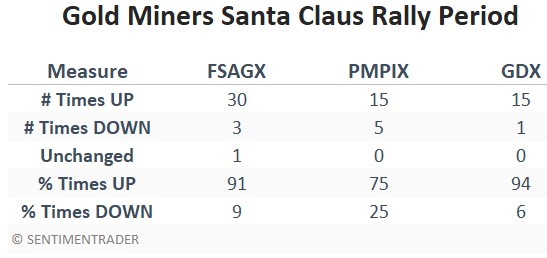
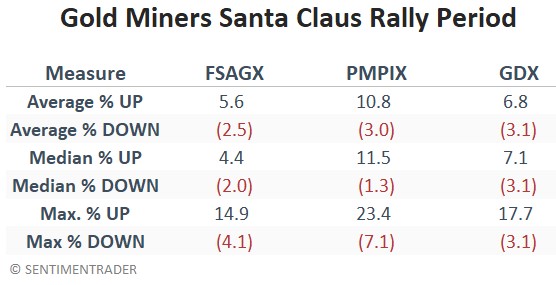
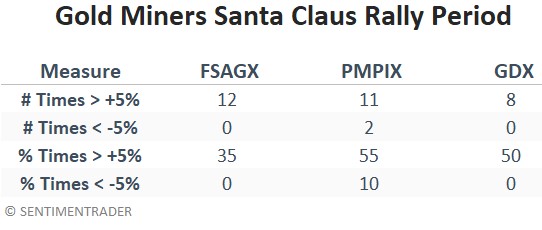
The tables below display the relevant facts and figures for each security during the Santa Claus Miner period. Note the consistency of positive returns and the probabilities of large gains versus large losses. The skew is undeniably to the upside.
What the research tells us…
In the past 30+ years, gold mining stocks have shown a strong tendency to rally between the 11th trading day of December and the first trading day of the new year. As with any seasonal trend, there is no guarantee that the precious metals mining sector will show a gain during this period in any given year. There are several ways to trade this tendency, all of which tend to show a similar positive skew to returns.