
The October/November Power Period

Key points
- A 5-day period encompassing late October into early November has shown a long-term tendency to be favorable for stocks
- This pattern is shaping up as a very "contrarian" play this year
- A long position in S&P 500 futures or an S&P 500 ETF (SPY or VOO) is the purest play
The October/November Power Period
For the record, "Yes," I know phrases like "Power Period" are hokey and borderline sensationalistic. But still, as a title, I think it has a little more pizzazz than, say, "A Period When the S&P 500 Has Gone Up 74% of the Time."
The period we will examine is the 5-trading day period that extends:
- From the close of the 3rd to the last trading day of October
- Through the close on the 3rd trading day of November
In plain English, we are talking about being long the S&P 500 Index during the last two trading days of October plus the first three trading days of November.
For 2023, this period will extend from:
- The close on 10/27/2023
- Through the close on 11/3/2023
A review of 74 years of history
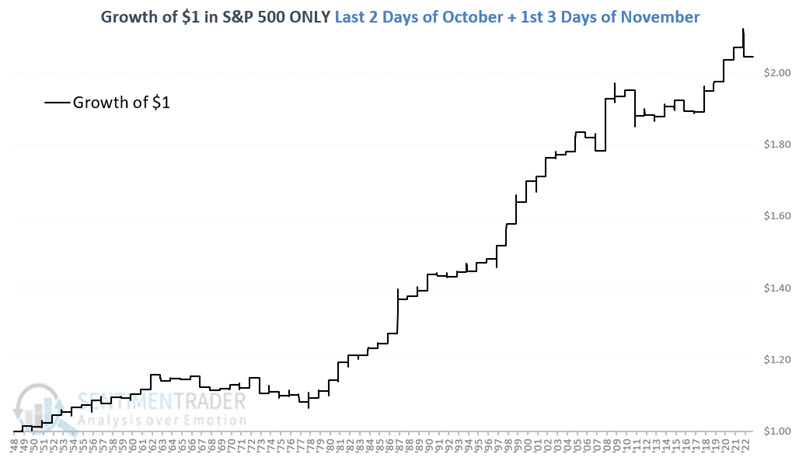
The chart below displays the cumulative growth of $1 invested in the S&P 500 Index (price-performance only) every year during the five days described above, starting in 1949.
The table below displays the results of this test.
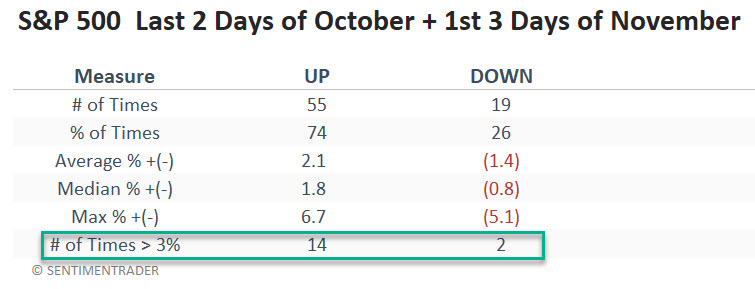
The good news is that the S&P 500 has shown a gain during this period in roughly 3 out of every four years over the past 74 years, and the average and median gain was larger than the average and median loss. The most significant piece of good news - as highlighted in the table above - is that large gains (defined as 3% or more over the five days) outnumbered large losses by a whopping 14 to 2 ratio. If we expand the count to include gains or losses of plus or minus 2% or more, the ratio is 26 up years to 6 down years.
The bad news is that this "trend" is in no way a "sure thing" on a year-to-year basis. The largest 5-day losses occurred in 1973 (-5.07%) and 1967 (-3.35%). In 2022, the first day of these five days saw the S&P 500 shoot higher by 2.5%, only to reverse sharply lower over the next four days and end with a 5-day loss of -2.30%.
A word on real-world trading
This quirky seasonal tendency is clearly for short-term traders only. This is not a position on which to "bet the ranch" but merely a potential opportunity for aggressive traders to try to exploit. The most straightforward approach would be to buy S&P 500 Index futures (ticker ES) for those inclined and/or willing to trade futures contracts. Non-futures traders could consider buying shares of an S&P 500 Index ETF such as tickers SPY or VOO. In any event, the results shown above do not relieve a trader of their responsibility to consider the risk side of the equation and formulate a plan for cutting a loss based on their personal tolerance for risk.
What the research tells us…
The market is working on its third consecutive losing month, and the narrative is highly bearish. Is it wise to buck this trend and jump into a bullish short-term trade in the face of market weakness? The reality is that only time will tell. Is the S&P 500 Index (and attendant index funds) certain to trade higher during these five trading days in 2023? Of course not. There are no "sure things" in the financial markets, and 2023 could easily be one of those "off years."
At the same time, a 74% Win Rate combined with an Average Win/Average Loss ratio of almost 1.5-to-1 over 74 years offers a potential "edge" that some traders may find compelling.