
The Nikkei has blown but fewer stocks are joining the party

Key points
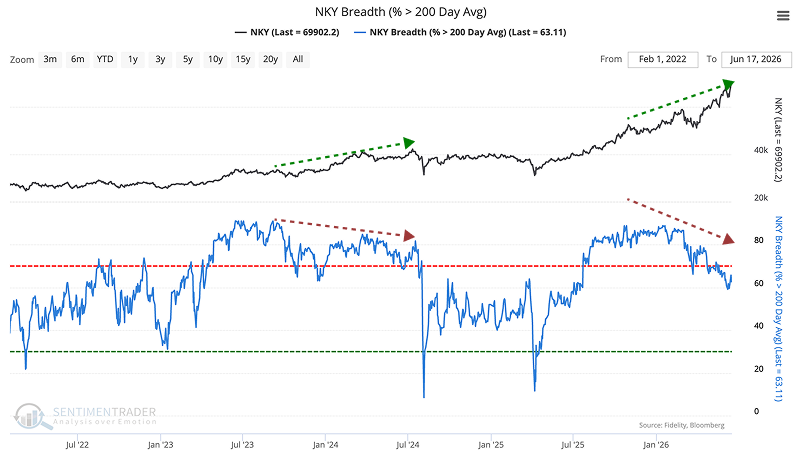
- Japan's Nikkei 225 has surged past 71,000 to fresh all-time highs, but the percentage of component stocks in long-term uptrends has been fading for months
- Divergences between the index and its breadth metrics are among the most extreme seen over the past 25 years
- Unlike what we'd expect from similar setups in U.S. indexes, these breadth divergences in the Nikkei have not been reliable warnings, though the exceptions have been punishing
Fewer stocks are holding their uptrends
Lately we've flagged the breadth divergences creeping into the S&P 500. The Nikkei 225 is showing the same pattern, on a bigger stage. The index closed at 71,216 on Wednesday, up 85% from a year ago.
It's a bit curious that not as many stocks are participating in the advance as the headline numbers suggest.
Divergences between an index and its constituent stocks can be resolved either by dragging the index lower or the index pulling the stocks higher. In theory, that can't happen; in practice, it's a handy heuristic. Basically, we just look to see whether divergences tend to be successful warnings or not.
In the Nikkei, the answer has usually been "not."
That said, it hasn't always been harmless. Two clusters, around 2007 and 2015, produced drawdowns of 20% to 31% over the following year when similar setups appeared. Those are the exceptions you can't ignore.