
The most platinum time of the year is near

Key points:
- Platinum futures are soon to enter their most favorable time of the year
- The consistency of this trend has been relatively remarkable
- A similar play can be made using an ETF instead of trading platinum futures
The data used for testing
We used a continuous platinum futures contract from Bloomberg to test platinum performance for this piece. This contract dates back to 1987. This contract may include market holidays when the New York Mercantile Exchange (NYMEX) is closed if electronic trading takes place on that day. In testing, we use this contract as a proxy for platinum bullion.
For ETF testing, we use the abrdn Physical Platinum Shares ETF (PPLT), which only trades when the NYSE is open.
The favorable period for platinum futures
The chart below highlights the most favorable time of the year for platinum futures. It extends from the close on Trading Day of Year (TDY) #254 through the close on TDY #36 of the new year.
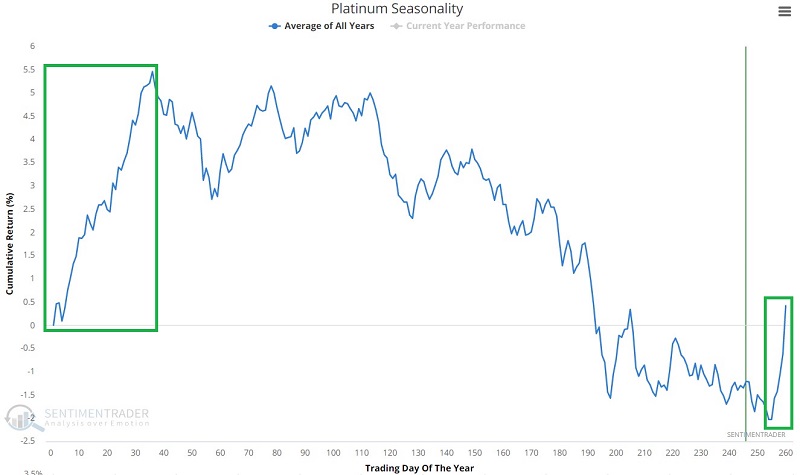
For 2022-23 this period extends for futures trading from the close on December 22 through the close next February 20.
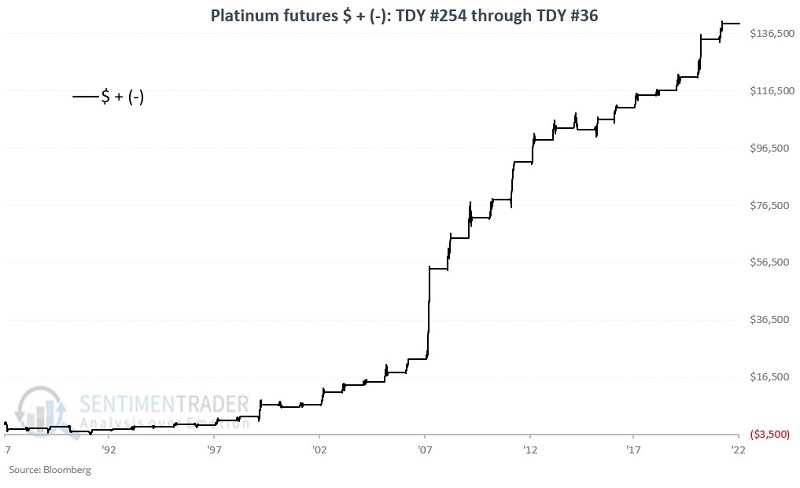
For platinum futures, each point movement in the price of platinum is worth $50. The chart below displays the cumulative hypothetical $ gain or loss achieved by holding platinum futures from the close on TDY #254 through the close on TDY #36 each year starting in December 1987.
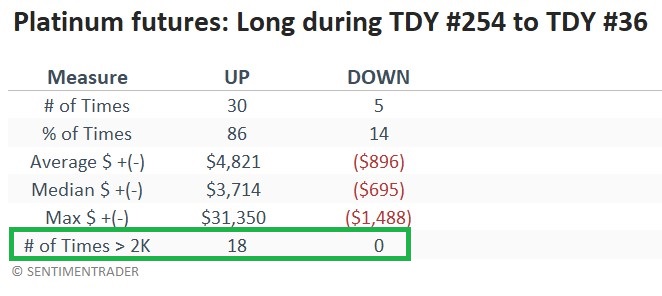
The table below summarizes platinum futures performance during the seasonally favorable period. The contract gained 86% of the time during these windows, with average gains far outpacing average losses. There were 18 years with large gains versus no years with large losses.
Using an ETF instead of trading futures
The one glaring problem is that most individuals will never trade platinum futures. So, let's consider an alternative.
PPLT (abrdn Physical Platinum Shares ETF) is an ETF intended to track the price of platinum bullion. Traders can buy and sell shares of PPLT just as they would shares of stock. While this approach lacks the leverage of futures trading, it makes a platinum investment more accessible to many individual traders.
Because this ETF does not trade electronically on market holidays like the futures contract we follow, it has fewer trading days in a typical year than the futures contract. As a result, the seasonally favorable period for PPLT is slightly different and includes the following:
- The last five trading days of the current year
- The first 33 trading days of the following year
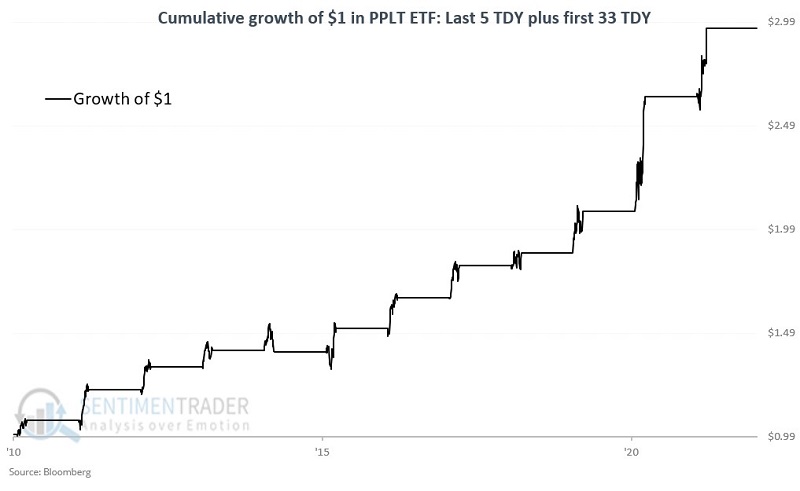
This year the favorable period for PPLT extends from the close on December 22 through the close on February 23, 2023. The chart below shows the growth of $1 invested in PPLT ONLY during our seasonally favorable period starting in December 2010.
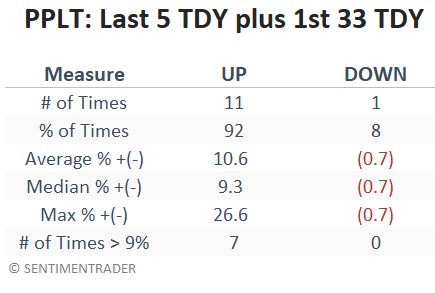
The table below displays year-by-year results for PPLT only during the seasonally favorable period. There was only one loss, and it was tiny.
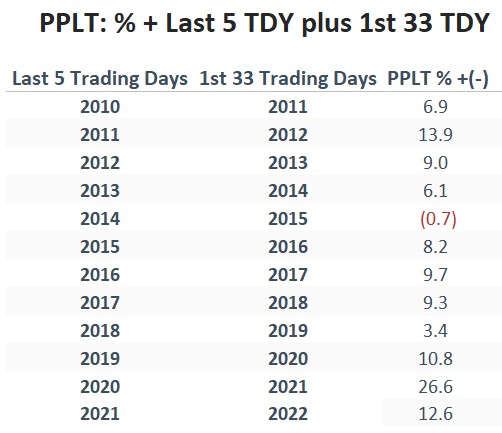
There were seven years with gains of 9% or more versus no large losses.
To fully appreciate platinum's performance during the seasonally favorable period, the chart below displays the cumulative growth of $1 in PPLT during all other trading days. It excludes the last five trading days of the year and the first thirty-three trading days of the following year.
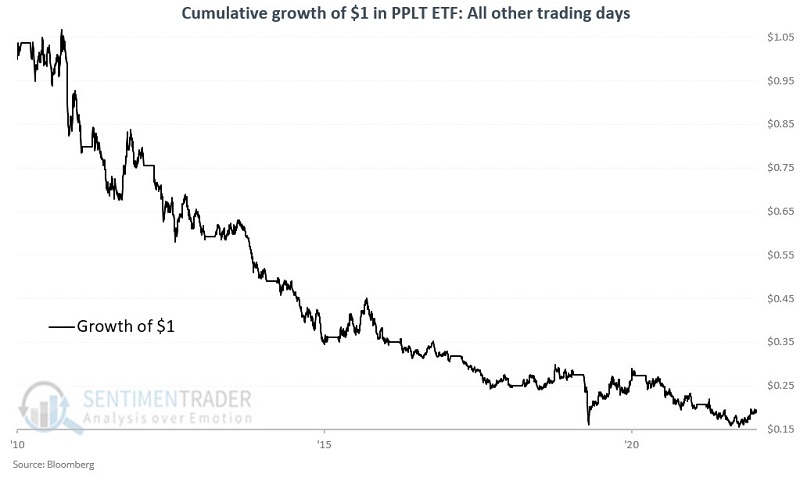
Over the past 12 years, PPLT has returned +196% during seasonally favorable periods and -80% during all other trading days
What the research tells us…
Platinum tends to rally early and very late in the year; however, results vary widely from year to year. While results have been consistently favorable in the past, there is no guarantee that this degree of favorability will continue. Platinum futures offer the potential for significant gains but also large losses for the unprepared and/or under-capitalized trader. The PPLT ETF offers traders an unleveraged way to play the long side of platinum.