Products
SentimenTrader Trading Tools
‍
Backtest Engine
My Trading Toolkit
Correlation Analysis
Seasonality
Market Prediction
Indicators & Data API
‍
Proprietary Indicators & Charts
Market Data API
Strategies & Scanner
‍
50+ Trading Strategies
Smart Stock Scanner
Smart Option Scanner
Research Reports
‍
Research Solutions
Reports Library
Free Resources
Simple Backtest Calculator
Simple Seasonality Calculator
The Kelly Criterion Calculator
Sentiment Geo Map
Public Research Reports
Education
Sentiment Indicators
Technical Indicators
Pricing
Company
About
In the News
Testimonials
Client Success Stories
Contact
Log inLoginSign up
< BACK TO ALL REPORTS

The Macro Index Model favors the S&P 500 over Crude Oil

by Sentimentrader
2026-01-05
The Macro Index Model (MIM) has crossed 0.6, signaling economic resilience. While this has historically been a perfect buy signal for the S&P 500 over 6 months, it often creates a divergence where Crude Oil underperforms. We analyze this split.

Key points

  • The Macro Index Model (MIM), which aggregates 11 key economic indicators, has crossed above the 0.6 threshold, signaling a low recession probability.
  • Historically, when the MIM crosses above 0.6 while the S&P 500 is in a long-term uptrend, equity returns have been consistently positive, achieving a 100% win rate over six months.
  • However, this same economic resilience signal has historically been a headwind for crude oil in the medium term.

The Macro Index Model

Our Macro Index Model (MIM) combines 11 various economic indicators to determine the state of the U.S. economy right now. Including:

  • New Home Sales
  • Housing Starts
  • Building Permits
  • Initial Claims
  • Continued Claims
  • Heavy Truck Sales
  • 10-year - 3-month Treasury yield curve
  • S&P 500 vs. its 10-month moving average
  • ISM manufacturing PMI
  • Margin debt
  • Year-over-year headline inflation

The model is constructed as an inverse of recession probability. So, you can subtract the model from 100% to get the recession probability in the months ahead. A model reading of 70% suggests a 30% recession probability; a reading of 20% suggests an 80% recession probability.
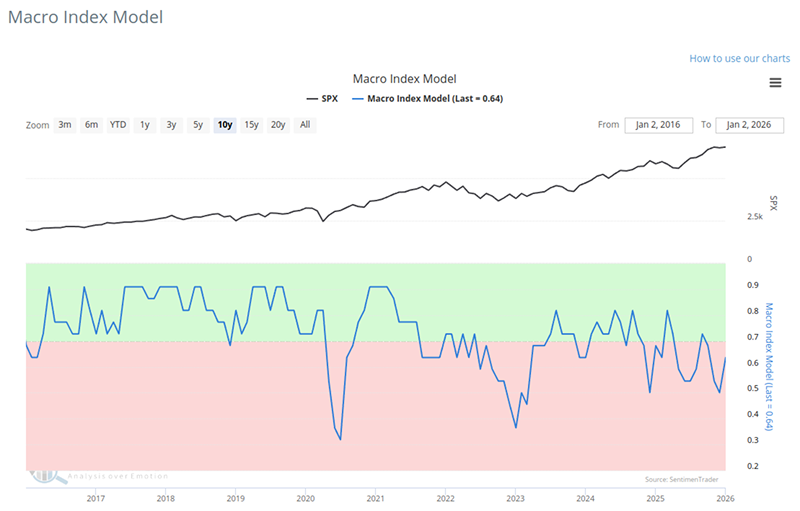
Returns were robust when the model was above 50%, and terribly subpar when it was 50% or below. The latest reading is 0.636. The model recently generated a "Golden Cross" by moving above 0.6. The chart below highlights the dates when the MIM crossed above the 0.6 level. For related backtest, click here.
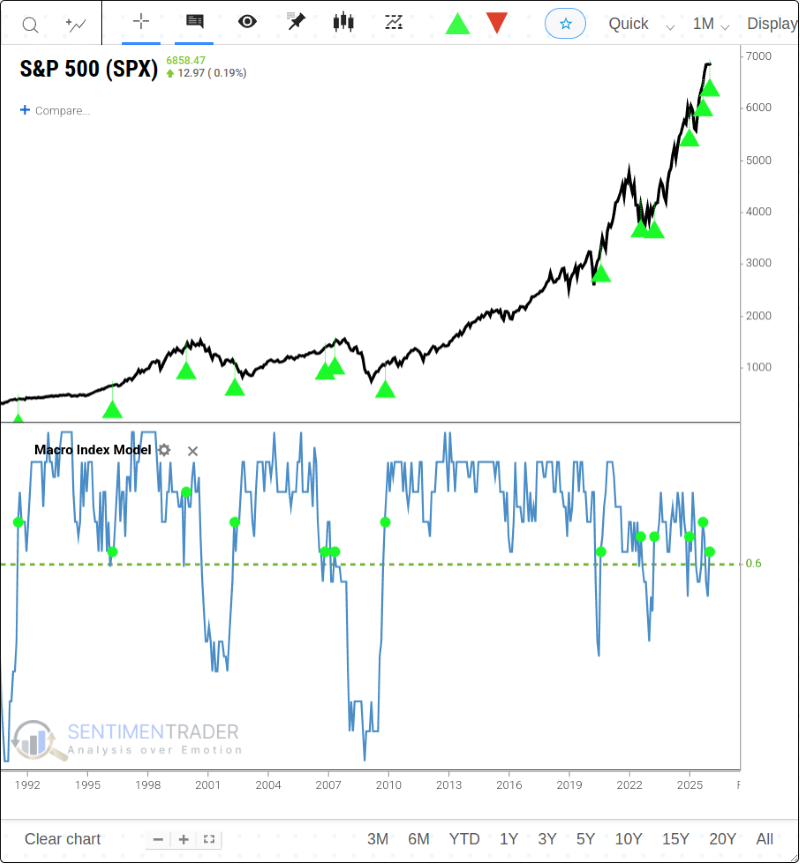
As you can see, performance has been relatively strong across various timeframes.
MIM signals when S&P 500 is trending up

To refine the signal further, we added a filter requiring the S&P 500 to be above its 10-month moving average, ensuring that the primary market trend is positive.

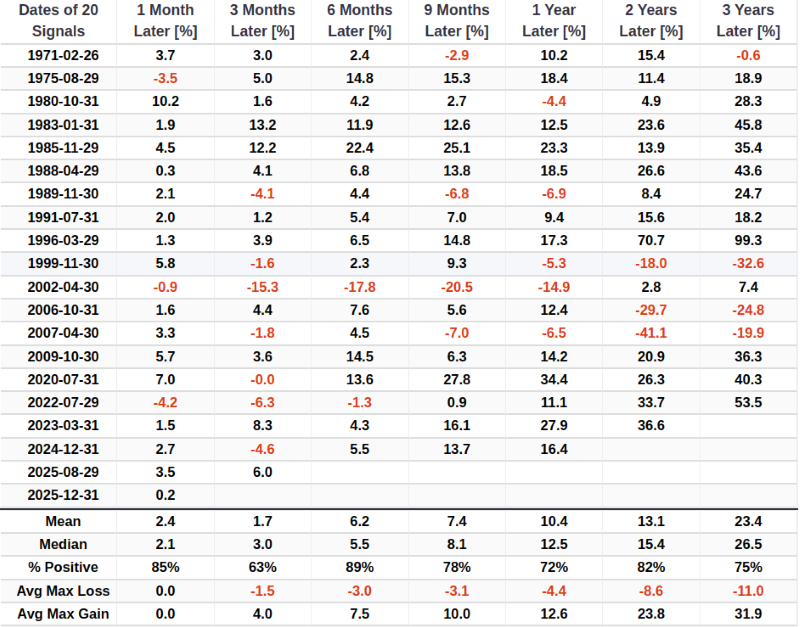
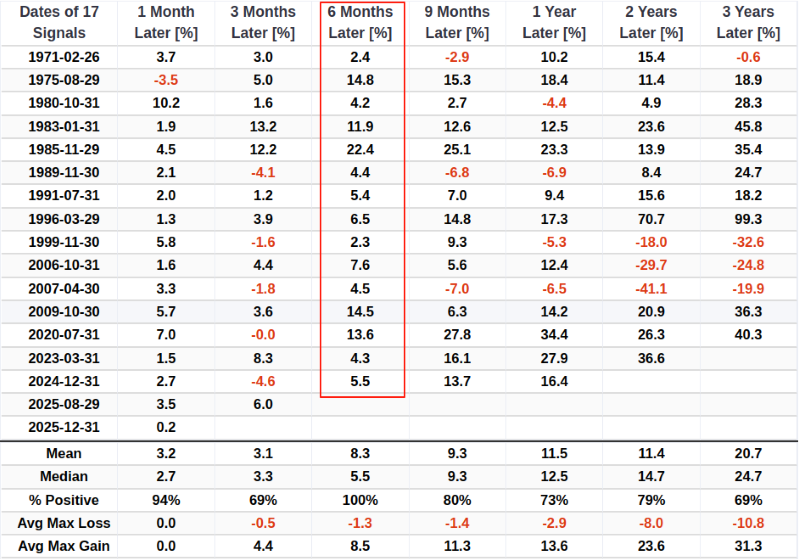
The chart and table below shows a summary of S&P 500 Index performance following all signals when:

  • MIM Crosses Above 0.6
  • AND the S&P 500 Index was ABOVE its 10-month moving average
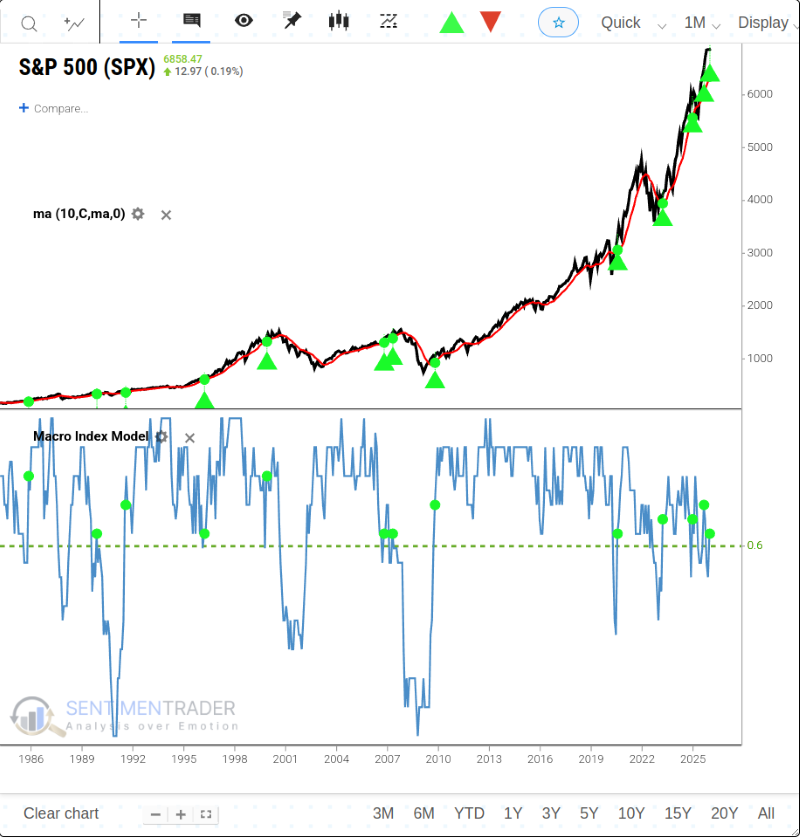
Historically, results have been primarily positive. Notably, the signal has achieved a perfect win rate over the six-month timeframe.
A closer look at crude oil

The chart and table below display crude oil following those occasions when the MIM crossed from below 0.60 to above 0.60.
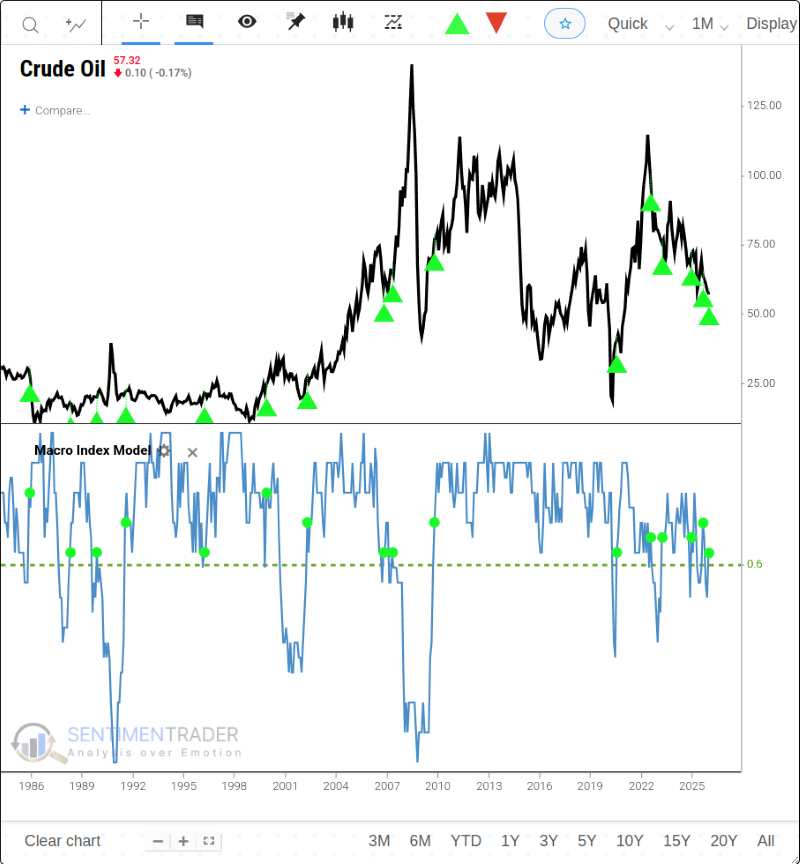
As shown below, crude oil performance has been underwhelming over the three-month period following these signals.
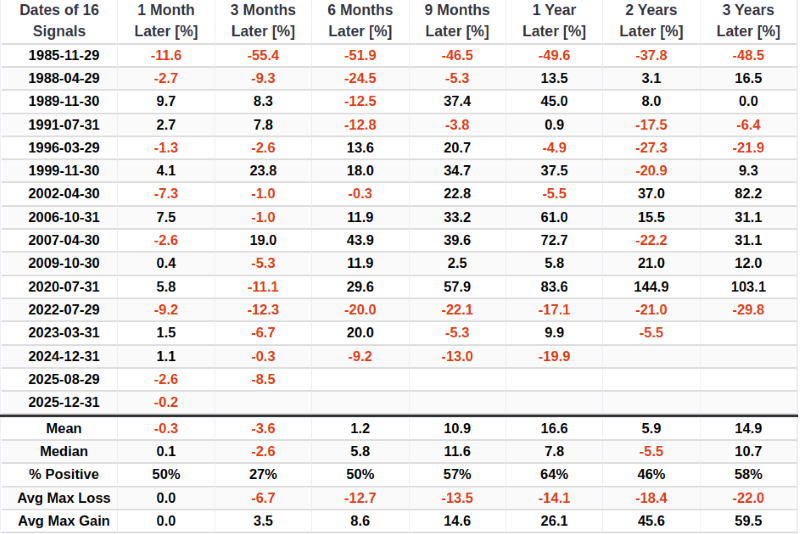
Given the current macroeconomic environment and geopolitical factors, volatility in oil prices may increase. The message here is perhaps not that traders should aggressively short crude oil right now, but rather that they should closely monitor opportunities to do so.

What the research tells us...

The Macro Index Model (MIM) has improved to a level that historically signals a low probability of near-term recession. This economic resilience, combined with the S&P 500 trading above its long-term trend, creates a favorable backdrop for equities, with historical data showing consistently strong returns over the next six months. However, this same environment has often coincided with weakness in crude oil prices.

The latest signal does not guarantee an economic boom or further stock market rally. It does, however, lend significant weight to the bullish case for both the economy and the stock market. 

PRODUCTS
SentimenTrader
Trading Tools
Indicators & Data API
‍
Strategies & Scanner
‍
Research Reports
FREE
RESOUrCES
Simple Backtest
Calculator
Simple Seasonality
Calculator
The Kelly Criterion
Calculator
Sentiment Geo Map
‍
Public Research Reports
‍
Education
Sentiment Indicators
‍
Technical Indicators
‍
Pricing
Bundle pricing
‍
FAQ
‍
Announcements
‍
COMPANY
‍
About
‍
In the News
‍
Testimonials
‍
Client Success Stories
CONTACT
‍
General Inquiries
‍
Media Inquiries
‍
Financial Professionals Inquiries
‍
© 2026 Sundial Capital Research Inc. All rights reserved.
Setsail Marketing
TermsPrivacyAffiliate Program
Risk Disclosure: The information and tools provided are for research and analytical purposes only and are not intended as investment advice. Market analysis involves uncertainty, and outcomes may differ from expectations. Users should conduct their own due diligence and consider their individual circumstances before making any financial decisions. Past performance is not necessarily indicative of future results.

Hypothetical Performance Disclosure: Hypothetical performance results have many inherent limitations, some of which are described below. No representation is being made that any account will or is likely to achieve profits or losses similar to those shown; in fact, there are frequently sharp differences between hypothetical performance results and the actual results subsequently achieved by any particular trading program. One of the limitations of hypothetical performance results is that they are generally prepared with the benefit of hindsight. In addition, hypothetical trading does not involve financial risk, and no hypothetical trading record can completely account for the impact of financial risk of actual trading. for example, the ability to withstand losses or to adhere to a particular trading program in spite of trading losses are material points which can also adversely affect actual trading results. There are numerous other factors related to the markets in general or to the implementation of any specific trading program which cannot be fully accounted for in the preparation of hypothetical performance results and all which can adversely affect trading results.

Testimonial Disclosure: Testimonials appearing on this website may not be representative of other clients or customers and is not a guarantee of future performance or success.