
The index soars, but the troops don't follow

Key points:
- The S&P 500 sits nearly 7% above its 200-day average, yet less than 60% of SPY components trade above their own 200-day line
- This divergence has triggered only 20 times since 1998 - adding a 126-day cooldown reduces it to 9 independent signals
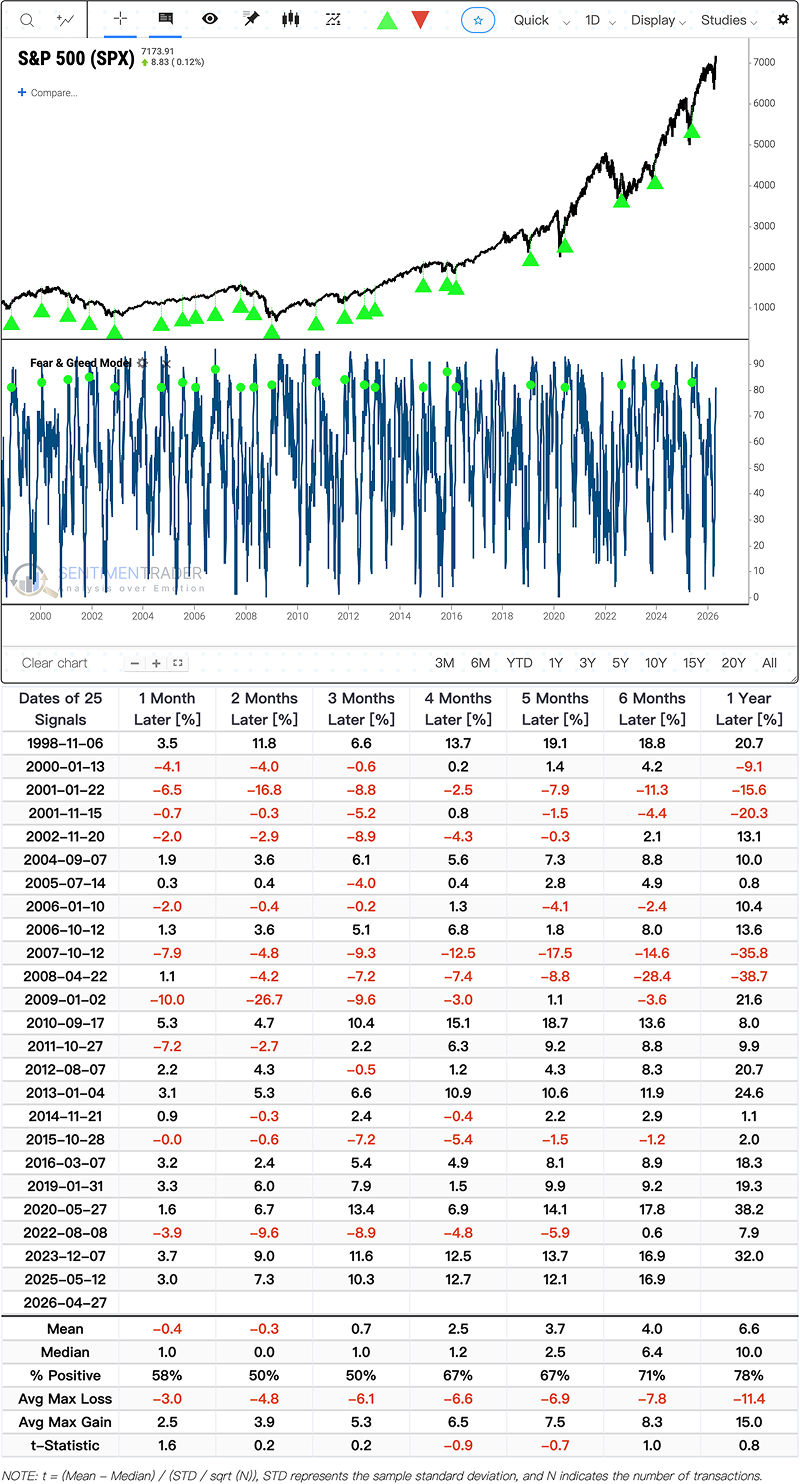
- The Fear & Greed Index just completed a full round trip from below 10 to above 80, a cycle that has happened 25 times in the index's history
- Short-term returns after the F&G cycle favor caution, but longer windows show the index was higher 78% of the time a year later
Price leads, breadth lags
The S&P 500 closed at 7,173 on April 27, stretching more than 6% above its 200-day moving average. By itself, that's not unusual during a bull run - indices are supposed to lead their components.
But underneath the surface, participation has thinned. Fewer than 60% of SPY constituents hold above their own 200-day averages. The index is running ahead of its own internals.
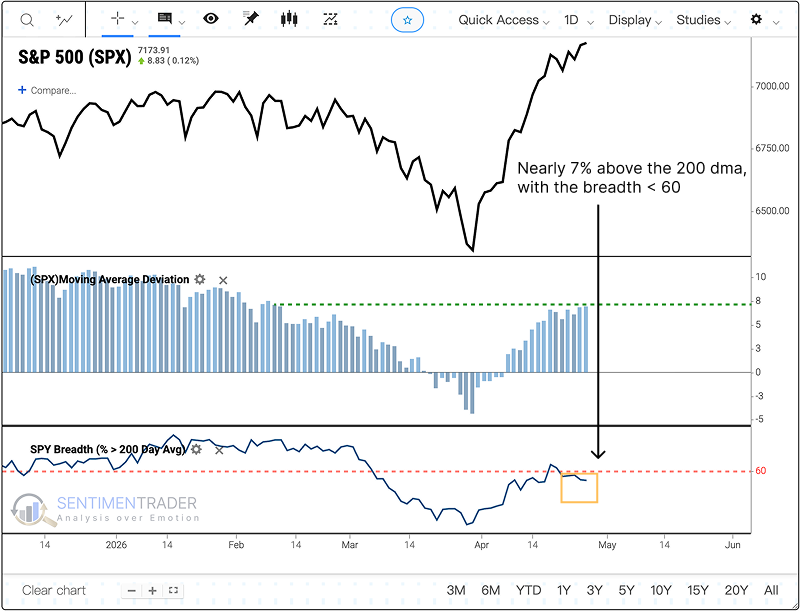
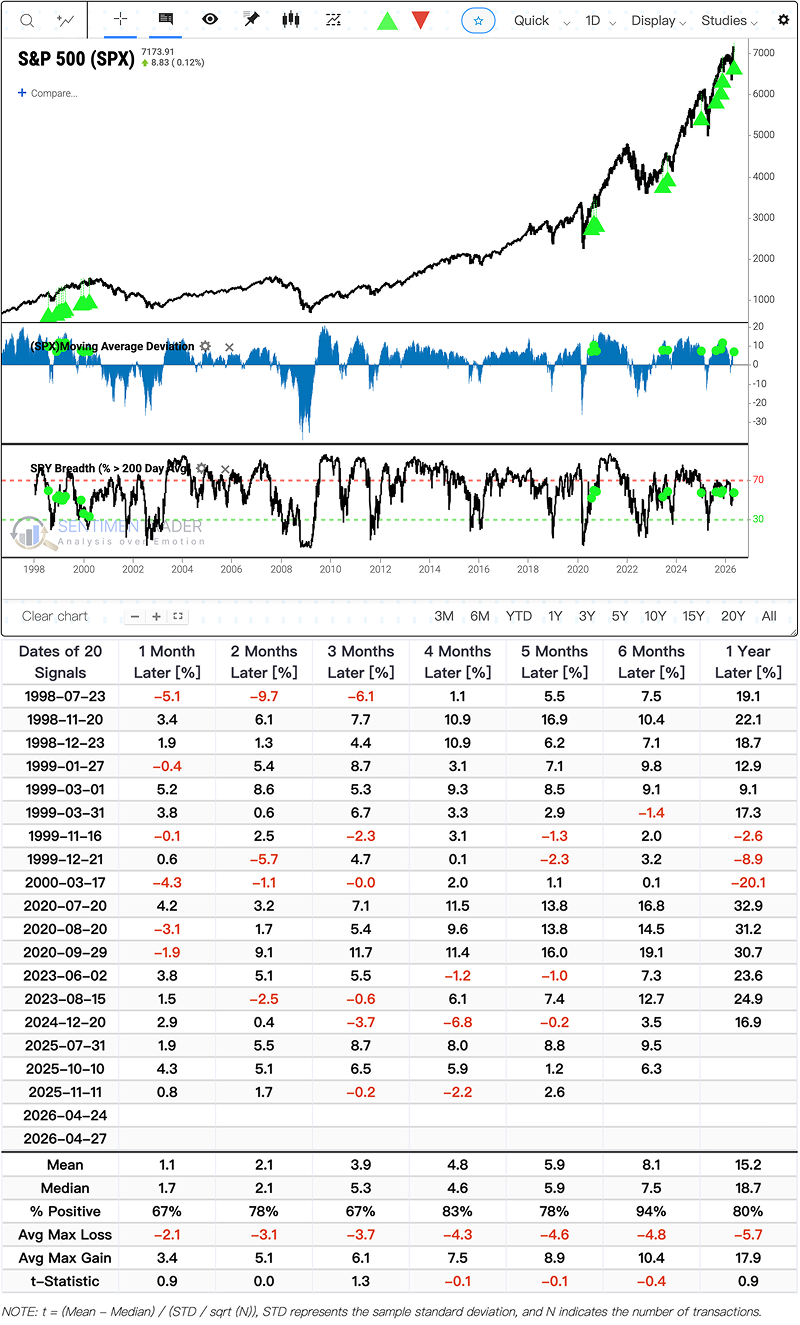
When the S&P trades this far above its trend while breadth trails, it has triggered a signal only 20 times since 1998. The cluster is telling - 1998 and 1999 account for nine of those, and five fired during the post-COVID rebound in mid-2020.
The most recent triggers came in late 2025 and again last week. Many of these signals bunch together during transitional periods when a narrow group of large caps pulls the index higher while the average stock hasn't kept pace.
The forward returns tell a constructive story, though with a catch. Six months out, the index was higher 94% of the time, averaging a gain north of 8%. A year later, the hit rate was 80% with an average return exceeding 15%. The worst average loss at the one-year mark was -5.7% - manageable, provided you could sit through the interim volatility. The shorter windows are less convincing: one and three months out, win rates drop to 67%, with average gains of just 1.1% and 3.9%.Click here.
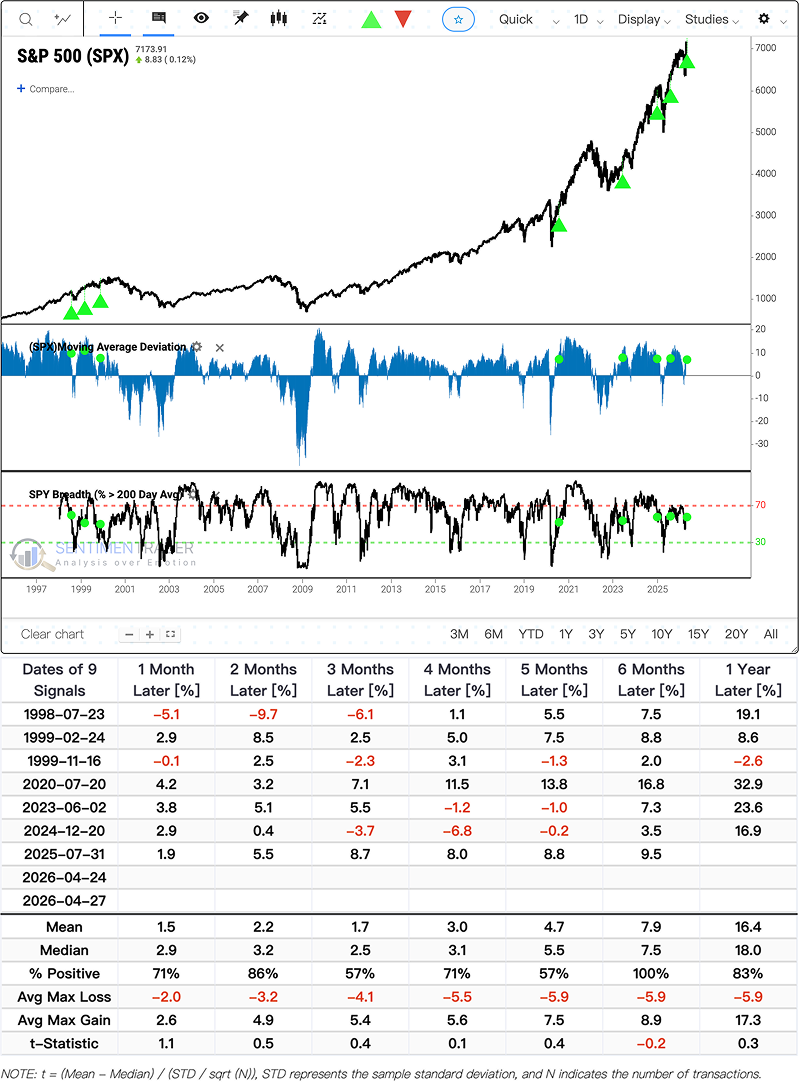
That bunching problem is real, though. Many of those 20 signals fired within days of each other, essentially counting the same market condition multiple times. Applying a 126-day cooldown - roughly six months between independent signals - trims the count to 9. The sample shrinks, but the signal quality improves. Six months after a cooldown-filtered trigger, the S&P was higher 100% of the time. A year later, 83% with a median return of +18.0%. Even the worst-case loss held at -5.9%. That's a small sample - treat it accordingly - but the direction is clear.Click here.
From fear to greed, fast
While breadth flags a participation gap, sentiment has swung to the other extreme. CNN's Fear & Greed Index recently surged to 81, completing a full round trip from below 10 to above 80. In late 2025, the index dipped into extreme fear territory. Six months later, it's back in greed. That's a full sentiment cycle - and it's happened 25 times since the index's inception in the late 1990s.
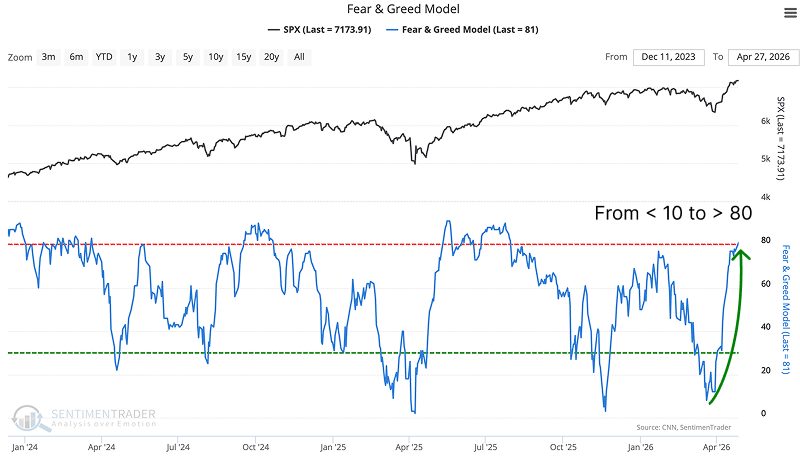
The historical track record after these cycles is mixed in the short run but tilts positive over longer horizons. One month after a completed F&G cycle, the S&P was higher just 58% of the time with a mean return of -0.4%. Two months out, it's a coin flip - 50% positive, essentially flat. The F&G model reaching 80 doesn't trigger a crash. It does suggest the easy money from the fear side has been made. Short-term returns are "meh" - not terrible, just uninspiring.
But patience gets rewarded. Six months out, the positive rate climbs to 71%, and a year later, 78% of signals saw the index higher. The median one-year gain was +10.0%, even though the mean was a more modest +6.6% - a few bad outliers dragged the average down. The worst average maximum loss at one year was -11.4%, which is not trivial. The range of outcomes is wide. For every 2009-style V-bottom that roared higher, there's a 2007 or early 2008 where the cycle completed right before things got ugly.Click here.
What the research tells us...
Two signals, two time horizons. The breadth divergence has historically resolved higher when price held above the 200-day. The F&G cycle's near-term caution is real, but the worst historical outcomes clustered around macro events - 2007, early 2008 - that have no clean parallel today. If breadth catches up to price rather than price catching down to breadth, the base rate favors staying long. We'll revisit in a month. If you're reading this the week of April 28, 2026, give it at least until mid-May before drawing conclusions.