
The Historical Implications of a NASDAQ Breadth Thrust

Key points:
- A "Breadth Thrust" detects market momentum, and typically involves a large number of stocks advancing over a given period relative to the number of stocks declining over the same period
- Two well-known breadth thrust indicators are the Zweig Breadth Thrust and Deemer Breakaway Momentum
- Another such measure that fewer investors are aware of is something I refer to as NASDAQ Breadth Thrust; It recently fired a new signal
A NASDAQ Breadth Thrust Defined
I define a NASDAQ Breadth Thrust (heretofore NBT) as follows:
A = Daily NASDAQ Advances
B = Daily NASDAQ Declines
C = 10-day total of A
D = 10-day total of B
E = ((C/ (C + D)) * 100)
Variable E is simply the percentage of total advances in the last 10 trading days divided by the total of advances and declines.
A new NBT occurs when Variable E closes a day at 62% or higher. A new NBT occurred on April 14th, 2026. Does it matter?
To address the potential significance, let's consider only the first NBT in any 12 months.
Market Action following the first NASDAQ Breadth Thrust in a year
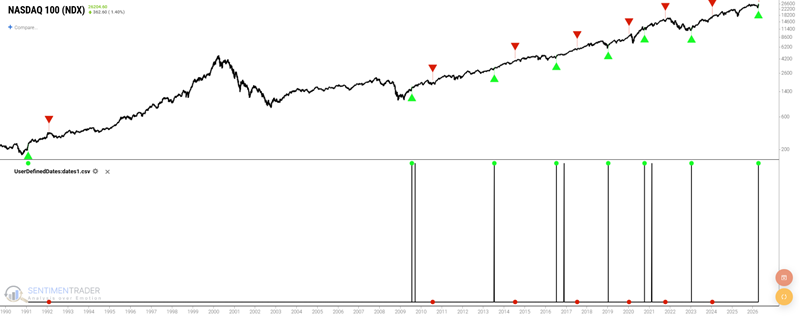
Let's take a closer look at Backtest Edge. The chart below displays all NBT (1st in 12-month) signals. The green up arrow highlights the date of the first NASDAQ Breadth Thrust in a 12-month period, and the red down arrow appears 252 trading days (i.e., 1 year) later.
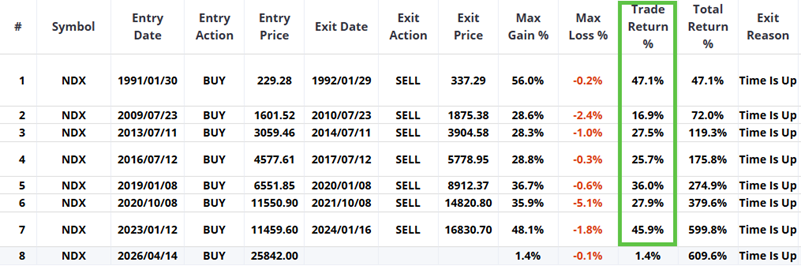
The table below shows Max Gain %, Max Loss %, and total Return % for each signal.
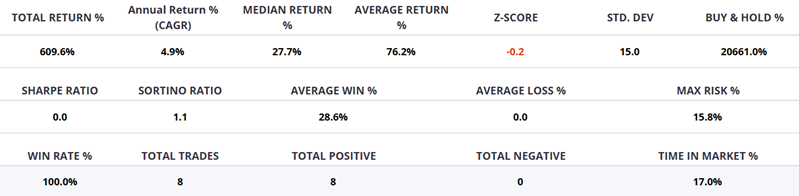
The table below summarizes the results of previous signals.
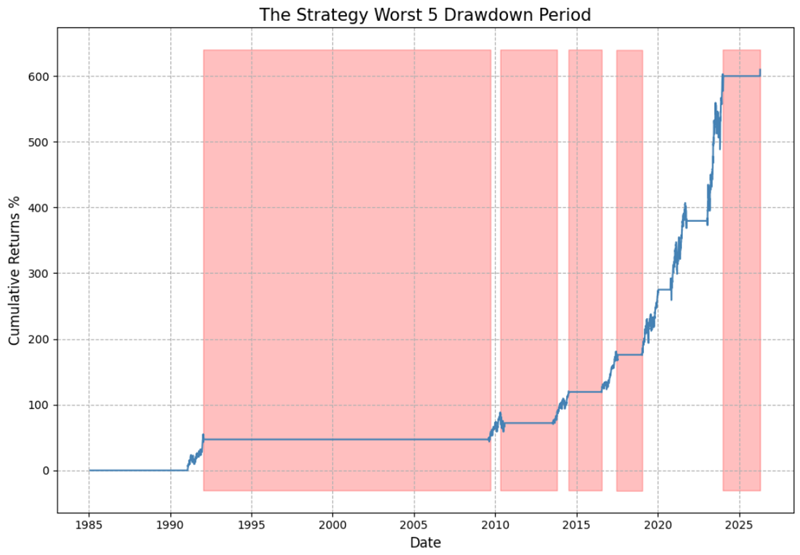
The chart below shows the hypothetical cumulative % gain achieved by holding the Nasdaq 100 Index for 252 trading days after every previous NBT (1st in 12-month) signals.
The next table summarizes the Nasdaq 100 Index performance in the year after each signal highlighted above. The results are compelling.
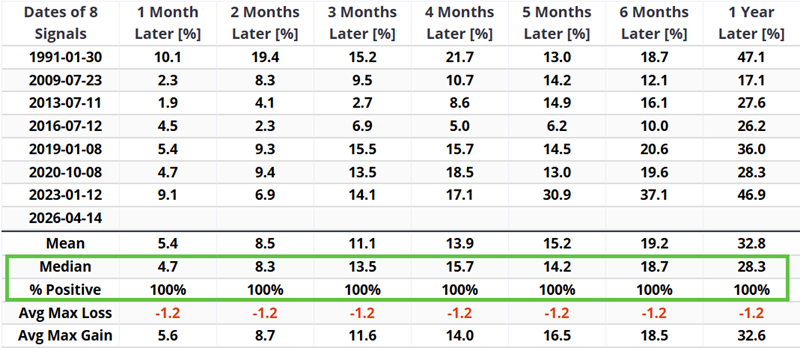
The next table shows the maximum gain and maximum loss for each time period in the first year after a signal.
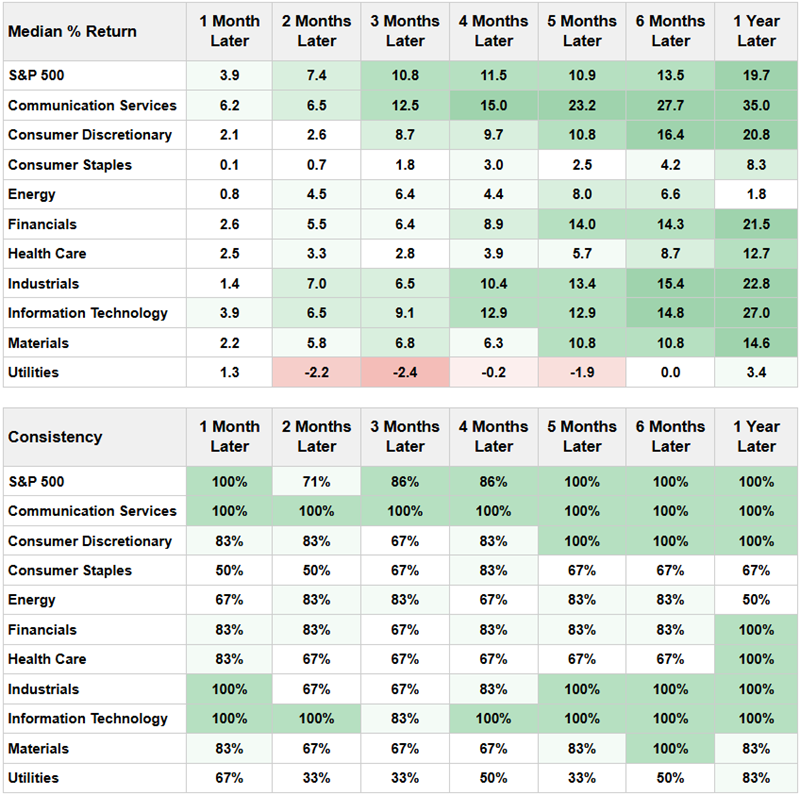
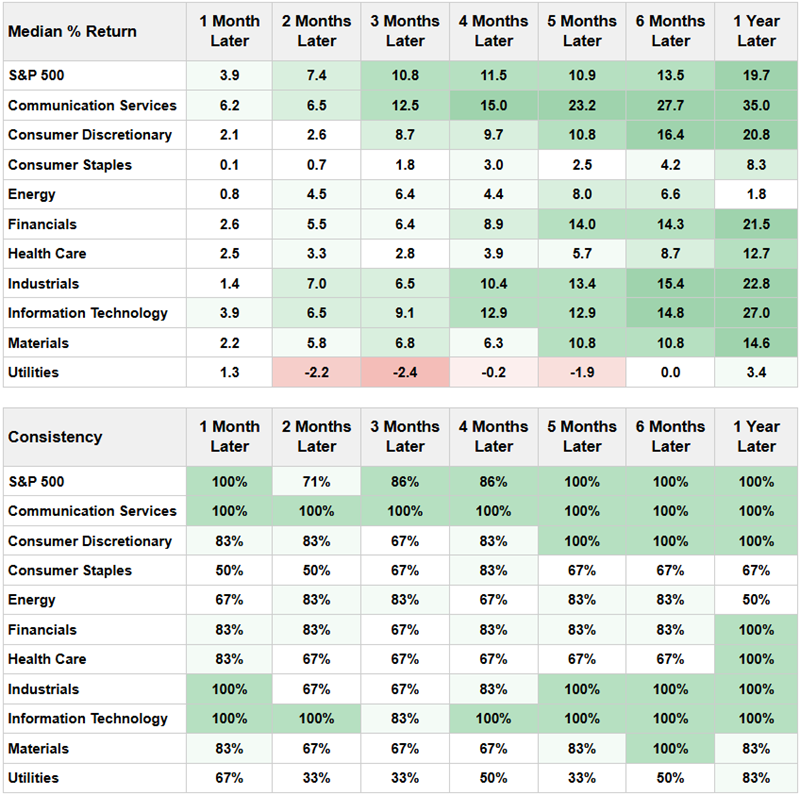
The table below summarizes the performance of the S&P 500 Industry Groups following previous NBT signals.
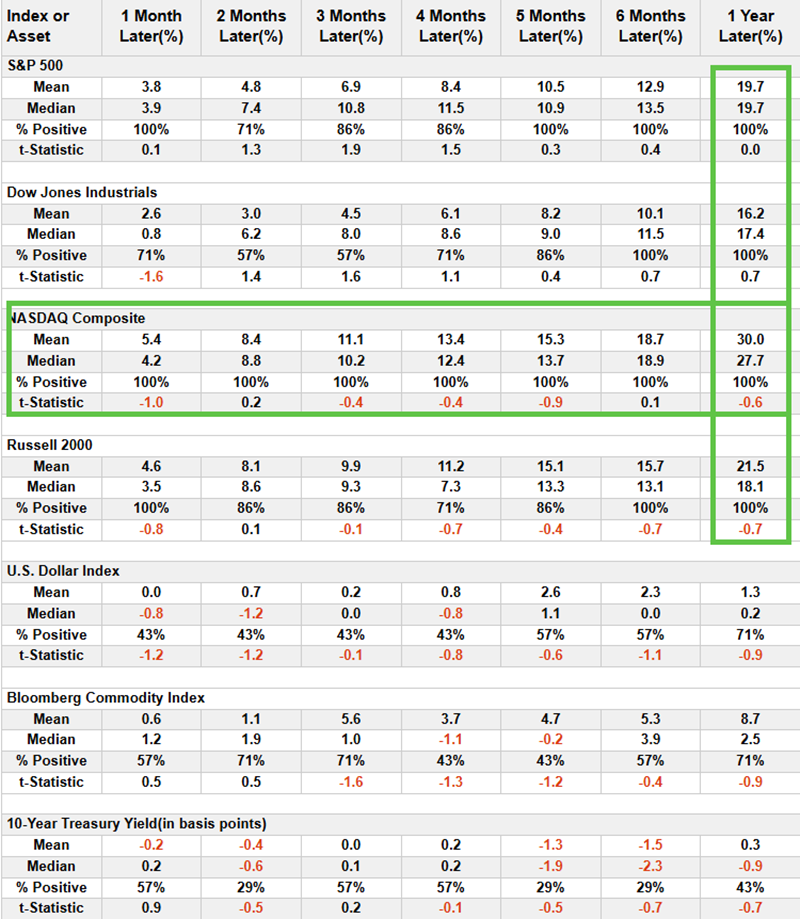
Lastly, the following table summarizes performance for a variety of major indexes following the NBT dates highlighted above. Note that the Nasdaq 100 index has historically outperformed other major stock indexes, such as the S&P 500 and Russell 2000. Note, however, that there is no guarantee that this trend will occur each time a new NBT is issued.
A technical note
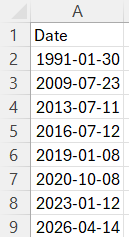
NASDAQ Breadth Thrust, as defined above, is not presently available as a standalone indicator on the website. I keep a database of Nasdaq advances and declines in a spreadsheet and use that to generate the signal. I created the backtest above in BacktestEdge by adding the dates shown below (in the YYYY-MM-DD format) to a CSV file and saving it as Dates1.csv. I then selected "User Defined Dates" as the "Entry Criteria" and selected the CSV file containing the signal dates.
You should be able to access the results by selecting "Backtest Edge/Backtest List/Analysts Backtests" in BacktestEdge.
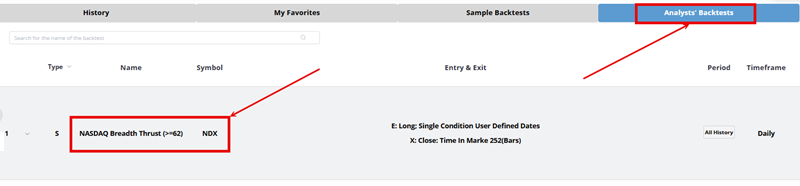
If not, you can create a CSV file containing the dates shown above. Then, under Backtest Edge/Backtest Setup, select "User Defined Dates" as "Entry Criteria" and import the file. Then run the test.

Maybe corporate insiders weren't so crazy after all
In my X feed, I have been noting for some time that insiders among the companies that comprise the Nasdaq 100 Index have been buying heavily even as the index itself has been lagging.
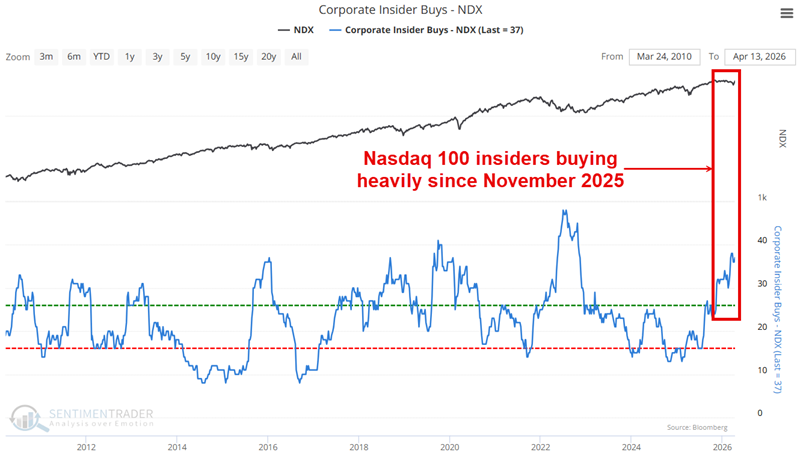
I have also been asking, "Are they crazy, or do they see something that many others do not?" It's too soon to answer that question definitively. But the recent NBT offers a clue.
What the research tells us…
The good news is that a true breadth thrust has historically been one of the most favorable signals for stock investors. The bad news is that there is absolutely no guarantee that the recent Nasdaq Breadth Thrust will be followed by the same type of results highlighted above. Nevertheless, history clearly suggests that investors continue to give the bullish case the benefit of the doubt as long as price action holds up and confirms this re-emerging favorable trend.