Products
SentimenTrader Trading Tools
‍
Backtest Engine
My Trading Toolkit
Correlation Analysis
Seasonality
Indicators & Data API
‍
Proprietary Indicators & Charts
Market Data API
Strategies & Scanner
‍
50+ Trading Strategies
Smart Stock Scanner
Research Reports
‍
Research Solutions
Reports Library
Free Resources
Simple Backtest Calculator
Simple Seasonality Calculator
The Kelly Criterion Calculator
Sentiment Geo Map
Public Research Reports
Education
Sentiment Indicators
Technical Indicators
Pricing
Company
About
In the News
Testimonials
Client Success Stories
Contact
Log inLoginSign up
< BACK TO ALL REPORTS

The first 100 days go to the bulls

Jason Goepfert
2024-05-22
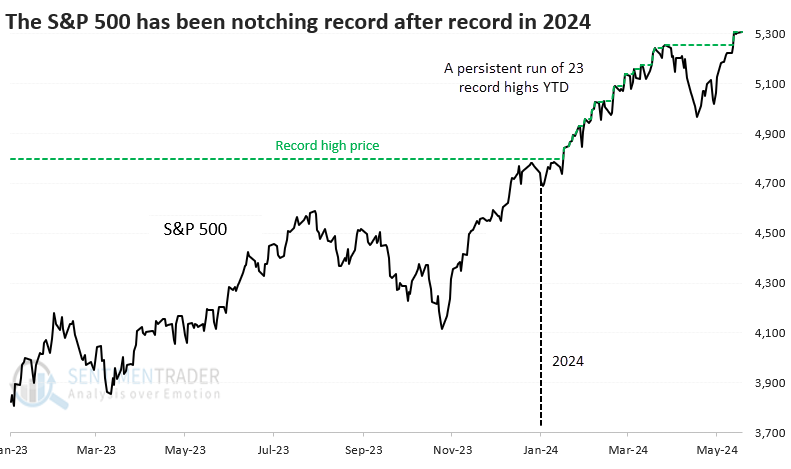
Stocks are about to close out the first 100 days of the year with a bevy of record closes. The S&P 500 has notched more than 20 of them during the 100 days, among the strongest starts since 1928. Other super strong starts, with many record closes, tended to see further gains into year-end.

Key points:

  • The S&P 500 has notched more than 20 record closes during the first 100 days of the year
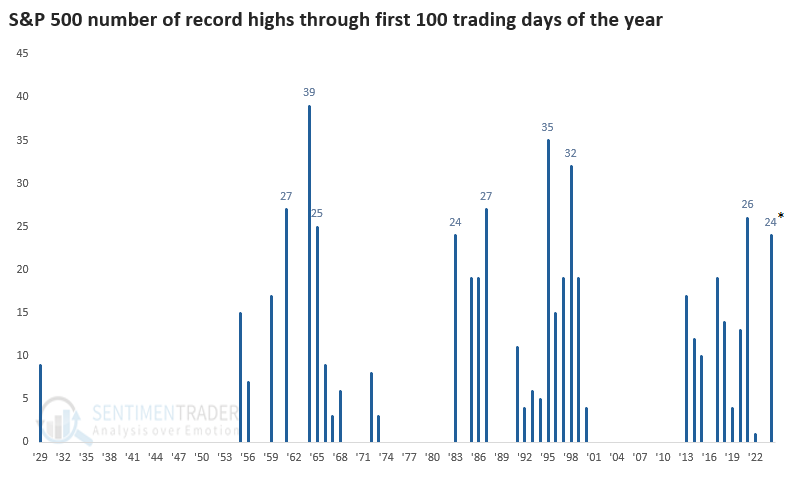
  • This makes 2024 one of the best-ever starts to the year since 1928
  • Other strong starts, with many record highs in the first 100 days, tended to see further gains into year-end

A hundred days to remember

Tomorrow, the market will reach the 100-day mark of the year. And what a year it's been for the most benchmarked equity index in the world, as the S&P 500 has set (at least) 24 record high closes during these 100 days.
This year qualifies as one of the best since 1928 in terms of persistent record highs. Only a handful of other years have matched or exceeded this performance, including only one over the past 25 years.
Strong starts = strong finishes (usually)

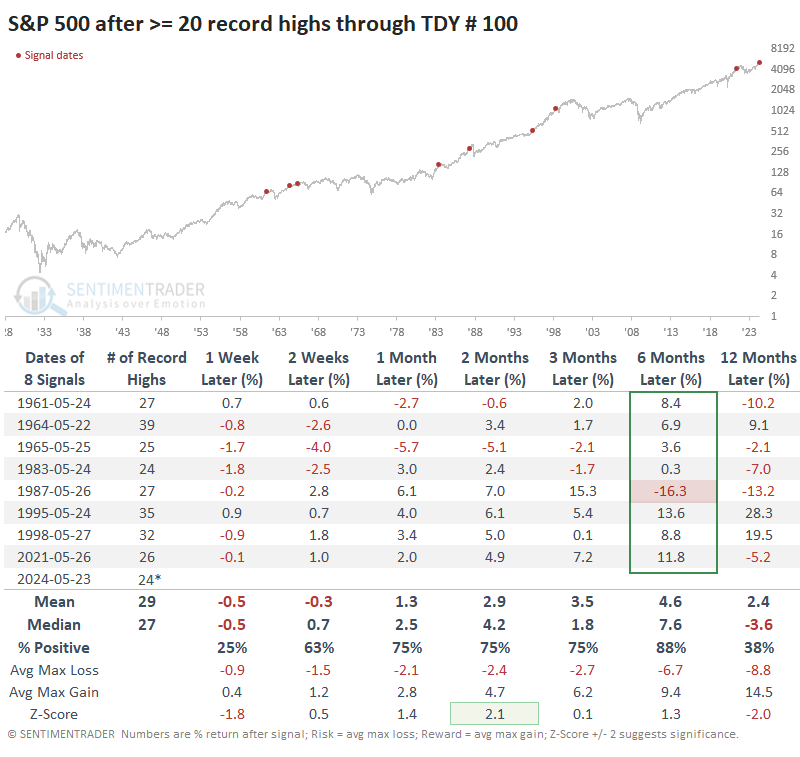
The table below shows each year that notched 20 or more record highs through the first 100 trading days of the year. The current year has an asterisk as the S&P may add to the total before Friday.

The first week after the 100-day mark showed some weakness, and none of the signals went gangbusters during the first week or two. But that was about it for weakness, at least over the summer months. During the next two to three months, there were some isolated weak returns but nothing significant through year-end (roughly the 6-month time frame). Only the 1987 crash interrupted what would have been a perfect record.
If we relax the parameters to look at years that enjoyed at least 15 record highs through the first 100 days, the biases persisted - weak in the very short term but strong into year-end. Over the next six months, only 2 signals out of 17 suffered a loss.
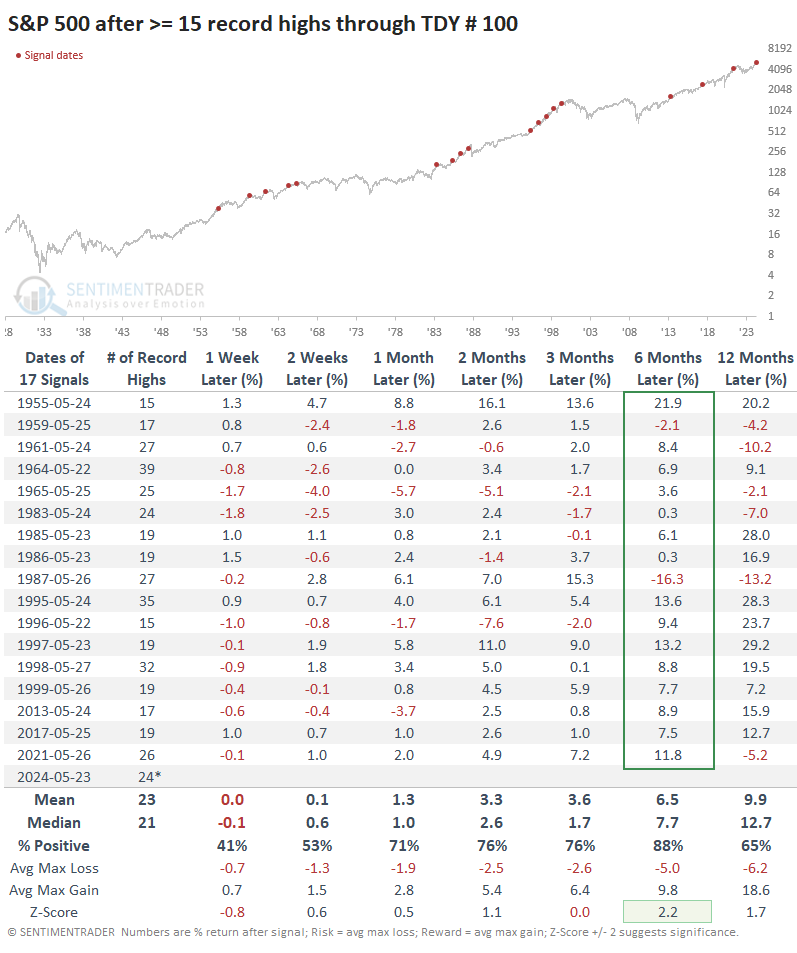
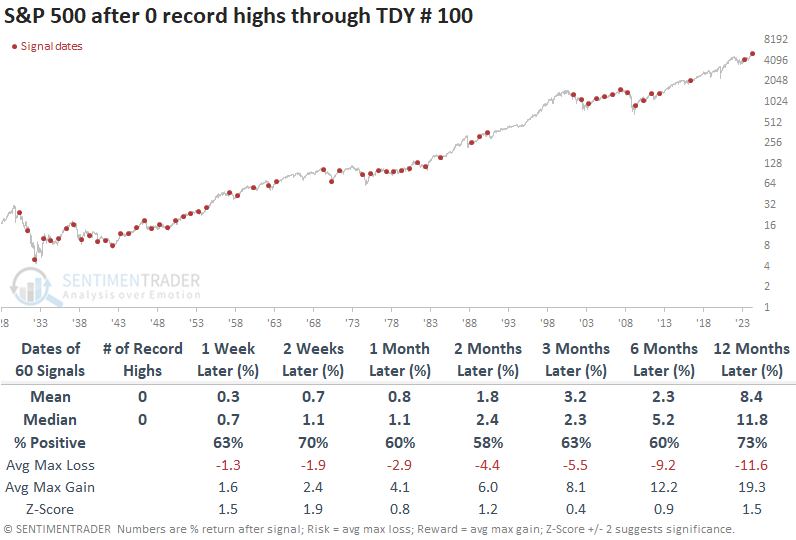
When we compare those returns to years when the S&P didn't manage any record highs during the first 100 sessions, the good starts underperformed in the short term but outperformed after that. After good 100-day starts, the S&P rallied into year-end 88% of the time compared to only 60% after bad starts, with significantly less risk.
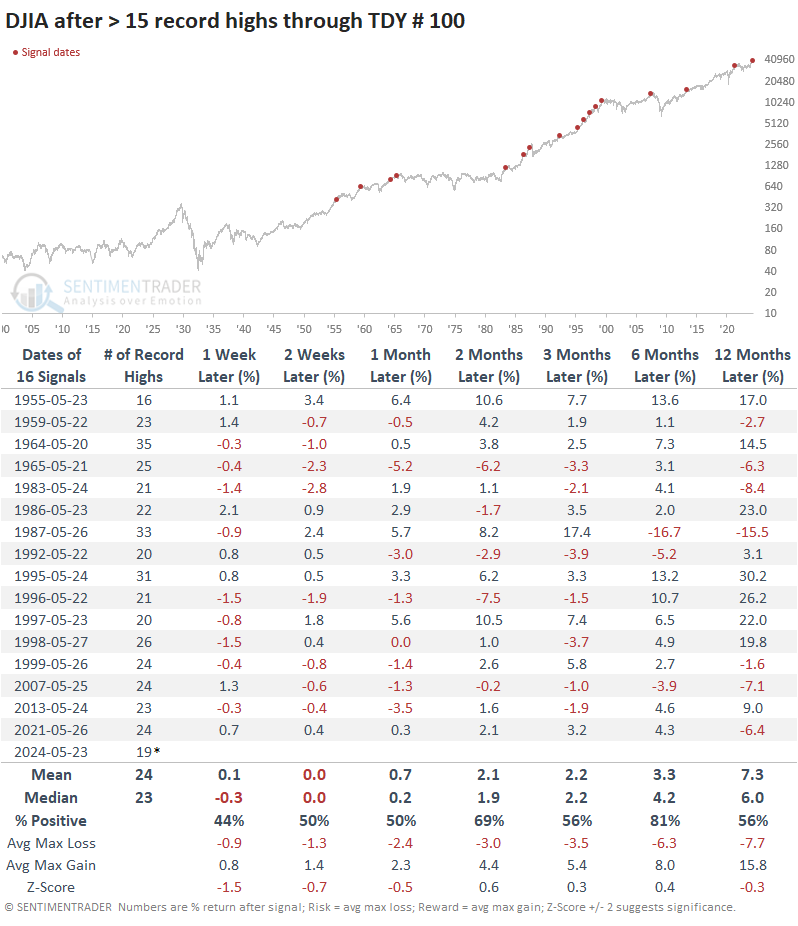
The Dow Jones Industrial Average has also recorded an impressive number of record highs during its first 100 days of the year. Like the S&P 500, the Dow showed weak returns in the short term but consistently rallied into year-end. Of the three losses, only one was much larger than -5%.
What the research tells us...

Over the past year and a half, we have shown many momentum studies, virtually all showing larger-than-average and more consistent-than-average returns over medium to long time frames. When stocks exhibit strong momentum, it often runs roughshod over sentiment extremes, and we've seen that during this latest cycle.

An excellent start to a year can be added to these momentum studies as a bullish data point. It's not as strong or consistent as many of the others we've looked at, but it is enough to be compelling into year-end.

Sorry, you don't have access to this report

Upgrade your subscription plan to get access
Go to Dasboard
PRODUCTS
SentimenTrader
Trading Tools
Indicators & Data API
‍
Strategies & Scanner
‍
Research Reports
FREE
RESOUrCES
Simple Backtest
Calculator
Simple Seasonality
Calculator
The Kelly Criterion
Calculator
Sentiment Geo Map
‍
Public Research Reports
‍
Education
Sentiment Indicators
‍
Technical Indicators
‍
Pricing
Bundle pricing
‍
FAQ
‍
Announcements
‍
COMPANY
‍
About
‍
In the News
‍
Testimonials
‍
Client Success Stories
CONTACT
‍
General Inquiries
‍
Media Inquiries
‍
Financial Professionals Inquiries
‍
© 2025 Sundial Capital Research Inc. All rights reserved.
Setsail Marketing
TermsPrivacyAffiliate Program
Risk Disclosure: Futures and forex trading contains substantial risk and is not for every investor. An investor could potentially lose all or more than the initial investment. Risk capital is money that can be lost without jeopardizing ones’ financial security or life style. Only risk capital should be used for trading and only those with sufficient risk capital should consider trading. Past performance is not necessarily indicative of future results.

Hypothetical Performance Disclosure: Hypothetical performance results have many inherent limitations, some of which are described below. No representation is being made that any account will or is likely to achieve profits or losses similar to those shown; in fact, there are frequently sharp differences between hypothetical performance results and the actual results subsequently achieved by any particular trading program. One of the limitations of hypothetical performance results is that they are generally prepared with the benefit of hindsight. In addition, hypothetical trading does not involve financial risk, and no hypothetical trading record can completely account for the impact of financial risk of actual trading. for example, the ability to withstand losses or to adhere to a particular trading program in spite of trading losses are material points which can also adversely affect actual trading results. There are numerous other factors related to the markets in general or to the implementation of any specific trading program which cannot be fully accounted for in the preparation of hypothetical performance results and all which can adversely affect trading results.

Testimonial Disclosure: Testimonials appearing on this website may not be representative of other clients or customers and is not a guarantee of future performance or success.