
The Financials triggered a breadth thrust buy signal

Key points:
- A breadth composite for the S&P 500 Financials triggered a buy signal, indicating broad participation
- Comparable thrusts near a high produced solid returns and consistency over the next year
- The capital markets ETF (KCE) contains numerous stocks with a bullish trend score condition
A resurgence of internal strength within financials validates the index's turnaround
Last week, I highlighted a rare breakdown reversal signal in the S&P 500 Financials sector, marking a bullish shift for the group. This rapid turnaround was supported by widespread stock participation, as a composite tracking multi-duration trends surged, activating a powerful thrust signal.
An alert is activated when the breadth composite rises by 38% over one week. Although this signal is often observed following more significant corrections, this latest instance occurred with Financials down less than 5% below their recent high, a critical piece of context.
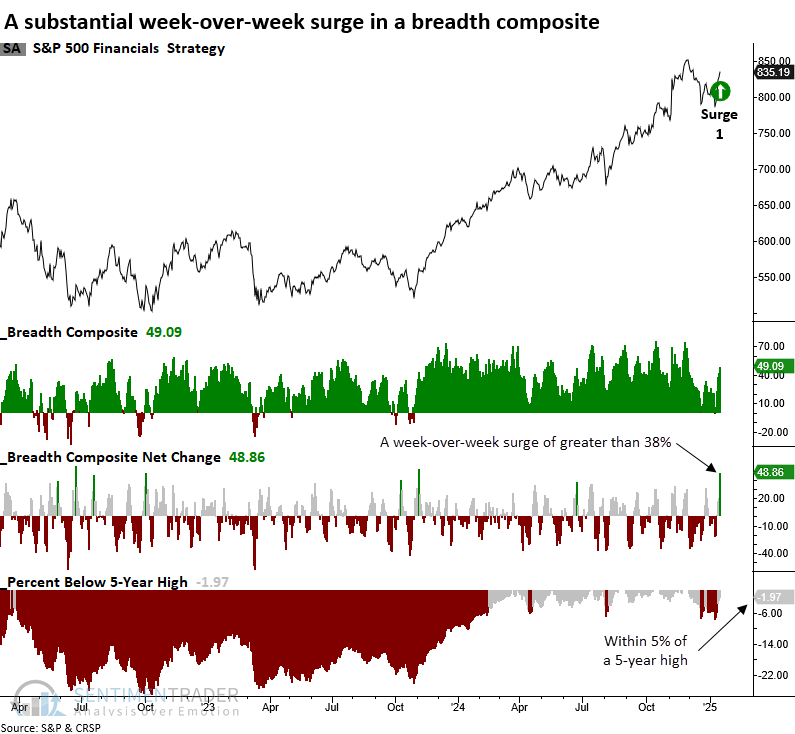
Two supplementary conditions are required in the breadth composite system. First, the composite must decline below a reading of 5%, indicative of weak breadth commonly associated with oversold conditions. The second is that the thrust signal must occur within two months of this reset to reflect precedents observed near such weak breadth scenarios.
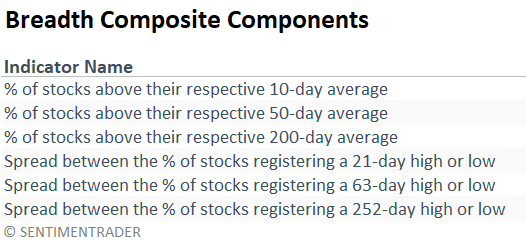
For your reference, the table below lists the components of the breadth composite.
Similar breadth composite thrusts preceded positive returns
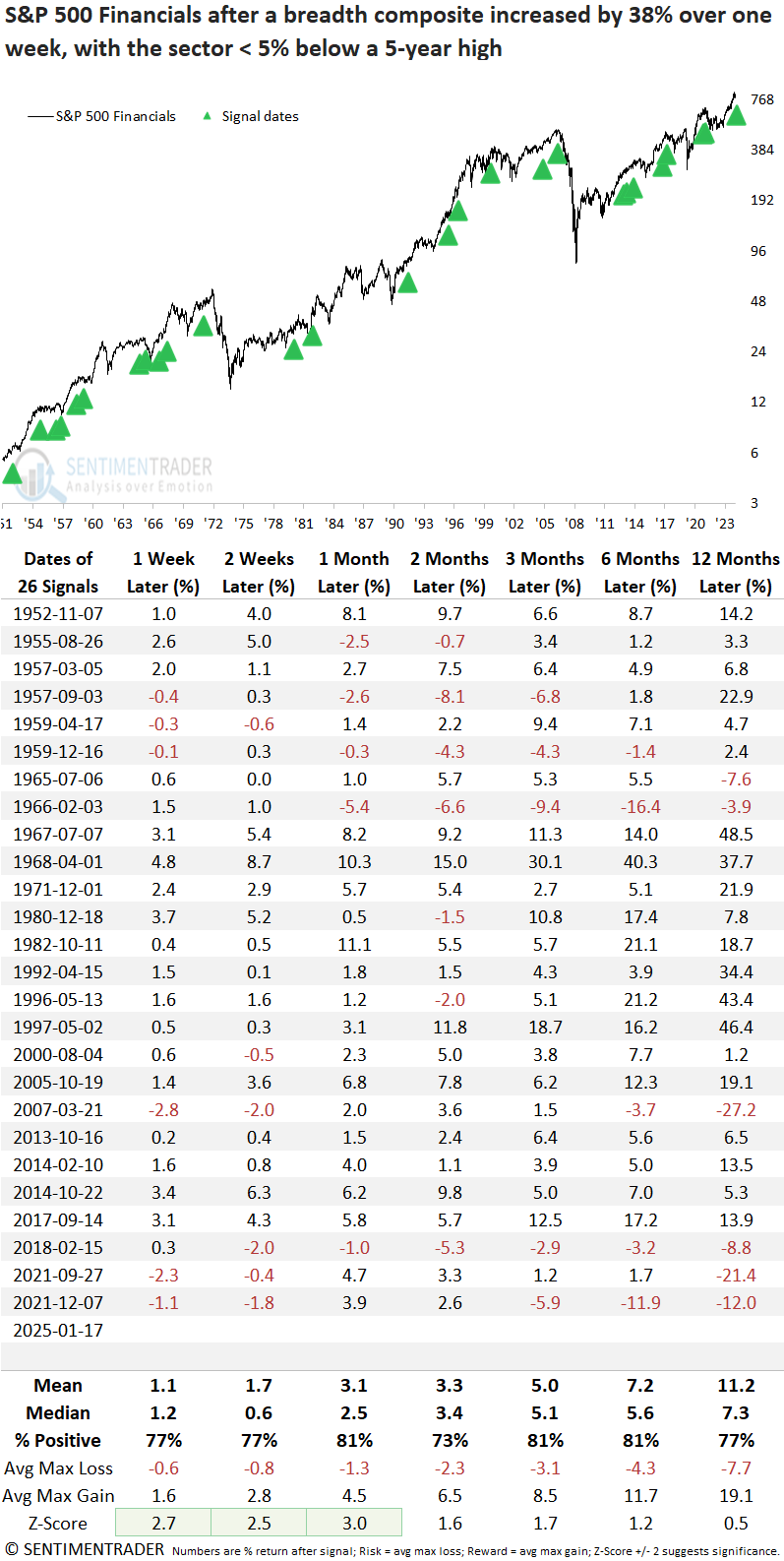
The S&P 500 Financial sector demonstrated excellent returns and consistency over the subsequent year when the week-over-week change in its breadth composite surged above 38%, and the group was within 5% of a 5-year high.
This effect was most pronounced in the near term, with returns exhibiting statistical significance compared to random outcomes one to four weeks later. Notably, the one-month horizon demonstrated remarkable consistency, achieving 15 consecutive winners between 1967 and 2017 and recording 17 gains out of 18 occurrences since 1967.
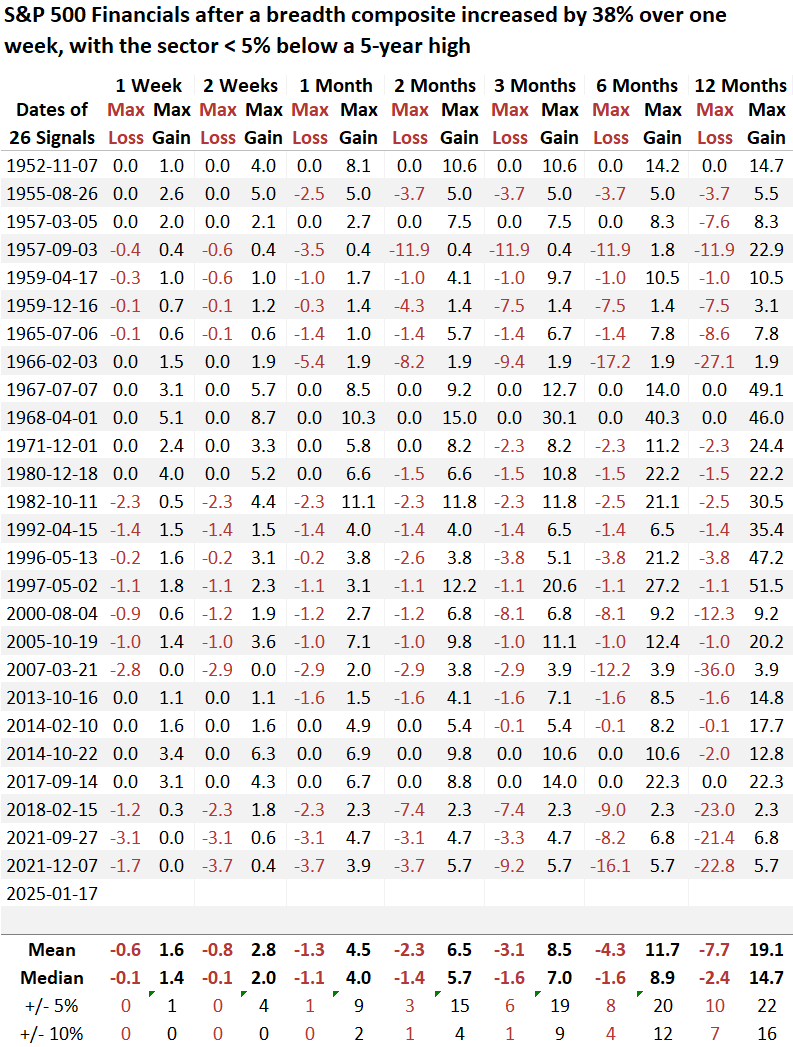
Over the subsequent two months, the S&P 500 Financials recorded three maximum losses of over 5%, with just one exceeding 10%, a rare occurrence last seen in 1957.
The relative trend timing system favors Financials
The relative strength timing system featured on our strategies page has maintained a "buy signal" for financials since July 2024, indicating a favorable tailwind for the group.
As I mentioned last week, financials present the most compelling alternative to the current growth-heavy stock environment.
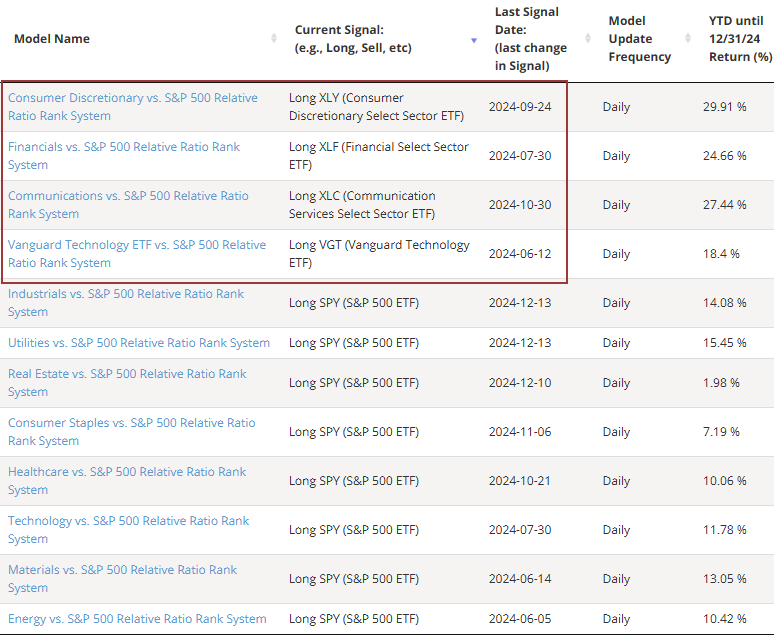
A bottoms-up assessment of trend scores displays a favorable backdrop for the financial sector
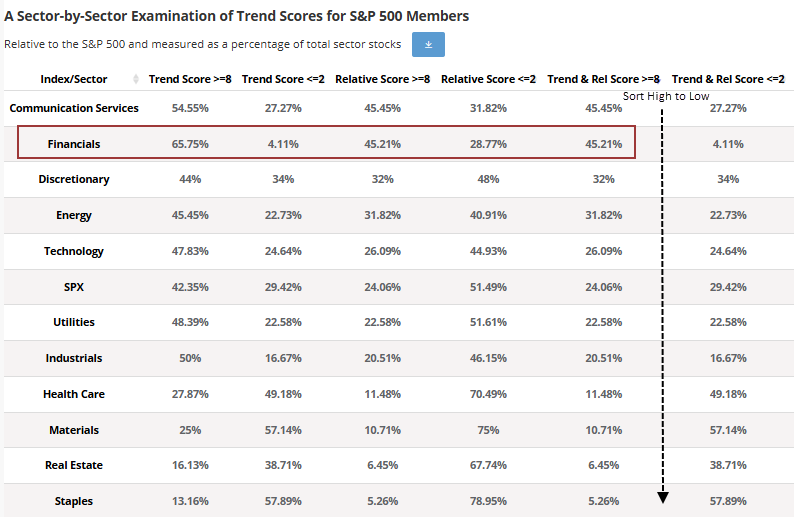
According to the website's trend score sector summary page, the S&P 500 Financial sector boasts the second-highest percentage of stocks with a trend and relative trend score of eight or higher, narrowly outpaced by Communication Services.
Trend score system applied to the capital markets ETF (KCE)
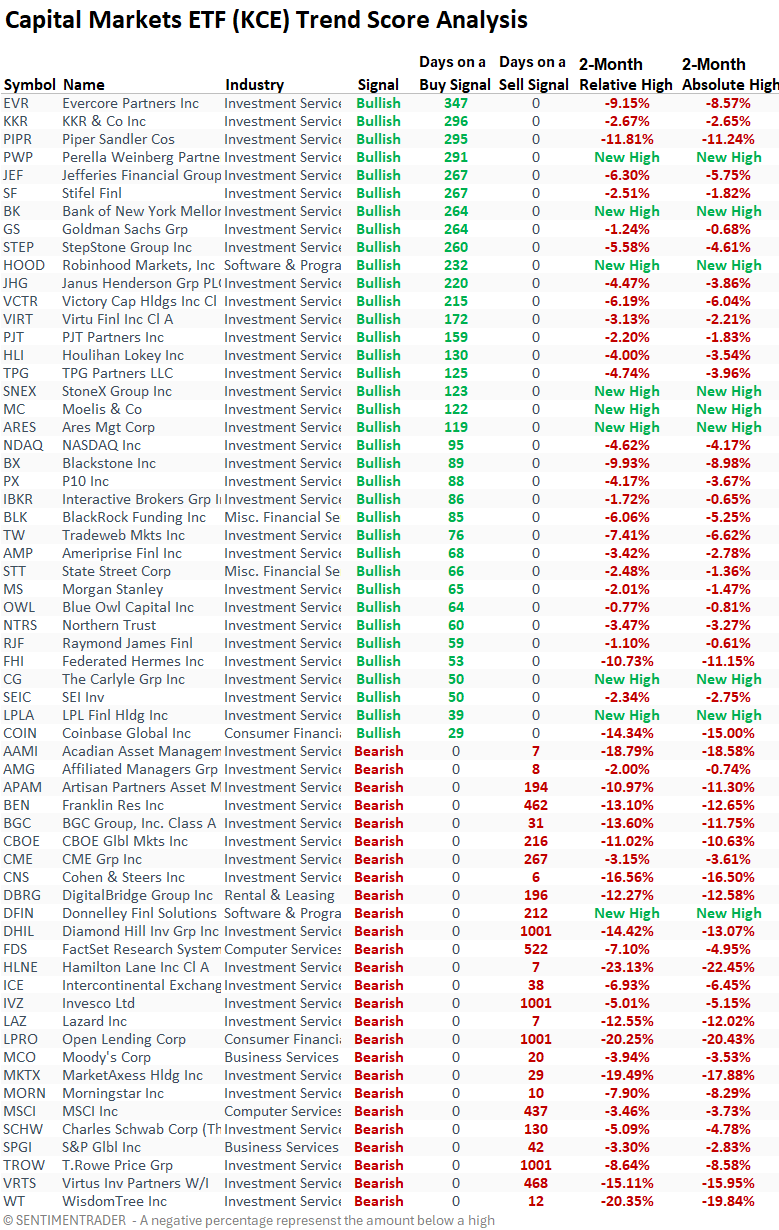
The Capital Markets ETF (KCE) offers a diverse array of financial sector stocks, spanning investment banking, asset management (traditional and alternative), exchanges, and other financial services, a potentially valuable resource for idea generation that could benefit from less regulation under the new administration.
When I apply my trend score system to the members within the KCE ETF, it shows 36 out of 62 stocks on a "bullish signal," with the latest alert triggering on Coinbase 29 trading sessions ago. Several of the stocks are registering 2-month absolute and relative highs today. Those include PWP, BK, HOOD, SNEX, MC, ARES, CG, LPLA, and DFIN.
Evercore Partners (EVR) has sustained a bullish signal for 347 sessions, delivering a 99.75% gain compared to the S&P 500's 32.79%, underscoring the advantages of targeting stocks with strong absolute and relative trends. Meanwhile, KKR has posted an even more outstanding return during its bullish signal, advancing 136.49% versus the S&P 500's 33.39%.
What the research tells us...
A breadth composite for the S&P 500 Financials triggered a thrust alert, indicating robust participation from stocks within the sector. Comparable signals produced excellent returns and consistency for financials over the following year. That was especially the case in the near term, where returns displayed significance relative to random returns from one to four weeks later. Several stocks within the capital markets ETF (KCE) maintain a bullish trend condition, offering ample opportunities for an industry that could benefit from deregulation.