
The Big Money has left the stock market

Key points:
- A semi-annual poll of large money managers shows that they are pessimistic on stocks
- This is the 2nd-lowest bullish reading in the survey's 23-year history
- Stocks tend to perform much better when these managers are optimistic
The Big Money is fleeing stocks again
The latest semi-annual poll of large money managers from Barron's showed a sharp drop in bulls. The survey represents the attitudes of hundreds of managers with influence over hundreds of billions of dollars under management.
While half of them were optimistic about the prospects for stocks last October, only a third of them are now. That's the 2nd-lowest percentage of bulls in the survey's history, next to October 2019, when only 27% of managers were bullish.
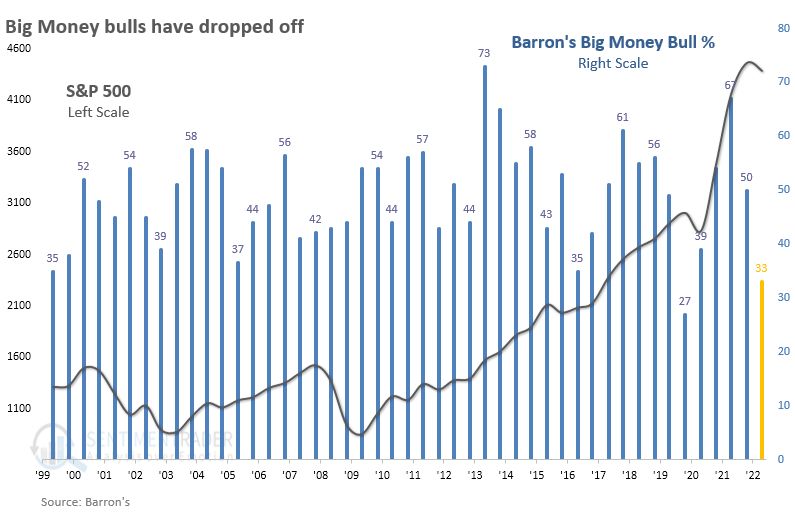
Even though they're not optimistic, they still expect the S&P 500 to gain nearly 9% from mid-April through December. That's par for the course - they almost always expect the S&P to gain about 7% over the next six months.
The percentage of bears rose, so the net difference between bullish and bearish managers plunged from +38% to only +11%, again the 2nd-lowest reading in 23 years.
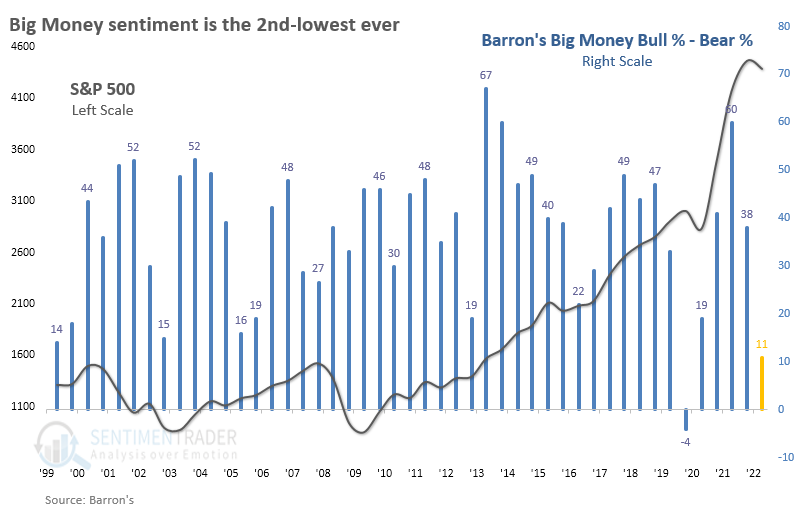
We've looked at this survey many times over the years, concluding that the managers can be a slight contrary indicator at extremes, but it's not a decisive edge. While some of the market's better long-term returns came after depressed sentiment, the S&P 500 performed better when managers were bullish and worse when they were bearish.
The table below shows the S&P's returns from one survey to the next, about six months apart. The first three columns show the survey dates with the lowest percentage of bullish managers, and the next three show the dates with the most bullish.
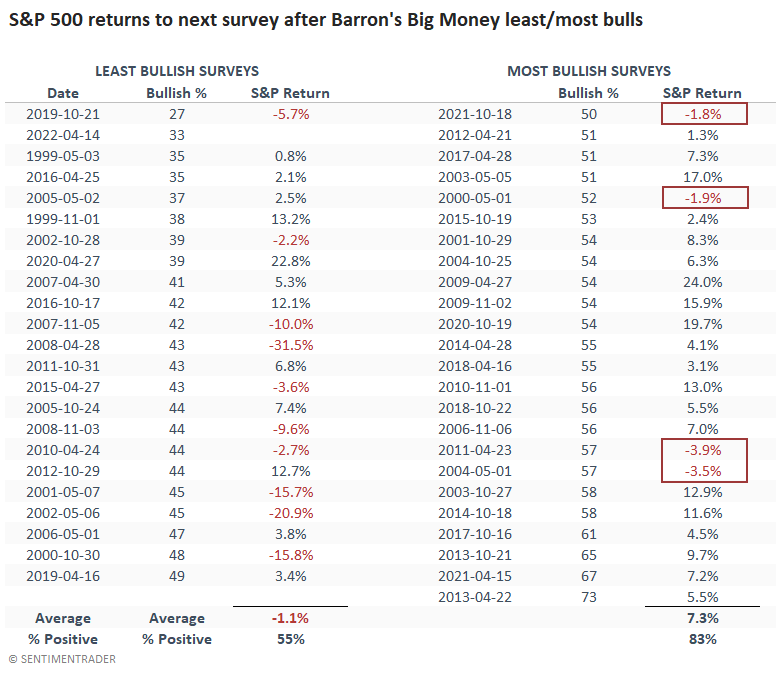
There was a clear difference in overall performance during the next half-year. When fewer than half of managers were optimistic, the S&P 500 returned an average of -1.1% and showed a positive return 55% of the time. The worst losses came when managers were not inclined to step in and buy.
But when more than half of managers were bullish, the index jumped an average of +7.3%, with 83% of periods showing a positive return. Most notably, the losses were small, none more than -4%.
What the research tells us...
Investors always seem to have a knee-jerk contrarian response to any survey of other investors. Maybe it's an inherent need to feel superior to others, even though the vast majority are trend-followers when actually putting money to work. People want to feel superior, but they need to be comforted by a crowd. When it comes to the kinds of large money managers surveyed by Barron's, there is compelling evidence that we should avoid this tendency in ourselves and not take their current pessimism as a sign that we should feel more optimistic. Quite the opposite, in fact. If those with influence over such large piles of money do not feel inclined to buy the dip, then stocks tend to struggle much more than when those people are feeling better about things. Add this to the pile of recent headwinds.