
Technology looks poised to continue its winning ways

Key points:
- Over the last four months, the cap-weighted Tech sector outperformed the equal-weighted version by 14%
- After similar divergences, both the cap and equal-weighted indexes showed strong results
- When the performance gap widens like now, the equal-weighted Technology index outperforms
Should we be concerned about the performance variance within Technology
I continue to see charts and comments about the narrow market breadth environment and how only a handful of stocks are responsible for the YTD gains in the S&P 500. While it's difficult to disagree with some of the concerns, I rarely, if ever, see the narrative-driven crowd apply a signal to the data so we can see what it means.
The latest topic du jour is the growing performance disparity between the cap-weighted S&P 500 Technology sector and the equal-weighted version. Once again, the narrative is this can't be good on a go-forward basis because only a handful of Technology stocks are pushing the index up.
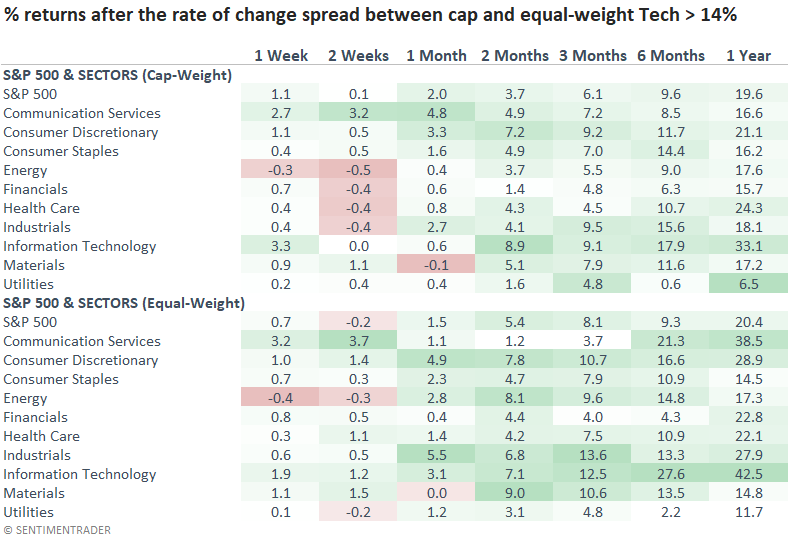
Over the last four months, the rate of change spread between the cap-weighted S&P 500 Technology sector and the equal-weighted S&P 500 Technology sector exceeded 14% for only the 16th time since 1960.
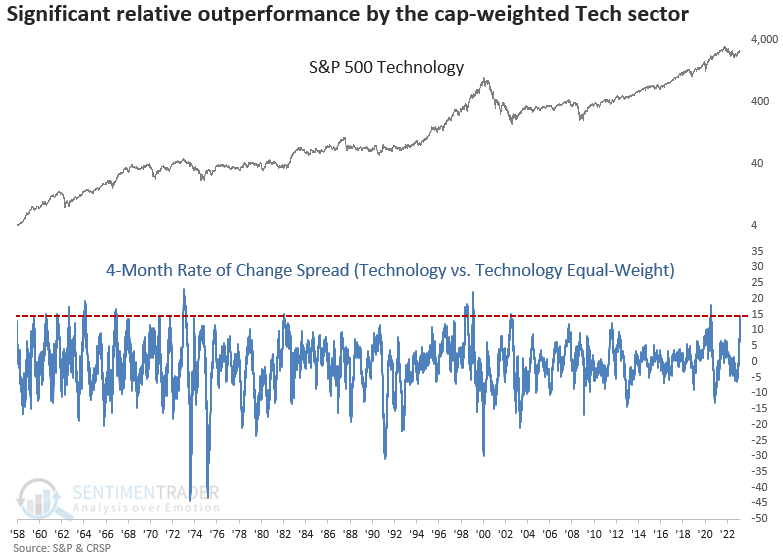
An equal-weighted index maintains an identical weighting for each member. In contrast, a market capitalization-weighted index holds an amount based on the company's size. i.e., Apple has a 7% weighting in the S&P 500 Index but only 0.2% in the equal-weighted version.
Similar rate of change signals preceded positive returns
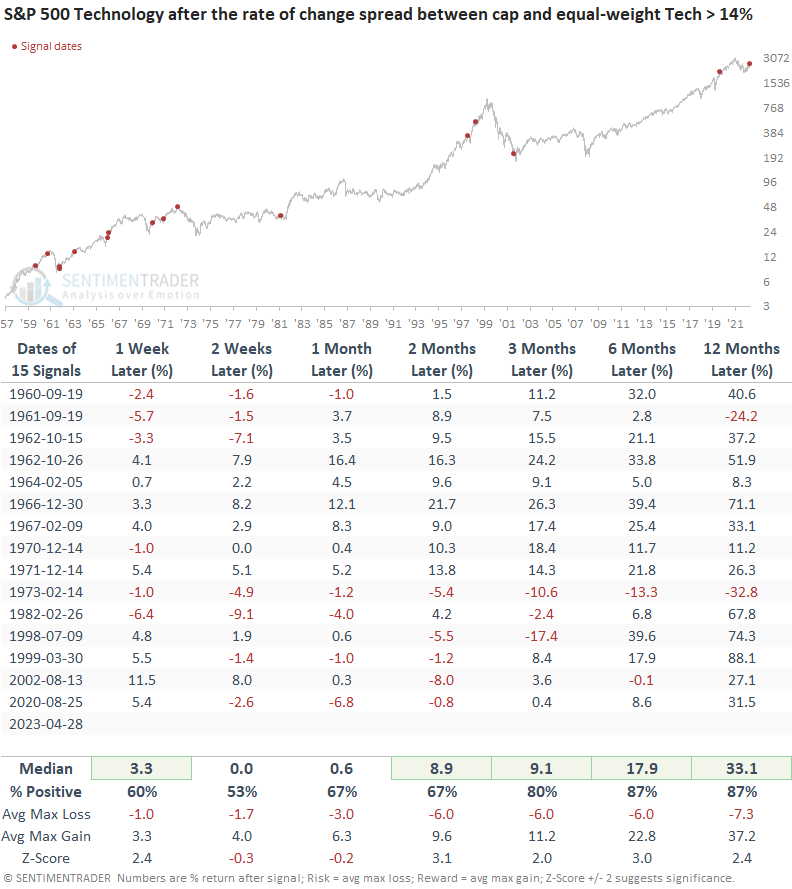
When the 4-month rate of change spread between the cap and equal-weighted Technology sectors exceeds 14%, forward returns and win rates for the cap-weighted index are excellent. The only instance to show a negative return across all time frames was the untimely signal in 1973.
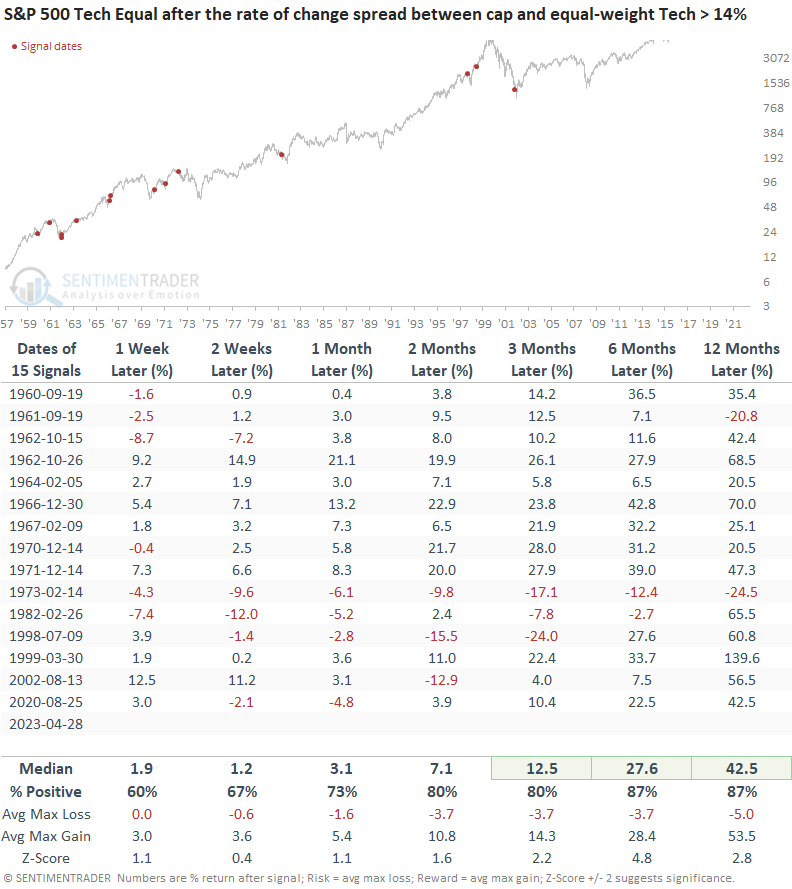
When I apply the signals to the equal-weighted Technology sector, win rates and returns look better across most time horizons. The median return over the six and twelve-month windows is notable compared to the cap-weighted version.
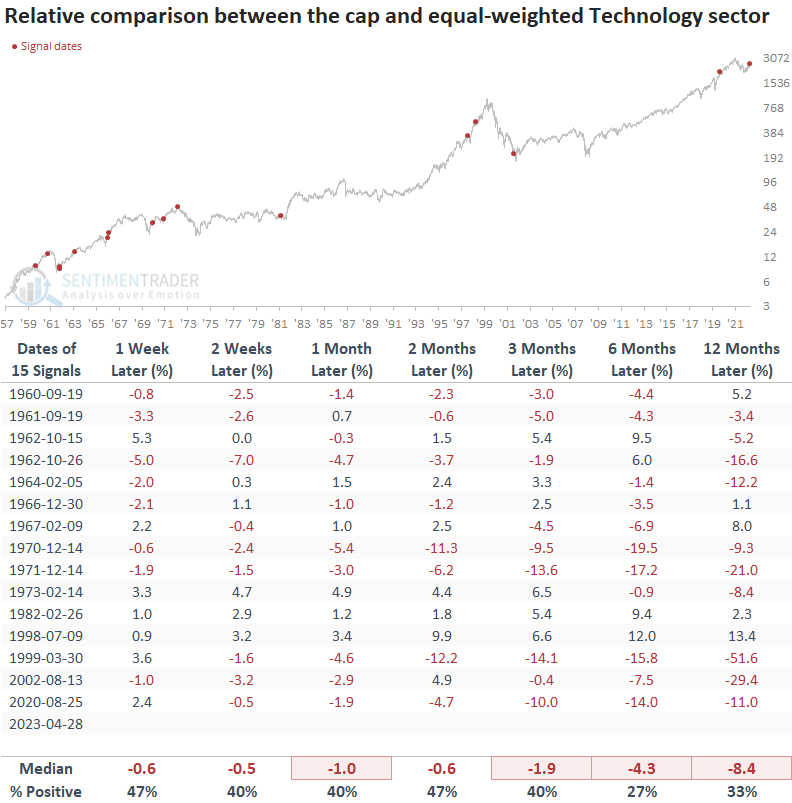
Suppose I net out the difference in returns between the two index weighting methodologies. In that case, the cap-weighted index underperforms the equal-weighted version across all time horizons.
So, if you're holding a cap-weighted Technology ETF like XLK, I would closely monitor the relative ratio between XLK and RYT, the equal-weighted Technology ETF, for a reversal in the ratio trend.
The market capitalization and equal-weighted Technology indexes outperform most other sectors across time.
The relative outperformance is especially noteworthy in the six and twelve-month horizons.
What the research tells us...
Investors crowded into mega-cap Technology stocks over the last four months, driving the performance disparity between the cap and equal-weighted Technology indexes to one of the widest margins in history. After similar performance gaps, Technology stocks rallied regardless of the index weighting methodology. However, from a comparative performance perspective, one would be better off holding the equal-weighted index.