Products
SentimenTrader Trading Tools
‍
Backtest Engine
My Trading Toolkit
Correlation Analysis
Seasonality
Market Prediction
Indicators & Data API
‍
Proprietary Indicators & Charts
Market Data API
Strategies & Scanner
‍
50+ Trading Strategies
Smart Stock Scanner
Smart Option Scanner
Research Reports
‍
Research Solutions
Reports Library
Free Resources
Simple Backtest Calculator
Simple Seasonality Calculator
The Kelly Criterion Calculator
Sentiment Geo Map
Public Research Reports
Education
Sentiment Indicators
Technical Indicators
Pricing
Company
About
In the News
Testimonials
Client Success Stories
Contact
Log inLoginSign up
< BACK TO ALL REPORTS

Tech rally brings new assets, and more ETFs

Jason Goepfert
2020-10-15
Technology stocks' dominance in 2020 has brought a lot of attention, and massive inflows to funds with large exposure. To meet this demand, fund companies have created new ETFs, which are dominating other types of funds. This is usually a long-term warning sign.

There's nothing like an established market trend to spur demand for MOAR. And when fund companies see that demand from investors, they will do whatever they can to supply it.

The breathtaking run in technology stocks has spurred Invesco, creator of the wildly popular QQQ exchange-traded fund, to create offshoots. As the Wall Street Journal notes (emphasis added):

"Invesco Ltd. is adding more Qs to its fund lineup, a wager by the world’s fourth-biggest issuer of exchange-traded products that investors’ love affair with technology stocks will continue."

We see this all the time. When a sector, or the market as a whole, does well, fund companies will create more ETFs, as we saw in the summer of 2015. Or the opposite - when a sector does poorly, then fund companies will quietly liquidate the funds or split the shares, like what happened with volatility ETFs in 2016.

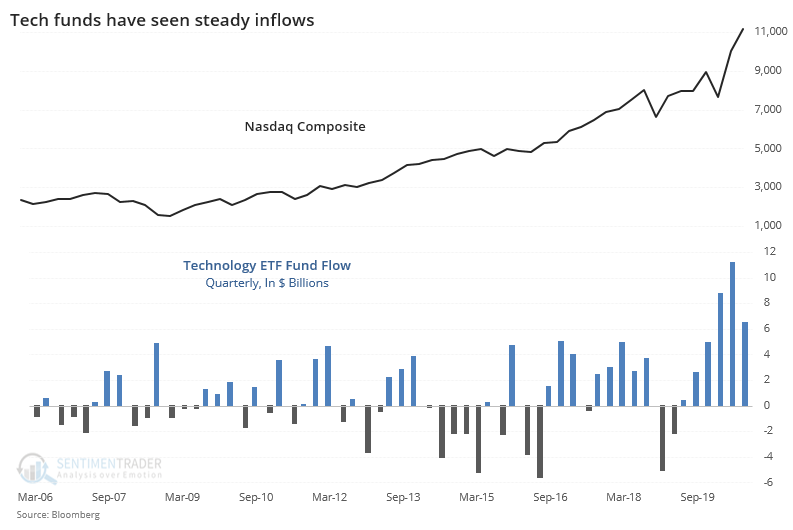
There has certainly been demand for anything tech-related. Flows into and out of QQQ have swung violently in 2020, but that isn't the only tech fund. As a sector, quarterly fund flows have soared this year.
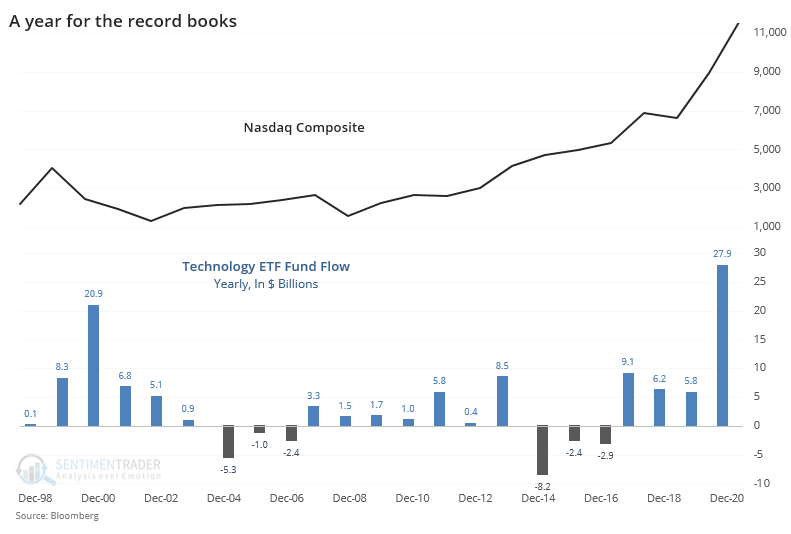
On a yearly basis, we've already surpassed 2000.
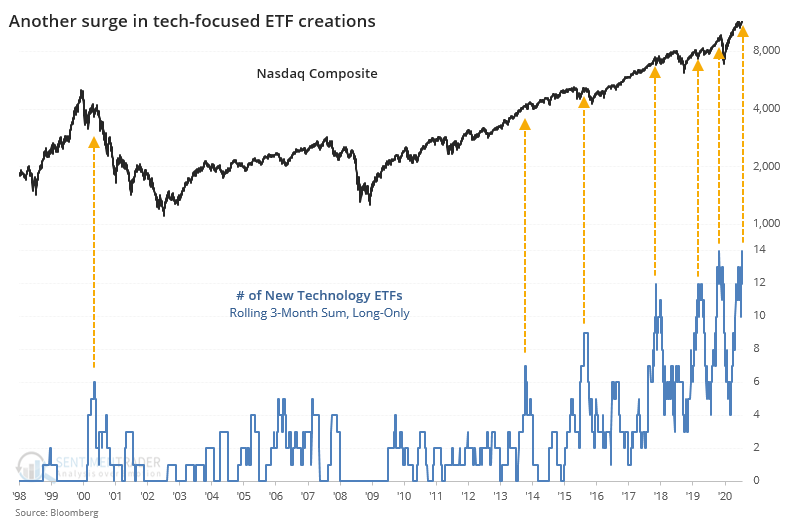
Because there is demand for tech stocks at the moment, fund companies are creating more ways to satiate that demand. Below, we can see a rolling 3-month sum of all new ETFs that explicitly have at least 25% exposure to the tech sector at inception.
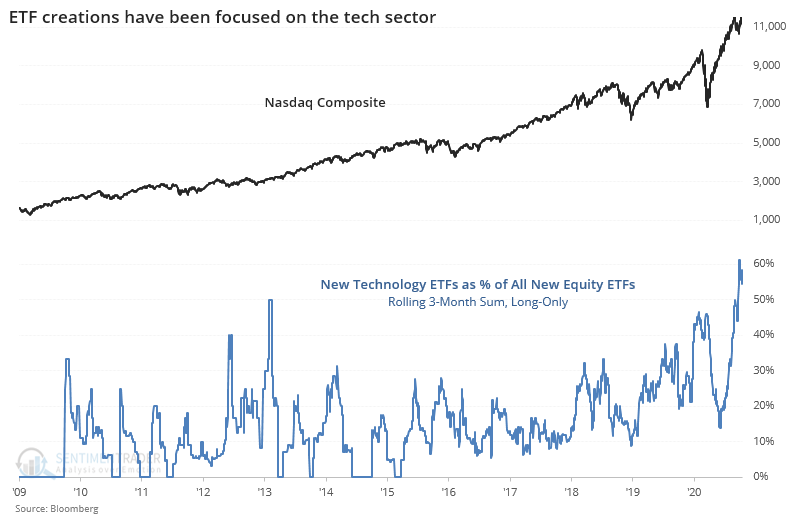
As a percentage of all new equity ETFs, these funds have never been more popular.
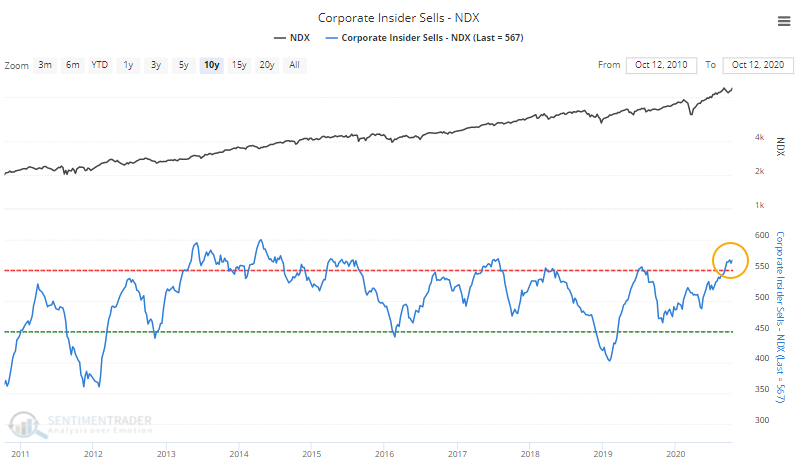
While demand from retail investors has been great enough to spur fund companies to undergo the expense and risk of creating new funds, corporate insiders in many of these companies continue to sell, with few buyers.

In Nasdaq 100 companies, open market purchases have tapered off significantly.
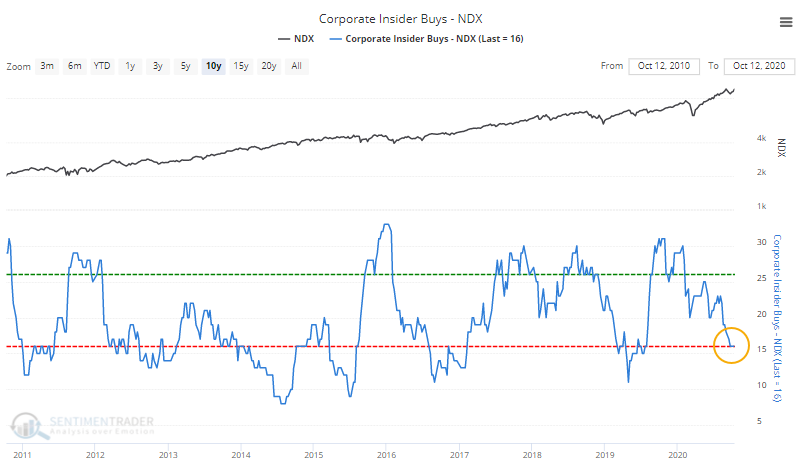
A drop in transactions isn't all that surprising as earnings season approaches, but at the same time, the number of open market sales remains high.
The recent surge in tech stocks has become about more than just a few massive stocks sitting at the top. This kind of broadening participation has been a consistently good sign over the medium-term. On a long-term basis, there has to be at least modest concern about the attention these stocks are getting. When any single sector becomes such a focus, there is usually something, at some point, that comes along to knock it down a peg.

PRODUCTS
SentimenTrader
Trading Tools
Indicators & Data API
‍
Strategies & Scanner
‍
Research Reports
FREE
RESOUrCES
Simple Backtest
Calculator
Simple Seasonality
Calculator
The Kelly Criterion
Calculator
Sentiment Geo Map
‍
Public Research Reports
‍
Education
Sentiment Indicators
‍
Technical Indicators
‍
Pricing
Bundle pricing
‍
FAQ
‍
Announcements
‍
COMPANY
‍
About
‍
In the News
‍
Testimonials
‍
Client Success Stories
CONTACT
‍
General Inquiries
‍
Media Inquiries
‍
Financial Professionals Inquiries
‍
© 2026 Sundial Capital Research Inc. All rights reserved.
Setsail Marketing
TermsPrivacyAffiliate Program
Risk Disclosure: The information and tools provided are for research and analytical purposes only and are not intended as investment advice. Market analysis involves uncertainty, and outcomes may differ from expectations. Users should conduct their own due diligence and consider their individual circumstances before making any financial decisions. Past performance is not necessarily indicative of future results.

Hypothetical Performance Disclosure: Hypothetical performance results have many inherent limitations, some of which are described below. No representation is being made that any account will or is likely to achieve profits or losses similar to those shown; in fact, there are frequently sharp differences between hypothetical performance results and the actual results subsequently achieved by any particular trading program. One of the limitations of hypothetical performance results is that they are generally prepared with the benefit of hindsight. In addition, hypothetical trading does not involve financial risk, and no hypothetical trading record can completely account for the impact of financial risk of actual trading. for example, the ability to withstand losses or to adhere to a particular trading program in spite of trading losses are material points which can also adversely affect actual trading results. There are numerous other factors related to the markets in general or to the implementation of any specific trading program which cannot be fully accounted for in the preparation of hypothetical performance results and all which can adversely affect trading results.

Testimonial Disclosure: Testimonials appearing on this website may not be representative of other clients or customers and is not a guarantee of future performance or success.