
S&P sectors meet yield curve un-inversion

Key points
- In a recent piece, I noted that the 10-yr./3mo. yield curve had un-inverted at the end of December 2024
- In that original piece, we analyzed forward performance for the S&P 500 Index and Coincident Economic Indicators index
- In this piece, we will zero in on sector and factor performance
A quick review
In the original piece, we highlighted the dates in the table below, which marked the end of the months when the 10-year./3-month yield curve was un-inverted (i.e., when the yield on the 3-month t-bill fell below the yield on the 10-year treasury note after being inverted for at least one month) and subsequent S&P 500 performance.
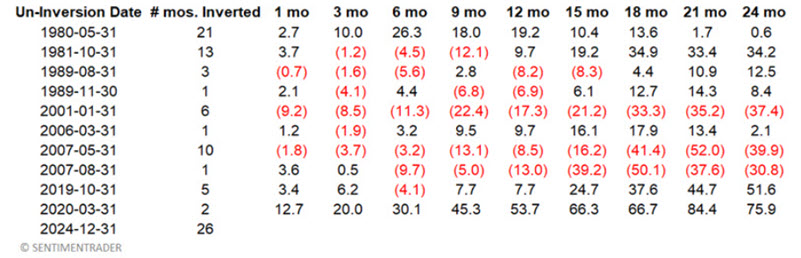
Now, let's examine the actions of the S&P 500 sectors following the yield curve un-inversion.
Sector performance following yield curve un-inversion
The table below displays the 12-month % return for each of the 11 S&P 500 sectors following all month-end dates shown in the table above (including overlapping signals in 1989 and 2007).
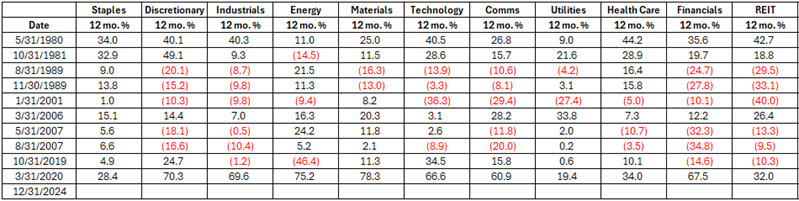
The table below summarizes the performance for each sector.
- The top performer in each category is highlighted in green
- The second-best performer in each category is highlighted in blue
- The third-best performer in each category is highlighted in yellow

Consumer Staples and Health Care have consistently scored in the top three in most categories. The Materials sector probably deserves an honorable mention.
Using a systematic approach
For this test, we will use the following rules:
- If the 10-year-3-month yield curve un-inverts in the current month, then starting at the end of that month, we will buy and hold all 11 S&P 500 sectors for 12 months
- If another un-inversion occurs during that initial 12-month holding period (i.e., if the yield curve inverts and then un-inverts again within 12 months of a previous un-inversion), we will extend the holding period for an additional 12 months
The table below displays the dates of the holding periods using the rules above and the performance for each sector during each holding period.

The table below summarizes sector performance during the holding periods shown in the table above.

Once again, Consumer Staples and Healthcare are the most consistent performers.
A closer look at the top two sectors
The data above suggests that a somewhat defensive approach is typically a prudent line of attack following a yield curve un-inversion. The chart below displays the hypothetical growth of $1 invested in each sector using the abovementioned rules.
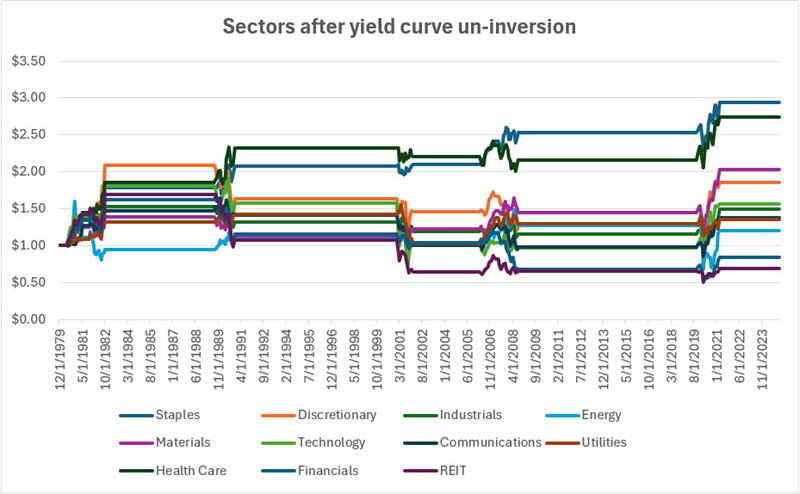
There is a noticeable gap between Staples and Healthcare and all other sectors.
The chart below shows the hypothetical growth of $1 in Consumer Staples and Healthcare following yield curve un-inversion through December 2024.
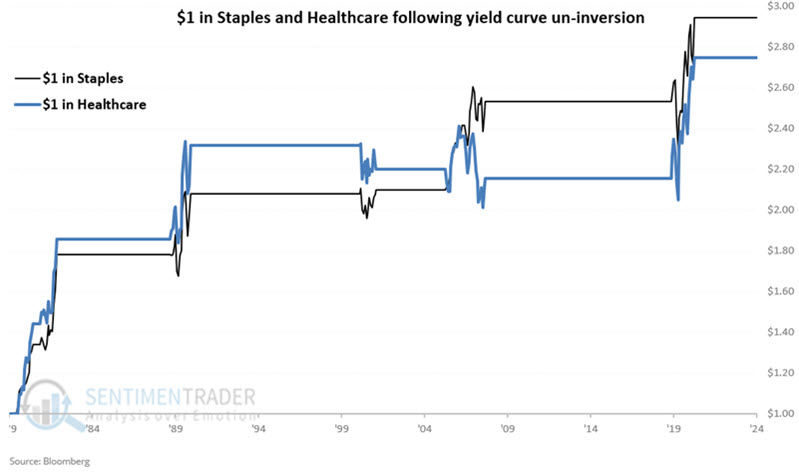
The historical performance looks good. But what about the here and now? Consumer Staples and Healthcare have lagged the S&P 500 badly for some time now, as illustrated below.
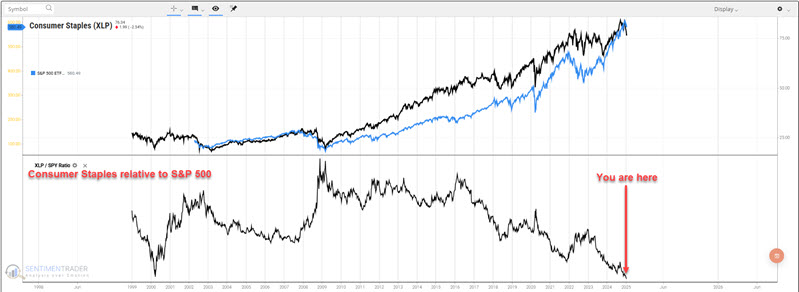
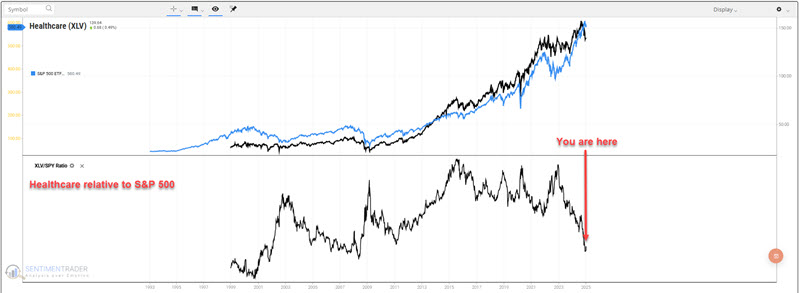
Aggressive investors might consider a potential "reversal of fortune" scenario. A more aggressive investor who buys right now is essentially betting that the most recent yield curve un-inversion is, in fact, something of a game-changer that will usher in a period that favors more defensive issues and sectors. History suggests this is a decent bet, particularly after consecutive 20+% years for the S&P 500. Still, less aggressive investors might strongly consider putting these two sectors "on watch" and looking for some objective signs of improving performance before taking the plunge.
What the research tells us…
Many factors influence stock market performance, so it is not advisable to focus solely on yield curve un-inversion as the basis for asset allocation. Still, the data presented above suggests that two defensive sectors- Consumer Staples and Healthcare- may ultimately be among the top-performing sectors in 2025. So far, they have not shown much in 2025, but there is a long way to go.