
S&P 500 sailing into a brief headwind

Key points
- Seasonality is climate, not weather
- Likewise, the annual seasonal trend for any security is a measure of the past, not a roadmap for the current year
- That said, the stock market has entered a period that has witnessed weakness more often than not
- The bottom line: A pullback or consolidation shortly should not come as a surprise
The mid-year lull
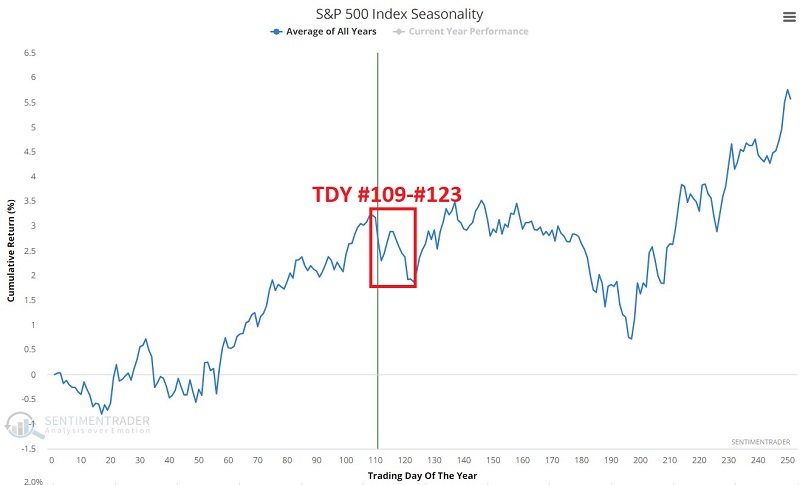
The chart below displays the annual seasonal trend for the S&P 500 Index. The period between Trading Day of the Year (TDY) #109 and TDY #123 is highlighted. For 2023, this period extends from the close on 2023-06-08 through 2023-06-28. The good news is through the first three trading days of this period the S&P 500 Index has gained +1.75%.
The chart below displays the growth of $1 invested in the S&P 500 Index only from the close of TDY #109 through the close of TDY #123 every year starting in 1960.
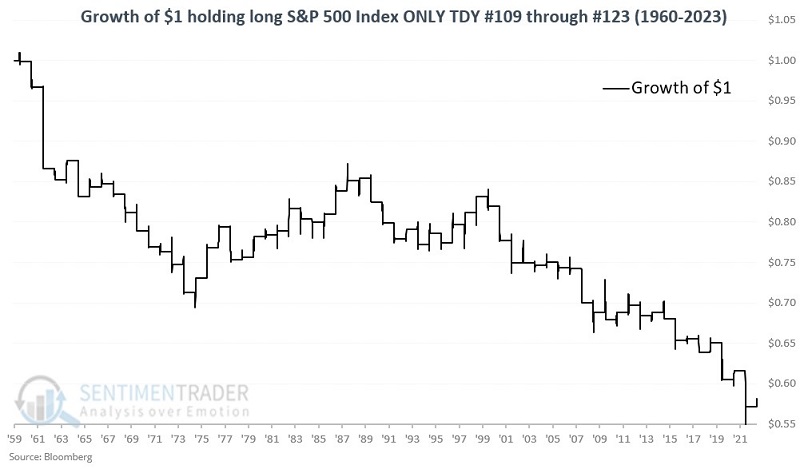
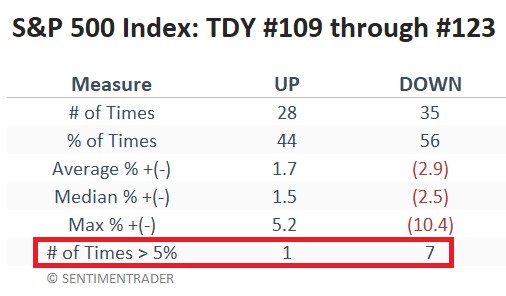
The long-term bias for weakness is unmistakable, but there is no way to predict from year-to-year how the market will perform during this period. The table below summarizes S&P 500 performance during this mid-year lull period. The key things to note are:
- The market has been down more often than up during this period
- Also, the down years have, on average, been more negative than the up years were positive
- The S&P 500 has gained more than 5% only once during this period but has lost -5% or more seven times
What the research tells us…
The bad news is that there has been an unmistakable tendency for below-average performance during this brief period. The good news is that there is no guarantee that this period will experience weakness during any given year - and so far, the market has continued to power ahead through the first few days of this period in 2023.
The real question is, "What to do with this information." The simplest is "nothing." In other words, don't do anything based solely on a slight seasonal bias. On the other hand, in light of recent market strength, proactive traders might watch closely for signs of reversal and look for an opportunity to play the short side of the market via a short-term trade. Longer-term investors might pursue a variety of tactics, including 1) If you are already thinking about selling some stock positions and lightening up, you might consider selling into strength, 2) Selling some covered calls against existing stock positions in hopes of collecting some premium if the market cools off for a few weeks, and 3) Investors with cash to invest might consider "keeping their powder dry" and looking for a better buying opportunity closer to the end of June.