
Soaring gas prices have triggered a record divergence in sentiment

A sentiment divergence
The latest monthly surveys of consumer sentiment are out, and they're...not good. The Consumer Sentiment survey from the University of Michigan was particularly despondent, with the 11th-lowest reading since 1978. The only lower readings during the past 40 years were during the depths of the global financial crisis.
Other surveys aren't quite so drastic, including the Conference Board survey of Consumer Confidence. But the two surveys have some differences, most notably among the questions they ask.
US Bancorp Asset Management gets to the gist of it:
"The Consumer Confidence questions place a greater emphasis on employment and labor market conditions while the Consumer Sentiment survey emphasizes individual household finances. This drives the impression Consumer Confidence more generally reflects consumer feelings towards the overall economy while Consumer Sentiment reflects consumer perceptions of their own personal circumstances."
A simple web search will turn up dozens of in-depth analyses of the two surveys, including academic studies of the inputs important to each of them. It typically boils down to gasoline - consumers in the U. of Michigan survey tend to be more influenced by high gas prices. Prices have been rising quickly, so sentiment has declined.
The spread between sentiment in the surveys just hit a record low. That (roughly) suggests that consumers have never been more pessimistic about their personal situation relative to the broader economy. And, when this spread has been extreme, it has had an impact on forward returns in the S&P 500.
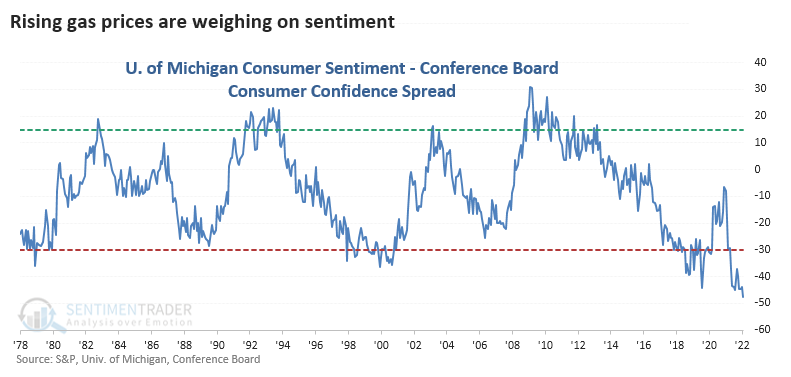
The S&P returned +17.1% p.a. when the spread was extremely positive, but a woeful -8.0% p.a. when it was extremely negative.
Among sectors and factors, the defensive Utilities and Health Care sectors showed the best annualized returns after extremely negative readings. Commodities also tended to do well.

The dollar faces a headwind from the calendar
Despite low rates, high debt, and competition from Bitcoin, etc., the US Dollar has performed very well since bottoming in May 2021. But Jay pointed out that the dollar is now entering a period of typical seasonal weakness.
The chart below displays the annual seasonal trend for the US Dollar. Note the large unfavorable period over much of the year - starting now.
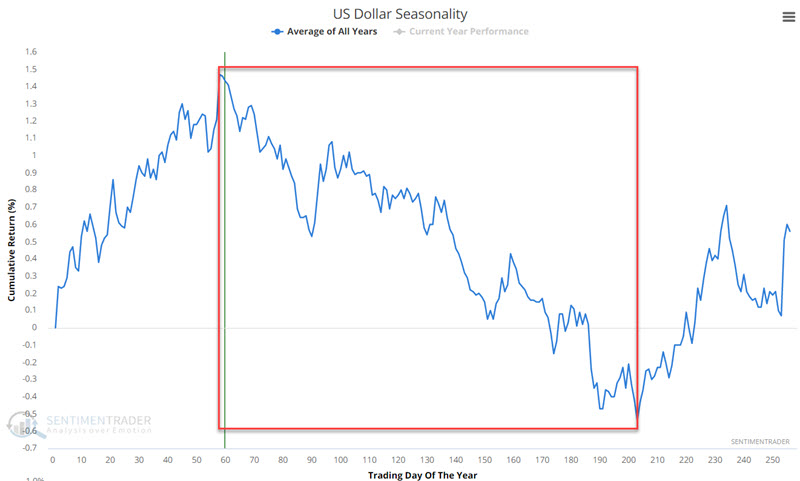
Over the past 37 years, this period showed a positive return 14 times and a negative one 23 times, with a much larger median loss than gain.
