
Sentiment has fully reversed at new highs

Key points
- The Smart Money / Dumb Money Confidence spread has cycled from above +0.25 to below -0.25
- The previous cycle in May 2025 resolved with one of the best 6-month rallies in the dataset
- This time the S&P 500 sits at all-time highs and the cycle was rapid, 31 trading days or less
- Historically, rapid sentiment cycles at record peaks have led to difficult outcomes
The mood has swung
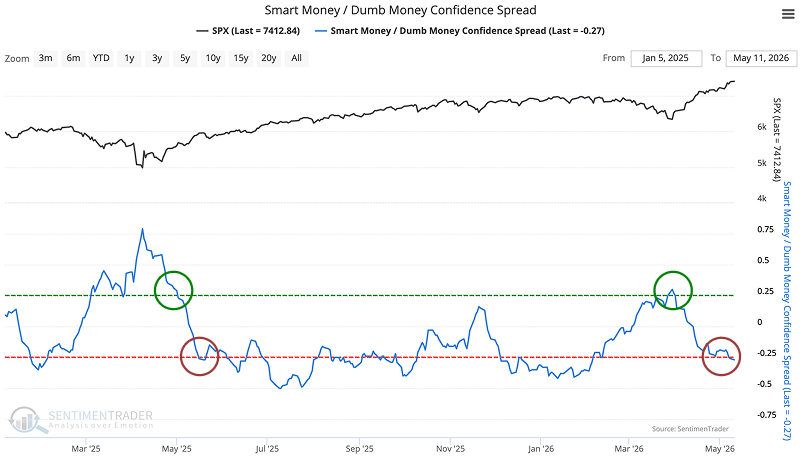
Here is a tale in two acts. First, from May 2025...
The Smart Money / Dumb Money Confidence spread crossed above +0.25. The S&P 500 sat near 6,000. The signal looked like it might be a problem. Historically, optimism at that level has been a mixed bag...And then a year later, the index had gained 52% over the next six months and kept climbing to 7,412. Now the spread has crossed back below -0.25.
The chart shows the full arc. It was not a slow drift from one extreme to the other. It was a sharp reversal.
The spread isn't all that extreme at -0.27, but it's at least through the lower threshold. Since 1999, the S&P 500 has returned an annualized 17.2% when the spread was above +0.25, 7.7% in the neutral zone, and 4.5% below -0.25. That's less than the other zones, but it's positive. The market has spent 37% of the past 27 years in this pessimistic zone, so it's not exactly a rare event.
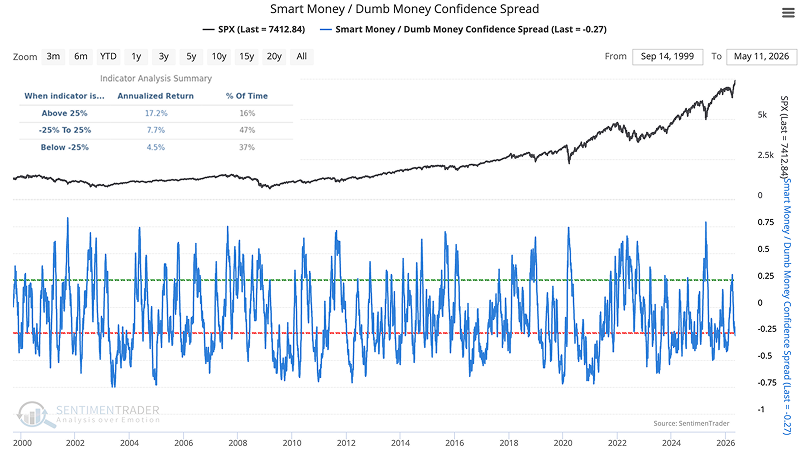
The full history
If we look at all 37 times the spread cycled from above +0.25 to below -0.25 since 2001, the forward returns were fine. A year later, the S&P 500 was higher 66% of the time, with a median gain of 7.1% and an average of 11.4%. The distribution had fat tails. The 2007 signal preceded a 40% loss. The 2020 signal delivered nearly 50%. The most recent cycle, from May 2025, was one of the best in the dataset, up more than 20% two months out, 52% six months later.
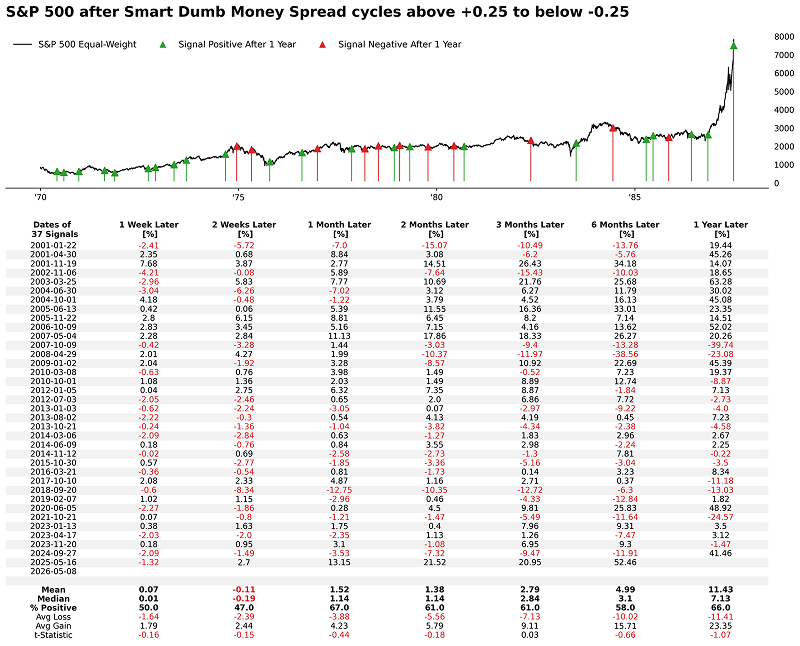
When the previous cycle resolved with that kind of strength, the index is naturally at a higher level when the next signal triggers. The S&P 500 now sits at all-time highs. That changes what the same signal means.
Adding the speed filter
After a rapid sentiment cycle, one that took 31 trading days or less to go from one extreme to the other, returns worsened in the short term. The median 1-year return dropped from 7.1% to 5.2%. The win rate slipped from 66% to 62%. Over the next two weeks, the index was higher less than half the time.
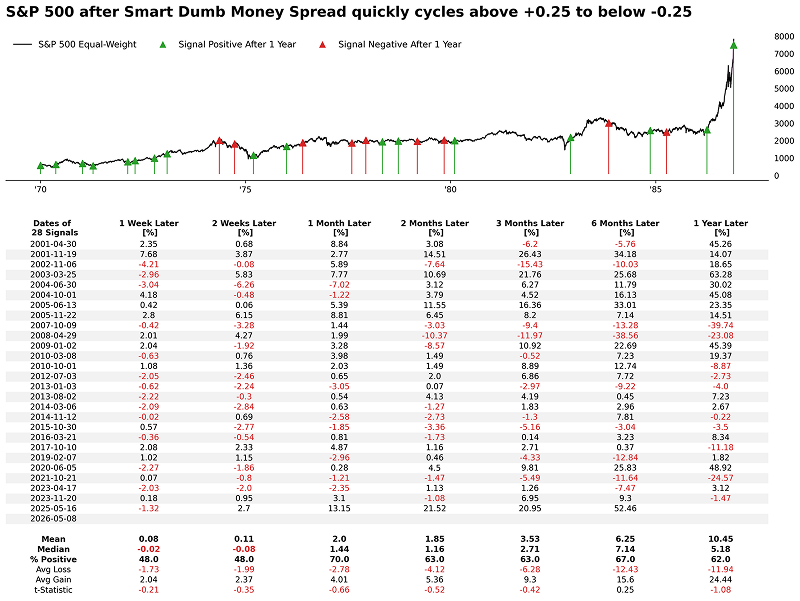
Over the next 6 to 12 months, the returns improved and came with less risk. The average gain a year later was 24.4%, the average loss 11.9%. Not terrible. The speed on its own isn't the issue. It's when the speed combines with something else that things get dicier.
The altitude problem
If we look at cycles that triggered when the S&P 500 was at all-time highs, the returns were worse. Across nine signals, the median 1-year return was -7.9%. The index was higher just 38% of the time a year later. The average loss of 18.6% swamped the average gain of 4.1%.
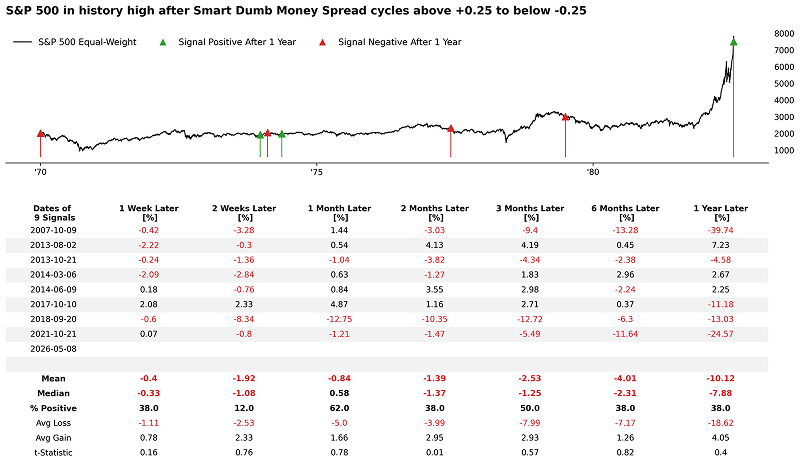
The sample is not deep. But it includes October 2007, September 2018, and October 2021, all three preceded double-digit declines. Almost every signal before 2018 was a loser; almost every one after that was a winner, so it may not be as bearish as it seems.
Combine the two, rapid cycle and all-time highs, and five historical signals remain. The median 1-year return was -11.2%. The index was higher 40% of the time. When it worked, the average gain was 5.0%. When it did not, the average loss was 25.2%.
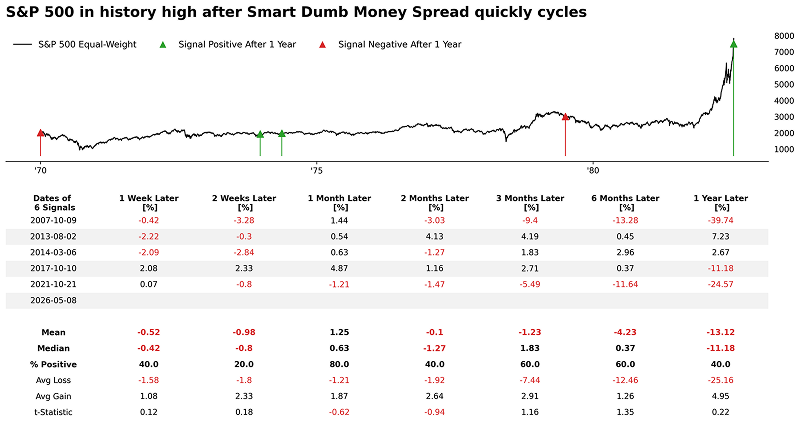
Five signals since 2007 is thin. Every one of them preceded at least a rough patch. The 2007 and 2021 signals led to losses of 40% and 25% over the next year. Even the better outcomes, 2013 and 2014, saw the index flat to modestly higher a year later, but only after digesting drawdowns in between.
What the research tells us...
Contrarians always get a little nervous when there is evidence of other investors cycling from comfort to anxiety. Sometimes, that nervousness is for a good reason. More often, it is not particularly problematic.
The base rate across all 37 cycles is benign. Most resolved with higher prices a year later, often substantially so. But the handful of signals that share the current setup's features, rapid cycle, at all-time highs, were not kind. The average losses in those five cases were three to five times the size of the average gains.
The last cycle, in May 2025, defied every cautious precedent and ripped higher. The market has been resilient in ways that make historical comparisons fragile. We've already seen buyers step in on weakness, which has been a reliable tell during this bull run. Even if the next few months get choppy, and they might, there's not much here yet that would point to something worse than that.