
Renewed strength in cyclical sector participation

Key points:
- Over 75% of stocks in three of four cyclical sectors closed above their 200-day average
- Similar breadth backdrops saw the S&P 500 rally without exception over the next four months
- Technology displayed the most consistent ability to outperform the broad market
Participation broadens
Market technicians had been voicing concerns about the lackluster participation, particularly in longer-term gauges such as the percentage of stocks trading above their 200-day moving average. That worry may now be easing, as last week brought a notable improvement in participation across the market.
Cyclical sectors such as industrials, financials, and consumer discretionary led the rebound, with over 75% of their stocks simultaneously reclaiming 200-day averages for the first time since the April low.
Given the importance of economically sensitive stocks, this provides yet another encouraging sign for the durability of the uptrend.
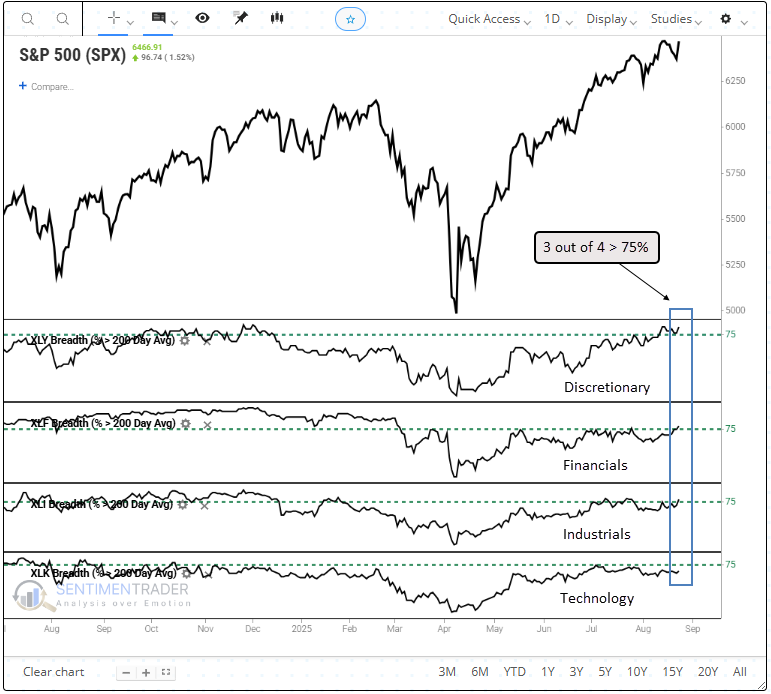
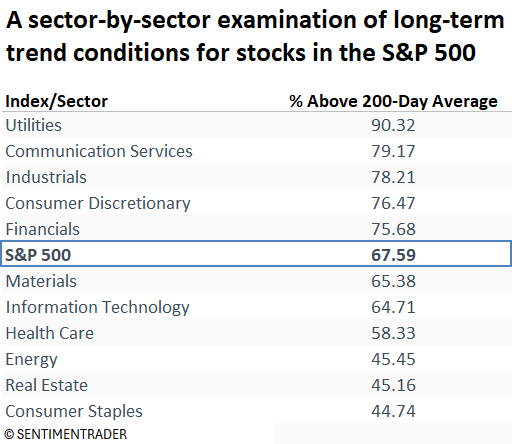
The percentage of S&P 500 stocks trading above their 200-day average has been held back by defensive, yield-oriented groups, which have been pressured by the "higher for longer" Treasury yield backdrop.
With Chair Powell's Jackson Hole remarks hinting at rate cuts, relief for these groups could be on the horizon. If they begin to participate, it would further strengthen the underlying foundation of the market.
A consistent upward bias
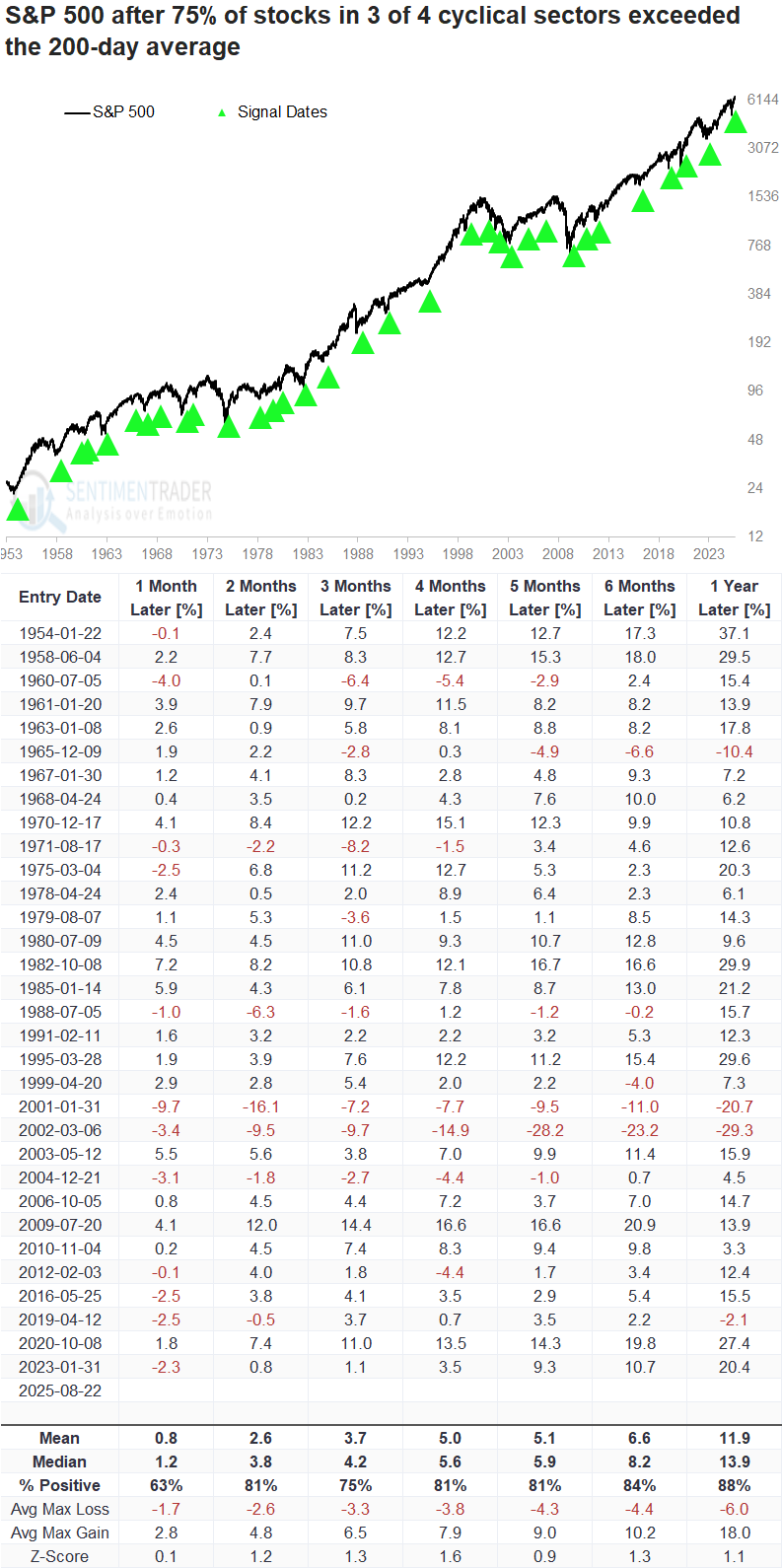
Whenever at least 75% of stocks in 3 of 4 cyclical sectors closed above their 200-day average for the first time after a six-month low, the S&P 500 delivered excellent returns and consistency over the following year.
Only twice did the signal lead to significant declines in the first four months, with both occurring during countertrend rallies in the 2000-02 bear market, a scenario that contrasts sharply with today's conditions, as the S&P 500 nearly closed at a new all-time high on Friday.
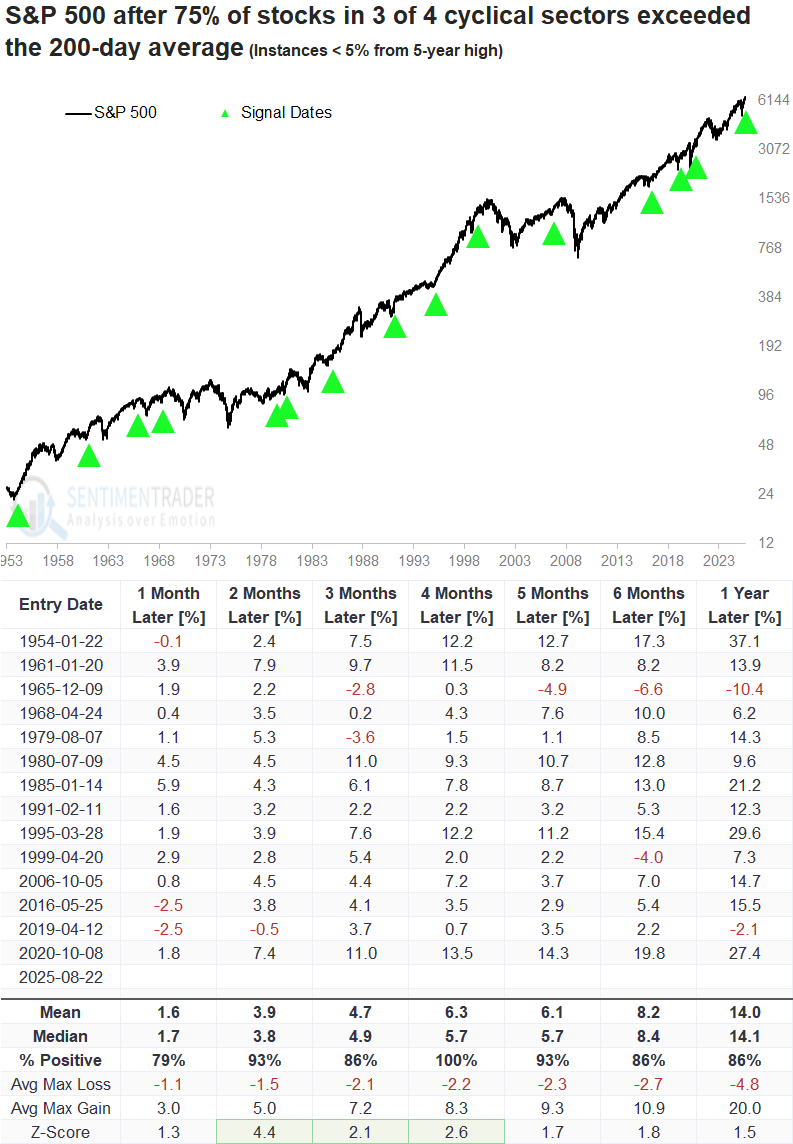
When isolating instances within 5% of a 5-year high, conditions more comparable to today, the S&P 500 demonstrated exceptional forward returns and consistency, achieving a 100% win rate at the four-month horizon.
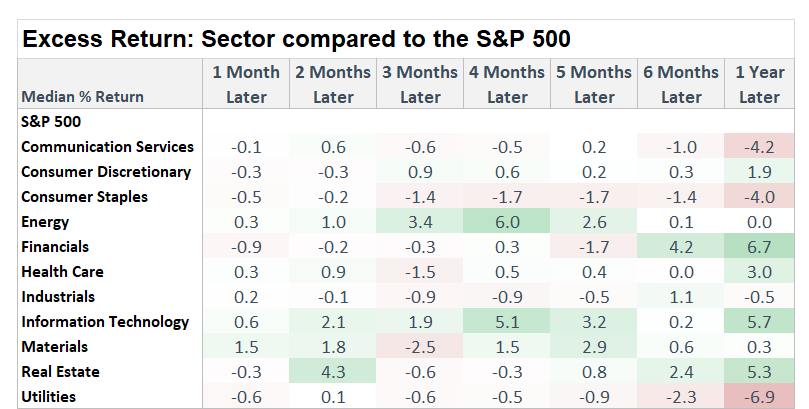
A year later, consumer discretionary, financials, and technology outperformed the S&P 500, suggesting investors were rewarded by overweighting these groups when cyclical sector stocks exhibited bullish long-term trend conditions.
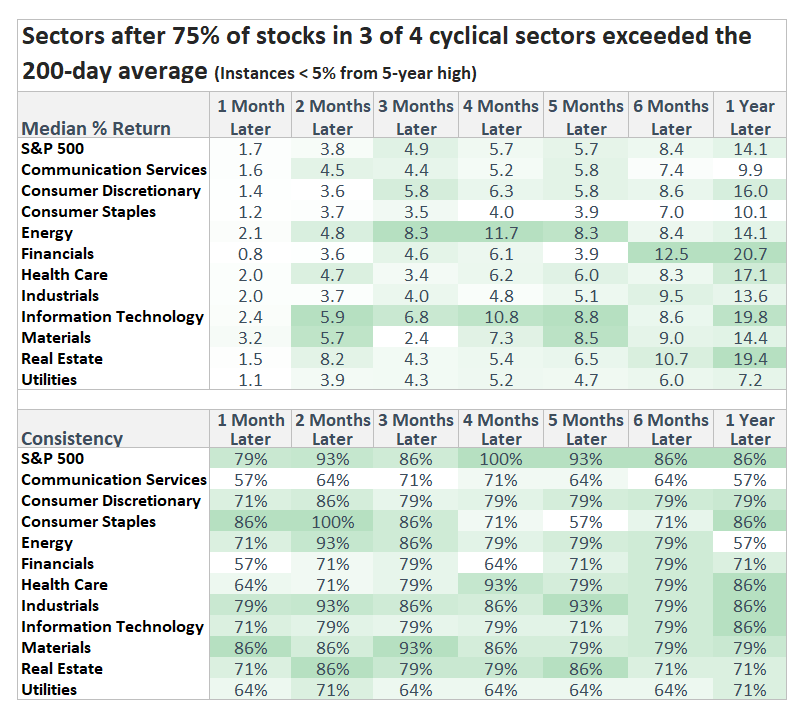
Measuring the net difference between a sector and the S&P 500 enhances the clarity of performance trends versus the broad market.
As illustrated in the table below, the technology sector outperformed the world's most benchmarked index across all time frames.
What the research tells us...
Cyclical groups continue to exhibit bullish characteristics, building on recent breakouts and sub-industry momentum. The latest signal comes from long-term trends, with over 75% of stocks in three of four major cyclical sectors now above their 200-day averages. Such strong participation near a high has historically led to robust gains over the following year, reinforcing the case for a sustainable uptrend.