Products
SentimenTrader Trading Tools
‍
Backtest Engine
My Trading Toolkit
Correlation Analysis
Seasonality
Market Prediction
Indicators & Data API
‍
Proprietary Indicators & Charts
Market Data API
Strategies & Scanner
‍
50+ Trading Strategies
Smart Stock Scanner
Smart Option Scanner
Research Reports
‍
Research Solutions
Reports Library
Free Resources
Simple Backtest Calculator
Simple Seasonality Calculator
The Kelly Criterion Calculator
Sentiment Geo Map
Public Research Reports
Education
Sentiment Indicators
Technical Indicators
Pricing
Company
About
In the News
Testimonials
Client Success Stories
Contact
Log inLoginSign up
< BACK TO ALL REPORTS

Redux: The 20-Year Cycle (Part III)

Jay Kaeppel
2024-08-28
This is a look back at a 2021 article written about the 20-year cycle in the stock market. This piece highlights 17 months within each 20 year cycle that have collectively experienced surprisingly - and consistently - poor performance.

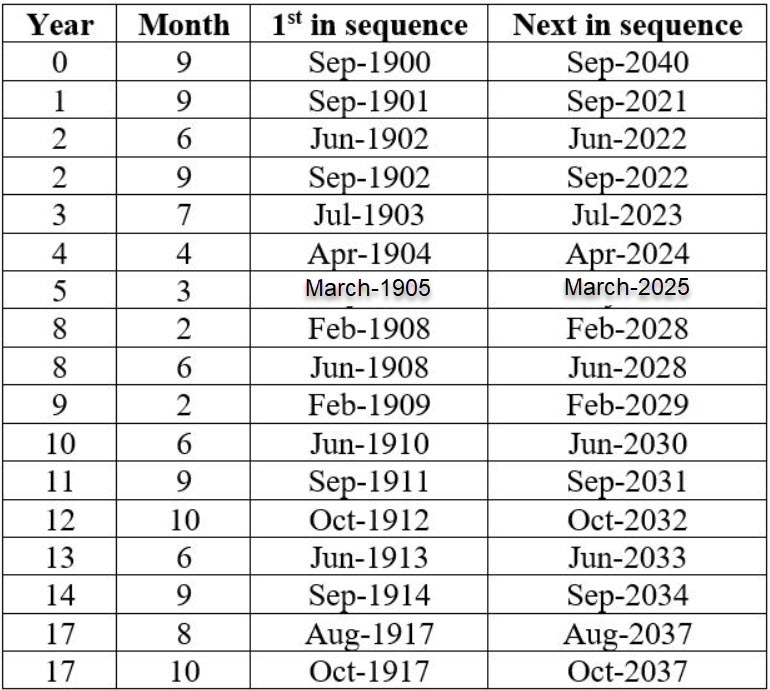
CORRECTION: There was an error in the 2nd table below that has been corrected. Pleas note that the next "Ugly Month" in the sequence is March 2025 and NOT May 2025 as stated in the original piece

I am on vacation this week but have decided to rerun some older pieces that have proven useful - and which will hopefully continue to be useful. This piece is Part III of a three-part series on the 20-Year Cycle in the stock market, which originally ran on 2021-02-12. It highlights 17 recurring months within each 20-year period which collectively have experienced surprisingly - and consistently - dreadful results.
This is Part III of a three-part series regarding the 20-year cycle in the stock market.

Part I of this series contained some "Bad News," and Part II contained some "Good News." Part III contains more bad news-that can potentially be twisted into good news. A close examination of stock market performance on a repetitive 20-year basis reveals some months that are consistently poor performers. That's the bad news. The good news is that by avoiding these particular months, an investor might be able to gain an "edge."

The 20-Year Pattern - Part III

The months we will look at are what I refer to as the "Ugly 17". These are 17 months out of every 240 months (i.e., 20-year cycles starting in 1900) that have tended to witness poor stock market performance cycle after cycle.

For our purposes, each 20-year cycle starts with "Year 0" (i.e., 1900, 1920, 1940, etc.) and ends with "Year 19" (i.e., 1919, 1939, 1959, etc.). 

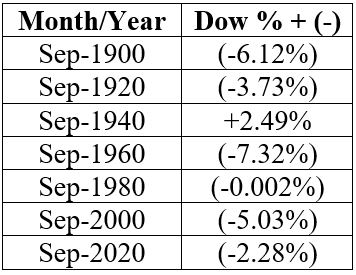
For openers, let's consider just one example. The first month in the "Ugly 17" is "September of Year 0." The figure below displays the price change for the Dow Jones Industrial Average during that month in the past.
A table with numbers and symbols

Description automatically generated

As you can see, every 20 years (starting in 1900) - with one exception (1940) - the month of September has come up a clinker. This represents only one of the "Ugly 17" months. The others are:
Now let's consider the performance of the Dow ONLY during these "Ugly 17" months as a whole. The chart below displays the cumulative % +(-) (with an emphasis on the minus sign) for the Dow Jones Industrial Average ONLY during these same 17 months during each 20-year cycle starting in 1900.
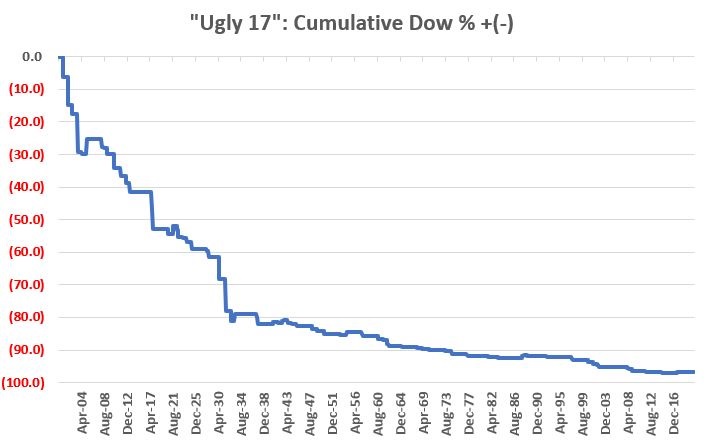
 A graph showing the average of the average of the u. s. average of the u. s. average of the u. s. average of the u. s. average of the u

Description automatically generated

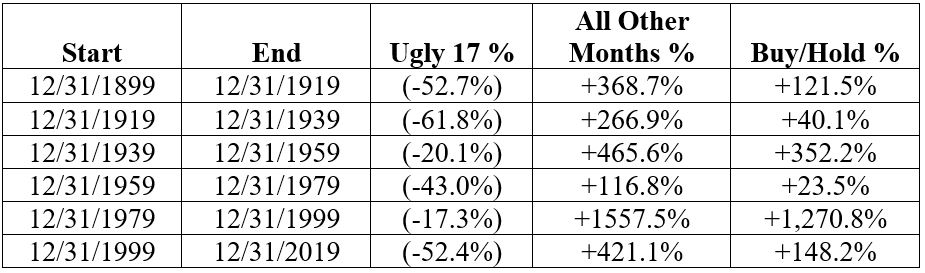
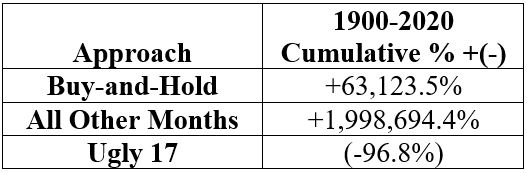
To get an idea, the table below displays the cumulative % +(-) across each 20-year cycle for:

  • Ugly 17 Months ONLY
  • All Other Months ONLY
  • Buy-and-Hold

A table with numbers and symbols 
Description automatically generated

So, what's the "Good News" in the "Ugly 17"? By avoiding these 17 months each 20-year cycle (for our test purposes we assume a 0% return during the "Ugly 17" months and a return equal to the percent price change for the Dow Jones Industrial Average during all other months), an investor might have vastly outperformed a buy-and-hold approach.
A table with numbers and symbols

Description automatically generated

2024 Update

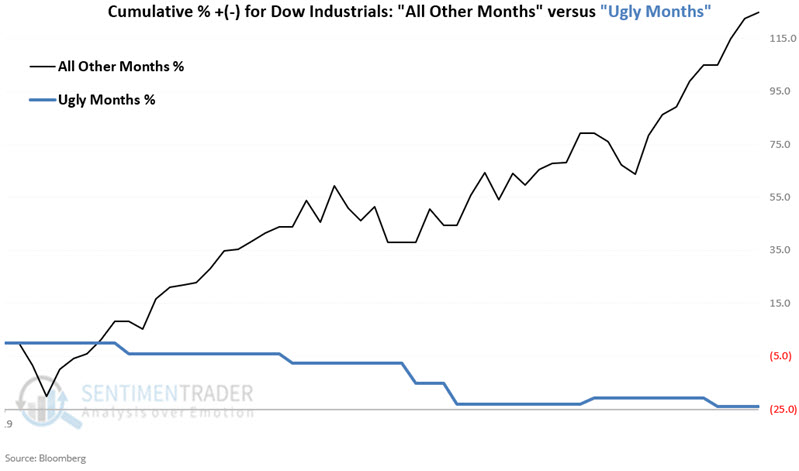
The chart below displays the cumulative % return for the Dow Jones Industrial Average since the end of 2019 for both the "17 Ugly Months" (blue line) and "All Other Months" (black line). From 2019-12-31 through July 2024:

  • All Other Months have gained +125%
  • The "17 Ugly Months" have lost -24% 

The next "Ugly Month" in the sequence is March 2025.
Summary

So, can an investor simply "follow the calendar" and outperform buy-and-hold by a significant sum? Well, maybe. The results above are fairly compelling, particularly since they rely on the exact same set of months on a repetitive 20-year basis. Still, as I always say, relying on any type of seasonality requires something of a leap of faith, as there is never any guarantee that what worked last time around will work again this time around.

PRODUCTS
SentimenTrader
Trading Tools
Indicators & Data API
‍
Strategies & Scanner
‍
Research Reports
FREE
RESOUrCES
Simple Backtest
Calculator
Simple Seasonality
Calculator
The Kelly Criterion
Calculator
Sentiment Geo Map
‍
Public Research Reports
‍
Education
Sentiment Indicators
‍
Technical Indicators
‍
Pricing
Bundle pricing
‍
FAQ
‍
Announcements
‍
COMPANY
‍
About
‍
In the News
‍
Testimonials
‍
Client Success Stories
CONTACT
‍
General Inquiries
‍
Media Inquiries
‍
Financial Professionals Inquiries
‍
© 2026 Sundial Capital Research Inc. All rights reserved.
Setsail Marketing
TermsPrivacyAffiliate Program
Risk Disclosure: The information and tools provided are for research and analytical purposes only and are not intended as investment advice. Market analysis involves uncertainty, and outcomes may differ from expectations. Users should conduct their own due diligence and consider their individual circumstances before making any financial decisions. Past performance is not necessarily indicative of future results.

Hypothetical Performance Disclosure: Hypothetical performance results have many inherent limitations, some of which are described below. No representation is being made that any account will or is likely to achieve profits or losses similar to those shown; in fact, there are frequently sharp differences between hypothetical performance results and the actual results subsequently achieved by any particular trading program. One of the limitations of hypothetical performance results is that they are generally prepared with the benefit of hindsight. In addition, hypothetical trading does not involve financial risk, and no hypothetical trading record can completely account for the impact of financial risk of actual trading. for example, the ability to withstand losses or to adhere to a particular trading program in spite of trading losses are material points which can also adversely affect actual trading results. There are numerous other factors related to the markets in general or to the implementation of any specific trading program which cannot be fully accounted for in the preparation of hypothetical performance results and all which can adversely affect trading results.

Testimonial Disclosure: Testimonials appearing on this website may not be representative of other clients or customers and is not a guarantee of future performance or success.