
Rays of Hope from Some Put/Call Ratio Extremes

Key points:
- Put/Call data can serve as a useful weight of the evidence tool when it reaches an extreme
- Extreme readings in put/call data offer a window into the minds of speculative traders - who often act based on emotion, and therefore tend to be wrong when they swing heavily in one direction or the other
- The OEX Put/Call Ratio and ROBO Put Call Ratio flashed favorable weight of the evidence signals during the recent market sell-off
The OEX Open Interest Ratio recently plunged
OEX is shorthand for the S&P 100, an index made up of the 100 largest companies in the S&P 500. Open interest is the total number of outstanding option contracts. Open interest increases with opening transactions and decreases with closing transactions. Someone buying a call to open (a bullish position) would increase open interest by one, and someone selling a call to open (a bearish position) would also increase open interest by one. The open interest indicator divides the total put open interest by the total call open interest. As more put contracts are opened (and/or call contracts are closed), the indicator rises; as put contracts are closed (and/or call contracts are opened), the indicator falls.
I view this indicator as a "weight of the evidence" tool rather than a trading signal generator. The chart below highlights all dates when the indicator value was below 0.70.
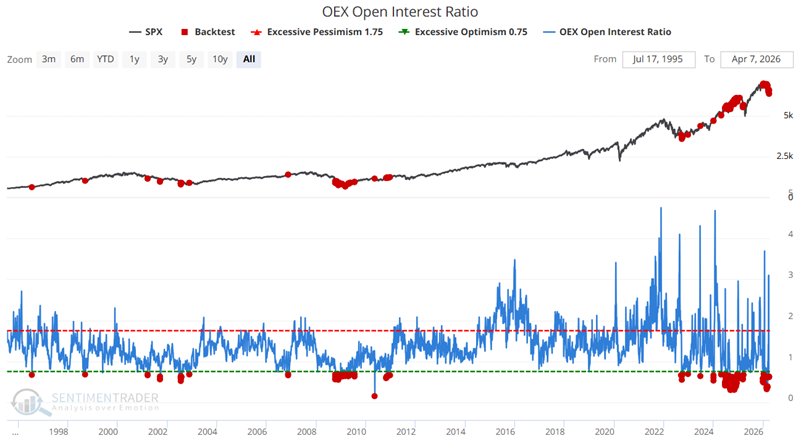
Note that this signal can occur often - typically in bunches - and that it is not uncommon for this signal to be "early." Hence, this is viewed as a weight-of-the-evidence rather than an outright "buy" signal. The table below summarizes subsequent S&P 500 performance. The key things to note in the table below are the 97% 1-Year Win Rate and the16.07% Median Return. This suggests that, while a given signal may be early, things have typically improved over the next 12 months.

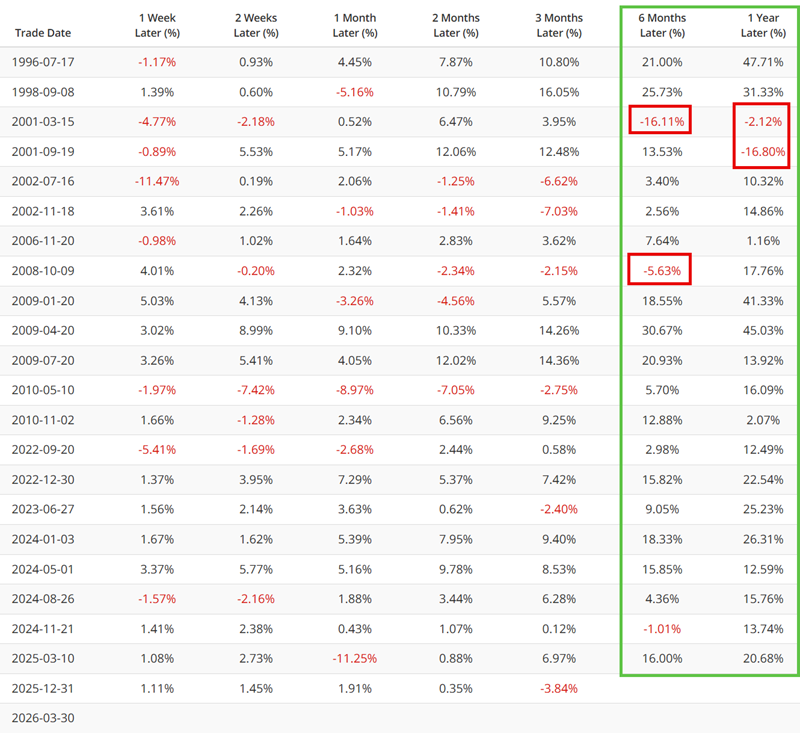
If we limit it to just the first reading (OEX Open Interest Ratio below 0.7) over the last three months, the 6 Month results improve meaningfully.
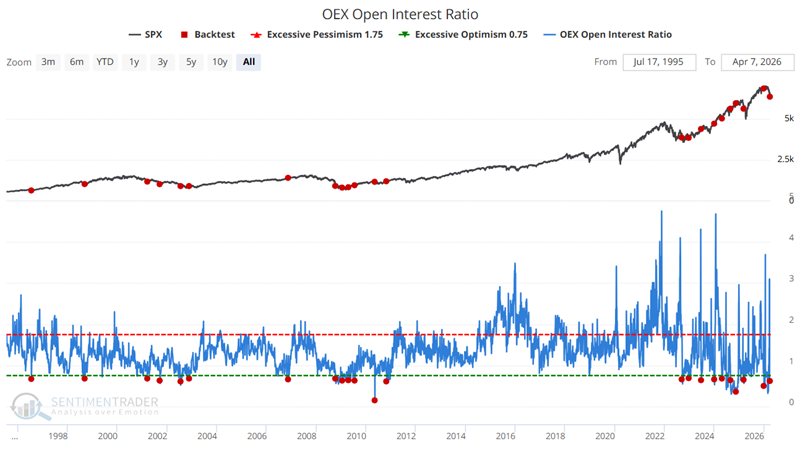

The table below shows results on a signal-by-signal basis.
ROBO Put/Call Ratio also flashes some favorable signs
ROBO is an acronym we coined for Retail-Only, Buy-to-Open. The ROBO Put/Call Ratio focuses on small traders to better understand what they're trying to do. When looking at put/call information, it is most helpful to see whether volume is going into opening or closing transactions, as this indicates how aggressive traders are betting on a market move. Also, especially for very small traders, buying options to open is more telling than selling options to open.
A small trader buys a call option to open a position for one reason - he thinks his stock is going higher. He buys a put option to open because he thinks his stock is going down. You may argue that he's hedging an underlying stock position, but it doesn't matter. If he thinks his stock is going up, he's not going to buy a put just for the thrill of it.
If we isolate trades to those of 10 contracts or fewer and further restrict them to buys and opening transactions only, we can get a true picture of what retail traders (i.e., small brokerage firm customers) are doing.
This ratio considers only buy-to-open transactions for trades of 10 or fewer contracts. Therefore, it is an excellent read on the emotions of the smallest of traders and should be interpreted in a contrary manner.
The chart below highlights all dates when the ROBO Put/Call Ratio was above 0.84. Once again, signals from this indicator should be thought of as "an alert that an extreme in contrarian sentiment may be occurring" and not as "it is automatically time to bet the ranch."
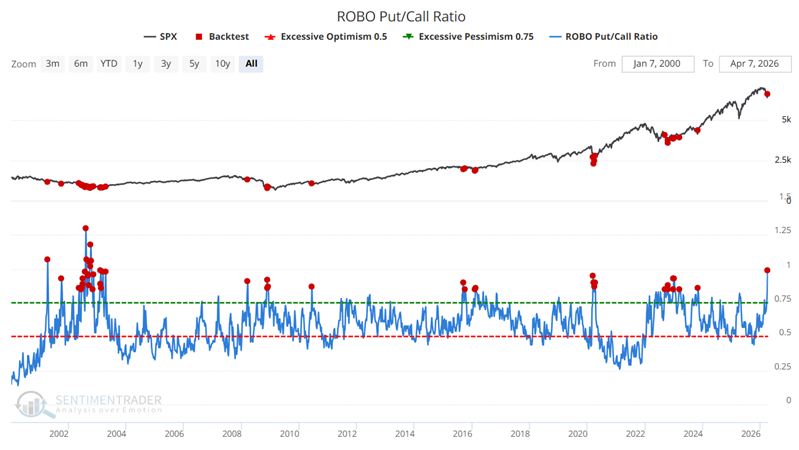
Like the OEX indicator above, the historical results show that this particular signal alerts investors that, despite their current concerns, things have typically improved in the following 12 months, with a median 1 Year return of 20.59%.

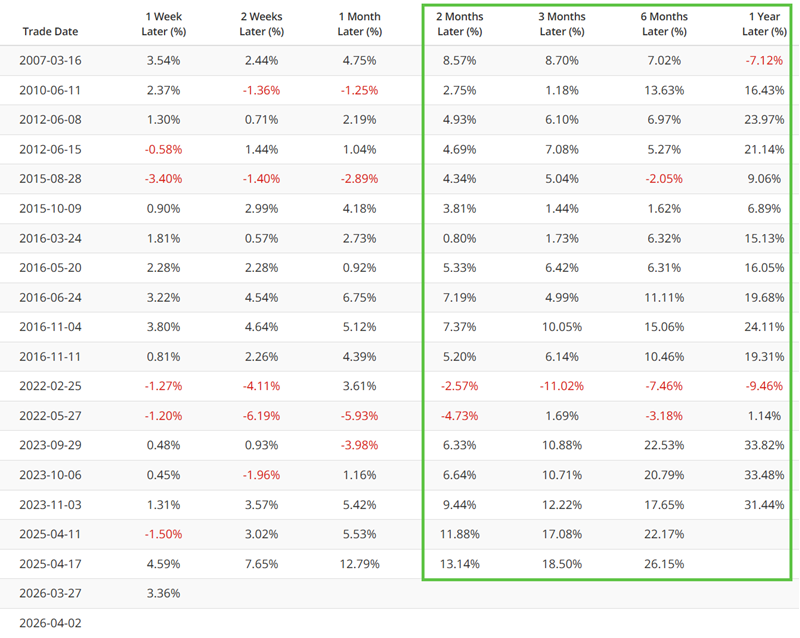
It is worth noting that different indicators can often be used in different ways. For example, the test below highlights only those dates when the ROBO Put/Call Ratio was above 0.79 (rather than 0.84 in the test above) while the S&P 500 Index was above its 100-week moving average. In other words, this test filters for a significant increase in bearish option trading sentiment while the overall market remains in a long-term (in this case, almost two years) uptrend.
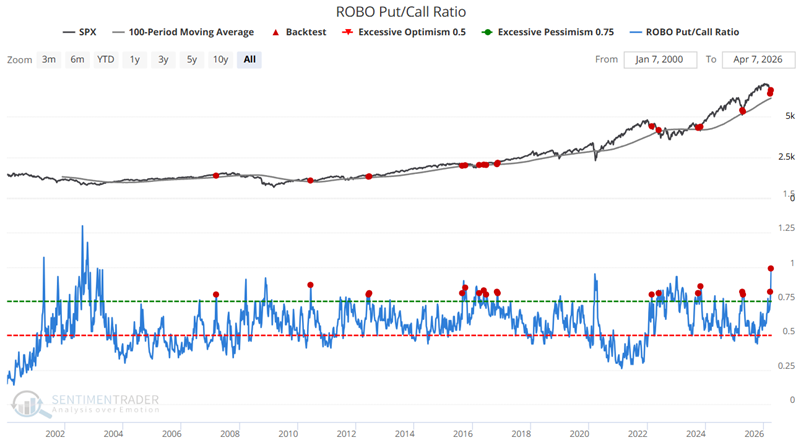
The tables below summarize subsequent S&P 500 performance and display results on a signal-by-signal basis, respectively. Note that the 94% 3-month Win Rate argues for a bounce in stocks between now and late June.

The table below shows results on a signal-by-signal basis.
What the research tells us…
A secret desire of most traders ("Hi, my name is Jay") is to find an indicator, or set of indicators, which will tell them exactly what the stock market will do over the course of some future given timeframe. Meanwhile, in the real world of trading, there is no such thing. Thus, it is essential to analyze market clues to gauge the likely direction over the traders' preferred timeframe. The put/call indicators highlighted above do not tell us "exactly" what the stock market will do over the next three to twelve months. But they do offer powerful clues. First off, the recent signals highlighted above suggest that bearish sentiment may have gotten overdone. In turn, we are then reminded that previous peaks in overly bearish sentiment have often - though importantly, not always - been followed by much better market performance in the months ahead. The stock market's action and recent put/call action suggest that a "Hope for the best, be prepared for the worst" mentality is likely the right approach for traders and investors at the moment.