
Q1 offers a stock market clue - Part II

Key points
- The S&P 500 index registered an annual decline during 2022
- The index recorded a gain during the first quarter of 2023
- This configuration of performance has historically offered an essential clue for stock investors
Recent S&P 500 performance has been down and then up
The S&P 500 was down over -19% in 2022. As you can see in the chart below (courtesy of AIQ TradingExpert), the index registered a gain for the first quarter of 2023.
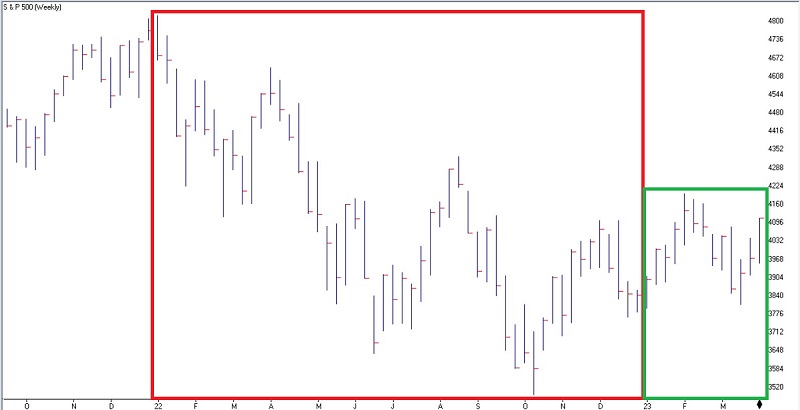
Let's take a closer look at those times when this configuration occurred.
An up Q1 after a calendar year loss
In this article, I highlighted market performance for the last nine months of the year if the S&P 500 did not close below the previous December's low during the first quarter of the new year. In this piece, we will first examine market performance for the last nine months when the S&P 500 a) registered an annual loss during the previous calendar year and b) a gain during the first quarter of the current year.
In the past 69 years, the S&P 500 has registered an annual gain 49 times and a yearly loss 20 times. Following those 20 losing years, we will analyze the performance of the S&P 500 during the first quarter of the following year to see if it registers a 3-month gain or loss. If the S&P increases during this period, we will analyze S&P 500 performance for the remaining nine months of the year.
The chart below displays the cumulative gain achieved by holding the S&P 500 only during the last nine months if Q1 is positive after a down calendar year.
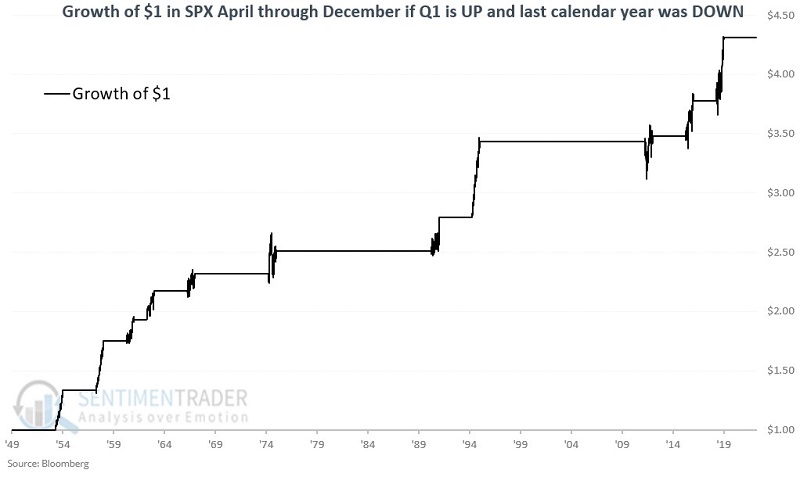
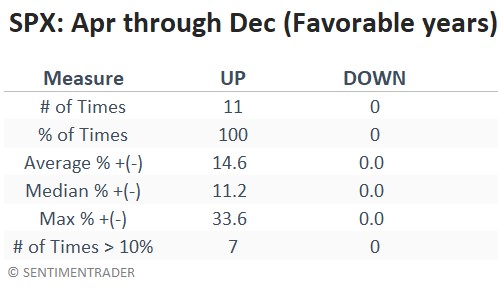
While the sample size is small (only 11 occurrences), the favorable historical bias is obvious. The table below summarizes the results.
The table below displays the March 31st through December 31st results for years when the S&P 500 shows a Q1 gain following a down calendar year. It also displays the largest drawdown below the March 31st closing price for the S&P 500 Index.
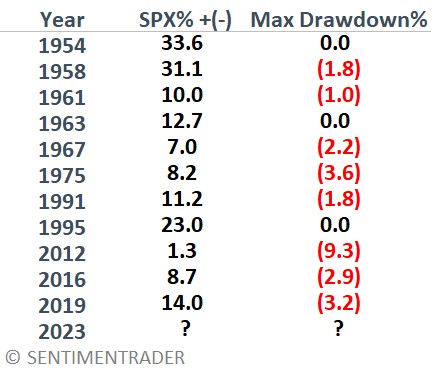
The most notable things regarding the results shown above are:
- All 11 occurrences saw the S&P 500 register a nine-month gain
- 10 of the 11 occurrences experienced no more than a -3.6% drawdown from the entry price (the exception was 2012 with a drawdown of -9.3%)
What the research tells us…
The first quarter of 2023 saw the S&P 500 Index register a gain following a calendar year loss during 2022. Over the past 70 years, a down year for the S&P 500 followed by a higher Q1 the next year has been a solidly bullish sign for the remainder of the year. With a double-digit average and median gain, a history of very shallow drawdowns, and no losing years, the results may inspire confidence regarding the market's prospects for the rest of 2023. That said, it is essential to remember that no indicator, pattern, oscillator, or trend is ever infallible. The above pattern is best used as part of an overall "weight of the evidence" approach rather than as a standalone trading method.