
Put/Call indicator signals signal disbelief among traders

Key points:
- Put/call data can at times offer a glimpse into the psyche of traders and offer clues to potential market direction
- When option speculators bet heavily in one direction or the other, they almost invariably tend to be wrong
- Our Gamma Exposure and Retail Only Buying indicators have flashed recent favorable signals
Gamma Exposure as a % of Market Capitalization crosses a threshold
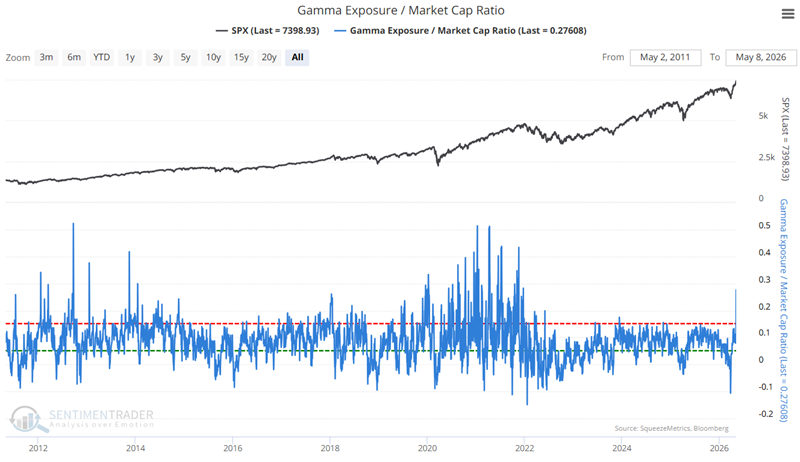
Gamma exposure refers to the sensitivity of existing option contracts to changes in the underlying price of the S&P 500 (see our Gamma Exposure chart for more details). This chart shows Gamma Exposure relative to the market capitalization of U.S. stocks. The higher the level, the more potential selling pressure. It is shown in thousandths of a percent.
The chart below shows daily data for the indicator. Note that on occasions, the data spikes sharply. For our purposes, we will use a longer-term moving average of daily data to smooth out day-to-day gyrations.
The chart below highlights all dates when the 50-day moving average of the Gamma Exposure / Market Cap Ratio indicator crossed above 0.05. The most recent signal occurred on May 8th.
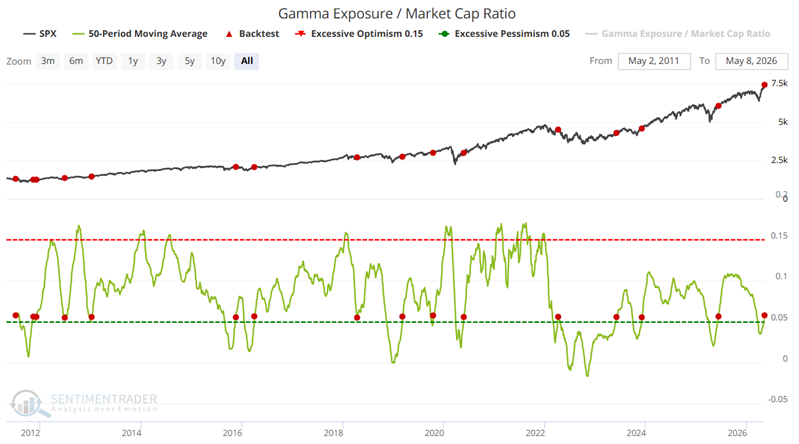
The table below summarizes S&P 500 index action following the dates highlighted in the chart above.

The table below shows S&P 500 action on a signal-by-signal basis.
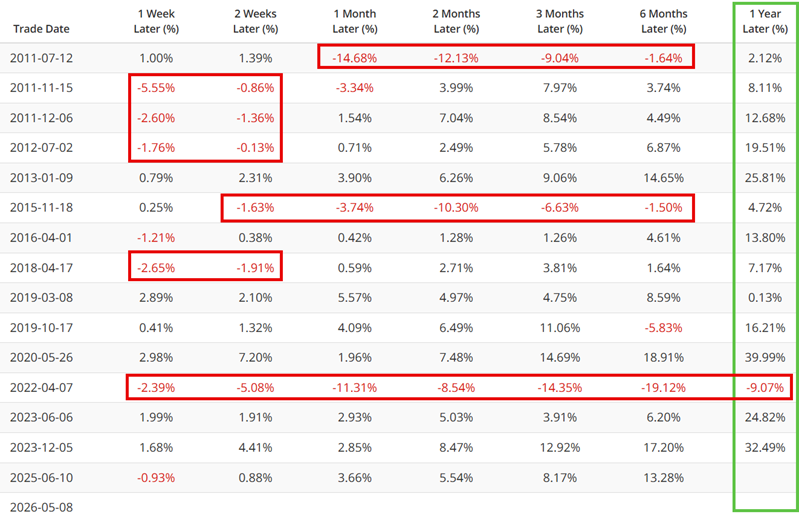
We can observe in the table above that a new signal is by no means an "All Clear/ Smooth Sailing Ahead" signal. Results can vary widely from signal to signal. However, the one constant has been that the market is higher 12 months later. As such, the most recent signal argues strongly for investors to give the bullish case the benefit of the doubt in the year ahead.
Robo Put/Call Ratio crosses a key level
ROBO is an acronym we coined for Retail-Only, Buy-to-Open. This ratio focuses on small traders to better understand what they're trying to do. When looking at put/call information, it is most helpful to see whether volume is going into opening or closing transactions, as this indicates how aggressive traders are betting on a market move. Also, especially for very small traders, buying options to open is more telling than selling options to open.
A small trader buys a call option to open a position for one reason - he thinks his stock is going higher. He buys a put option to open because he thinks his stock is going down. You may argue that he's hedging an underlying stock position, but it doesn't matter. If he thinks his stock is going up, he's not going to buy a put just for the thrill of it.
If we isolate trades to those of 10 contracts or fewer and further restrict them to buys and opening transactions only, we can get a true picture of what retail traders (i.e., small brokerage firm customers) are doing.
This ratio considers only buy-to-open transactions for trades under 10 contracts. Therefore, it is an excellent read on the emotions of the smallest of traders and should be interpreted in a contrary manner.
The chart below reveals that daily fluctuations can vary widely (and that the ratio tends to spike near market lows).
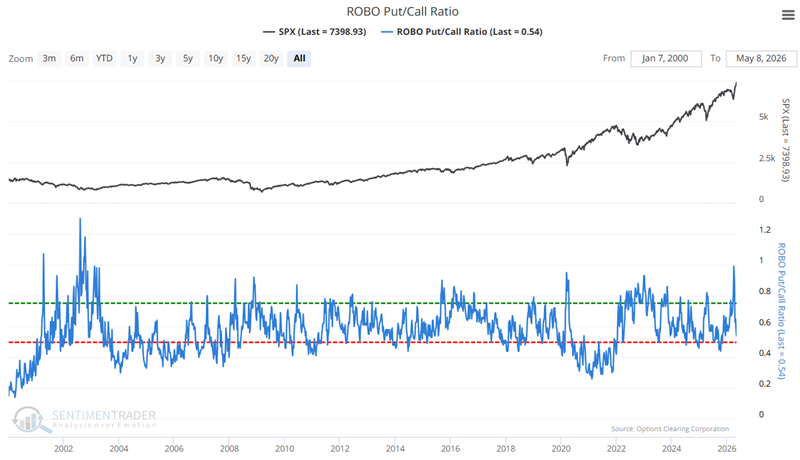
To smooth out daily readings, let's once again apply a moving average. The chart below highlights all dates when the 10-day moving average of daily ROBO Put/Call Ratio readings crossed above 0.75. The most recent signal occurred back on April 24th.
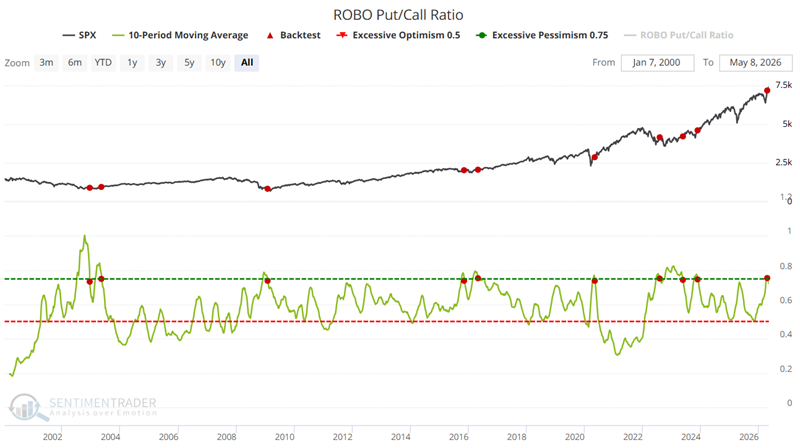
The table below summarizes subsequent S&P 500 performance following the signals highlighted in the chart above.

The table below shows S&P 500 action on a signal-by-signal basis.
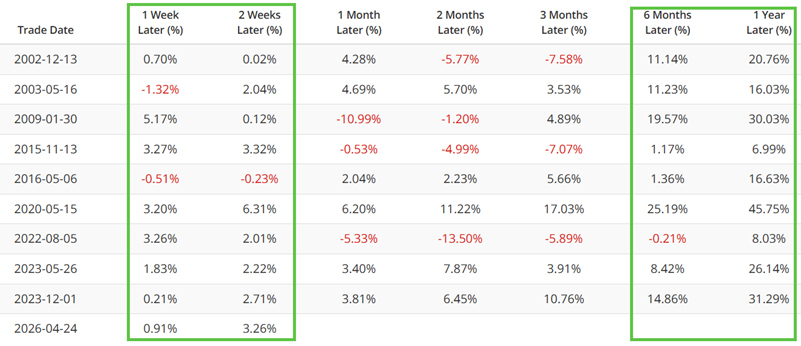
The good news is the high win rates 6 months and 1 year after previous indicator signals (89% and 100%, respectively). The sample size is relatively small, so as always, this is no "sure thing" despite the 100% 1-Year win rate. But one hopeful piece of news is that, for each prior signal, the return after 12 months was greater than that after 2 weeks. This provides one more weight of the evidence factor that may compel investors to give the bullish case the benefit of the doubt.
What the research tells us…
None of the indicator signals detailed above qualify as something that we rely upon as an automatic "trade signal generator." Nevertheless, because we rely on a weight-of-the-evidence approach, these signals offer value. The ongoing rise in crude oil prices and concerns about stock market valuation metrics have put many investors on edge. The favorable signals detailed above, however, remind us to "trade the trend we see" and not whatever we think may be lurking around the corner.