
Potential seasonal opportunities in biotech and Nasdaq index

Key points:
- Seasonal trends should not be thought of as "buy" or "sell" signals
- Seasonal trends should be thought of as "clues" that tell us "When to look where" for potential opportunities
- With that understanding in mind, traders might consider looking more closely at biotech (XBI) and the Nasdaq 100 Index (QQQ) for potential trading opportunities
Biotech (XBI) is in the seasonal sweet spot
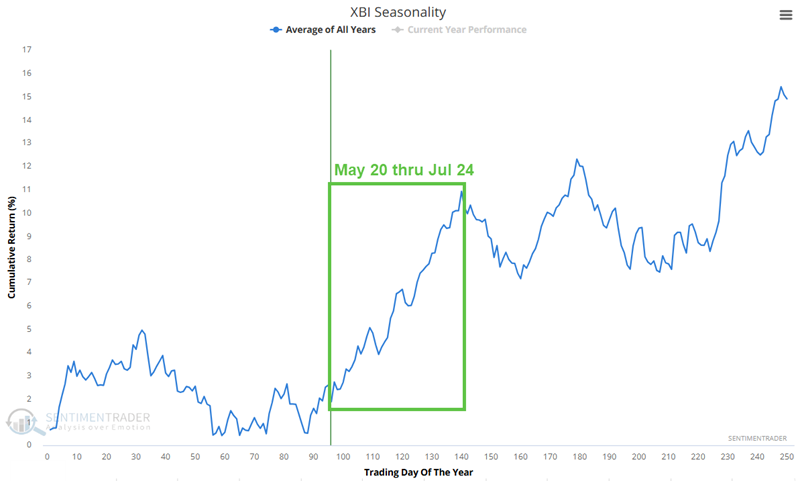
The Annual Seasonal Trend chart for the State Street SPDR S&P Biotech ETF (XBI) suggests a bullish bias for the next several months. The chart below highlights the period from Trading Day of the Year (TDY) #96 through TDY #140. For 2026, this period extends from May 20th through July 24th.
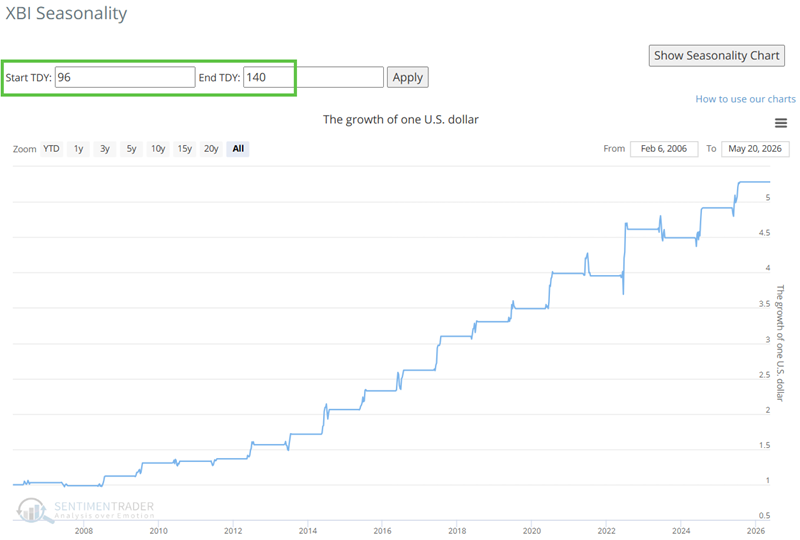
The chart below displays the hypothetical growth of $1 achieved by holding a long position in XBI only during this period every year since 2006
The table below summarizes XBI performance during this period.
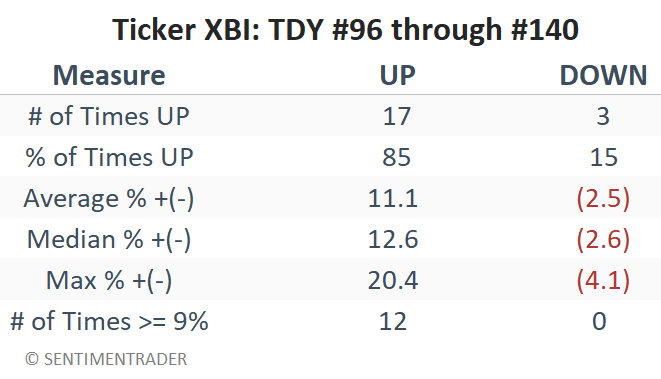
Aggressive short-term traders might consider buying shares of XBI (with a stop-loss to limit risk) or an options trade on XBI. As always, no seasonal trend is guaranteed to play out as expected "the next time around." However, the 85% win rate and the fact that big movers (gains or losses of 9% or more) have skewed 12-to-0 in favor of winners suggest a favorable reward-to-risk tradeoff.
A typically favorable period for the Nasdaq 100 Index approaches
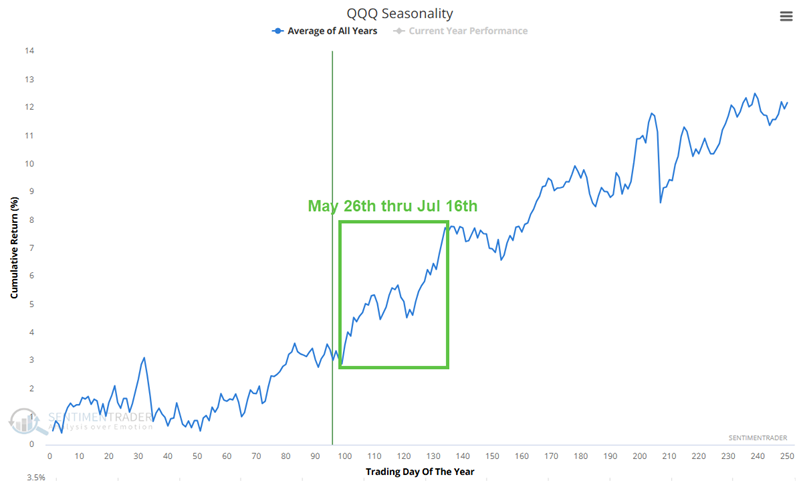
The Annual Seasonal Trend chart for the Invesco QQQ Trust, Series 1 (QQQ) shows a typically favorable period from Trading Day of the Year (TDY) #99 through TDY #134. For 2026, this period extends from the close on May 26th through July 16th.
Ticker QQQ tracks the Nasdaq 100 and started trading in 1999. In order to generate a longer testing history, we will use actual Nasdaq 100 data starting in 1985. The chart below displays the hypothetical growth of $1 achieved by holding a long position in the Nasdaq 100 Index only during this period every year since 1985
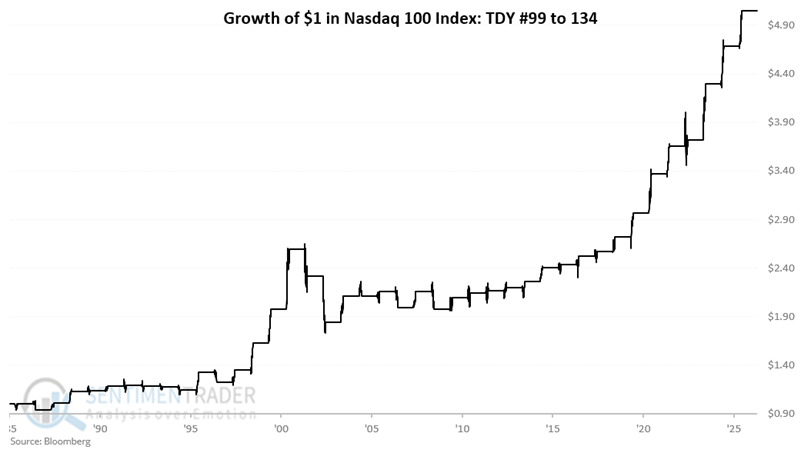
The table below summarizes the Nasdaq 100 performance during this period since 1985.
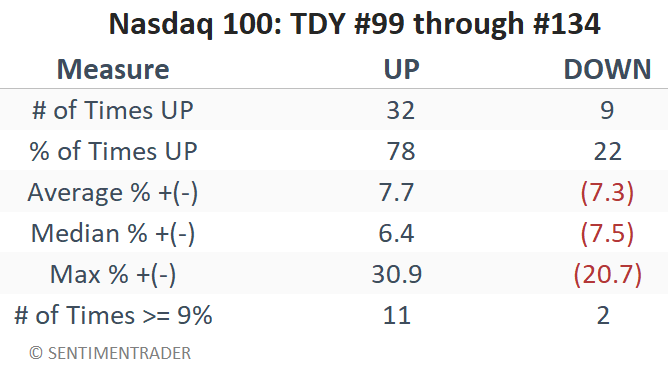
Aggressive short-term traders might consider buying shares of QQ (with a stop-loss to limit risk) or an options trade on QQQ. Traders should be aware that the Nasdaq 100 Index lost 20.7% during this supposedly favorable period in 2002, and -10.5% during this period in 2001. So some thought must be given to position sizing and a potential stop-loss point.
What the research tells us…
The onset of a historically favorable or unfavorable period for a given sector or ETF does not automatically constitute a "trading signal." Seasonal tendencies merely suggest "When to look where," i.e., they offer an alert to a possible trend. As confirmation, it is generally helpful to enter trades where both the seasonal trend and actual price action are favorable or unfavorable. This can significantly increase the likelihood of success for a given trade. That said, price action can always reverse unexpectedly. As a result, it remains each trader's responsibility to select an actual entry point, to allocate capital responsibly, and to manage risk ruthlessly.