
Platinum is entering the danger zone

Key Points
- Platinum is about to enter its weakest seasonal period of the year
- The period will begin with price already in an established downtrend. This is often - though notably, not always - a powerful bearish setup
- Historically platinum has traded higher 40% of the time during this period - however, the down years have tended to be significantly worse than the up years
Platinum seasonality
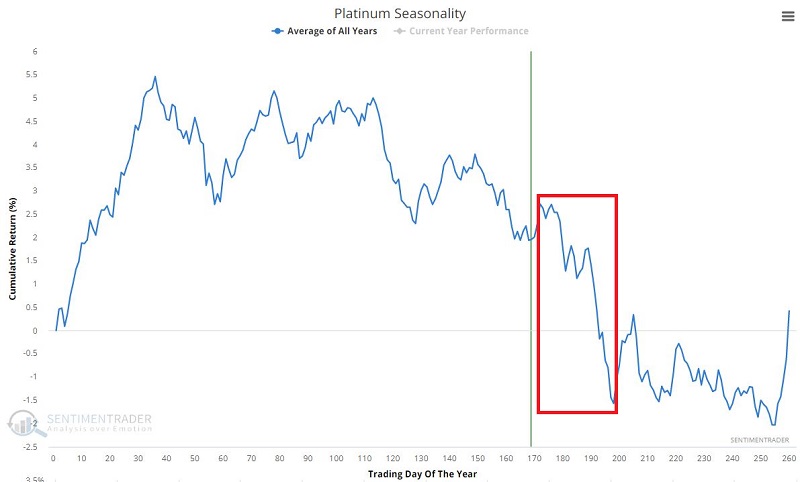
The chart below displays the annual seasonal trend for platinum futures. As you can see, it is about to enter a period of typical price weakness that extends from the close on Trading Day of the Year (TDY) #172 through TDY #198. For 2022 this period extends from the close on 2022-08-30 through the close on 2022-10-05 (NOTE: The futures contract data from Bloomberg that we follow includes trading on holidays).
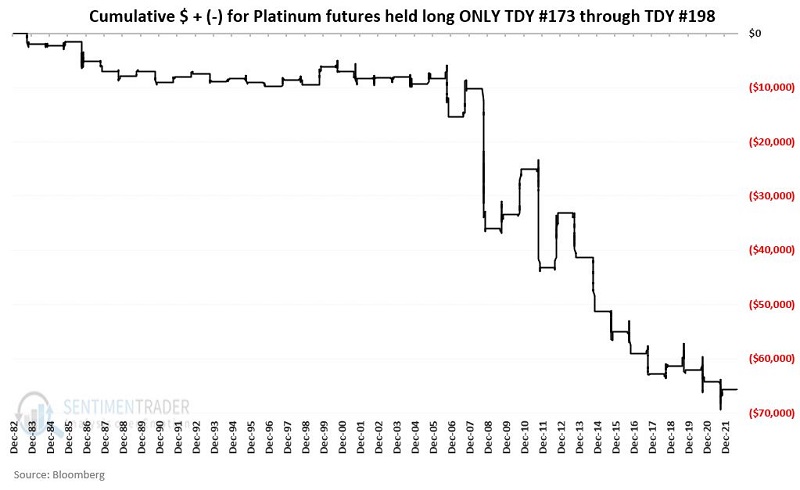
The chart below displays the cumulative $ +(-) for platinum futures held long only during Trading Day of Year #173 through TDY #198 since 1983. While anything can happen during a given year, the long-term results speak for themselves.
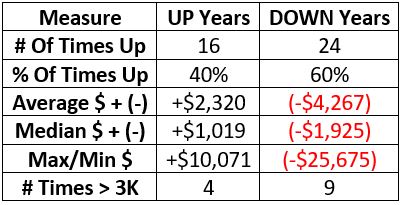
The table below summarizes platinum performance during this seasonally unfavorable period. After looking at the chart above, it is somewhat surprising to learn that platinum has declined only 60% of the time during this period. The critical thing to note, however, is that the average and median decline is almost twice as large as the average and median advance.
Price action
The chart below (courtesy of Barcharts.com) displays price action for October platinum futures.
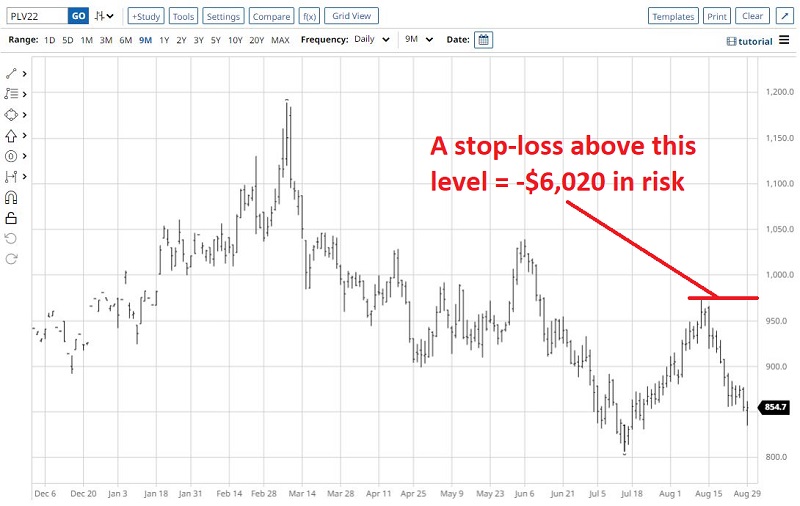
Note that the price is in a downtrend. So, barring an immediate reversal, price action and seasonality will soon be in a bearish agreement. Does this mean platinum is sure to decline? Not at all. But it does present a setup worth considering. Before taking the next step and selling short a futures contract, traders must consider where to place a stop-loss and how much they can afford to risk on a single contract.
Note that as this is written, October platinum futures are trading at 854.70. The most recent obvious high was up at 974.60. Placing a stop-loss order above this price allows one to stay in the trade as long as resistance holds. However, if a trader sold short at 854.70 and placed a stop at 975.10, this would entail a risk of -$6,020 per 1-lot of platinum futures. Each trader needs to decide if this is an acceptable risk or not. And if not, a stop-loss order must be placed below resistance (which entails a higher probability of getting stopped out) or eschew the trade altogether.
What the research tells us…
The caveat with seasonality never changes: there is no guarantee that even the most persistent seasonal trend will hold the next time. Still, the purpose of considering seasonal trends is not to engage in pinpoint market timing. The real goal is to find situations where price action and seasonality align and a trading opportunity with an acceptable tradeoff between reward and risk exists.
There is no reason why platinum cannot surprise everyone and rally in the weeks ahead. The real question, however, is this: With seasonality and price action soon to be aligned to the bearish side, is this a good time to play the long side? On the other side, if a trader wishes to play the short side based on bearish price and seasonal trends, the questions to be answered are how much to risk and where to place a stop-loss.