
Optimism resets to a more favorable condition for stocks

Key points:
- Several sentiment composites dropped to the lowest level in more than a year, suggesting less optimism
- Similar sentiment resets tended to result in a rally in the S&P 500 over a medium-term basis
Optimism resets, setting the stage for a resumption of the uptrend
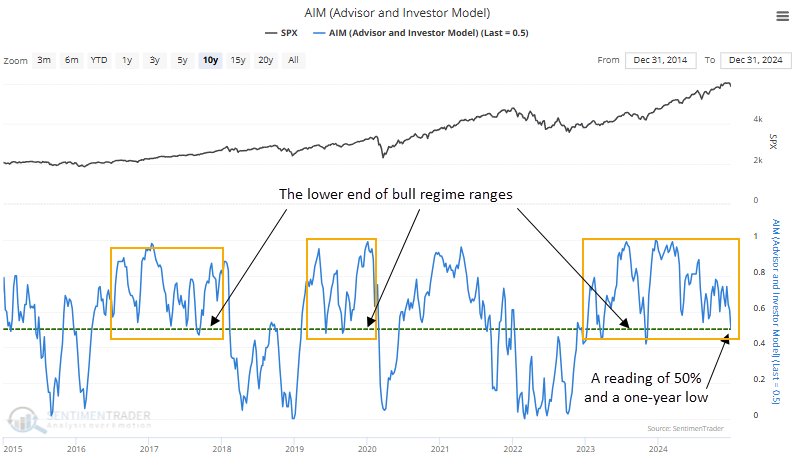
Several sentiment-based composites, which measure a combination of investor surveys and real-money indicators, have declined to their lowest levels in over a year, indicating that investors have increasingly become less optimistic about the stock market outlook.
Furthermore, the current readings for these indicators have dropped to the lower bounds of their bull market ranges, a zone that historically attracts buying interest from traders, as depicted in the accompanying chart featuring the Advisor and Investor Model.
Such pessimism can act as a contrarian indicator, as excessive caution among investors frequently sets the stage for a rally, a scenario we've seen over the last few sessions.
Similar sentiment resets suggest the uptrend resumes
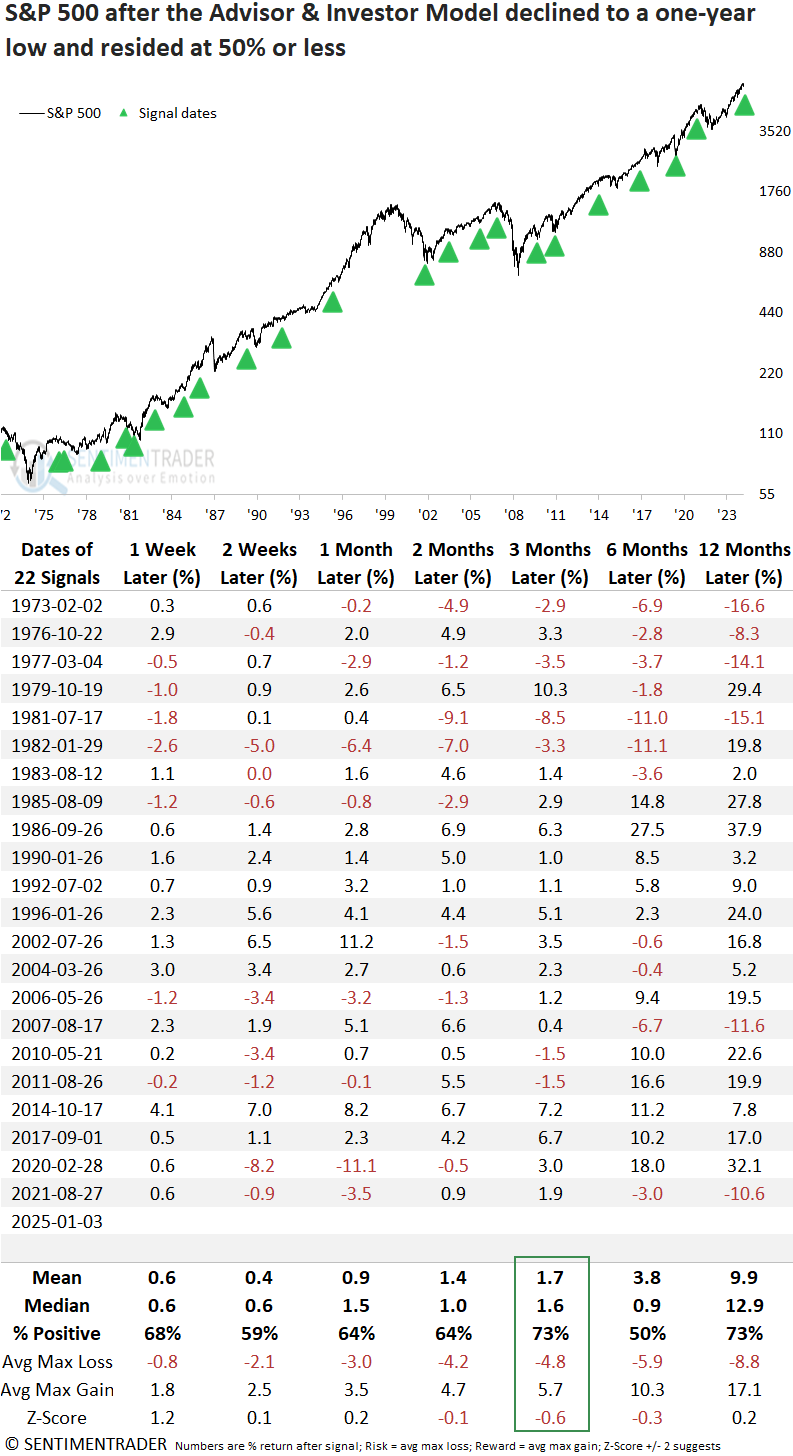
A decline in the Advisor and Investors Model to a one-year low and a reading of 50% or less tended to precede a rally in the S&P 500, with the world's most benchmarked index rising 73% of the time over the subsequent three months. Since the 1982 secular bottom in stocks, these occurrences have been even more bullish, with the index rising 88% of the time in the same horizon.
Instances near a high
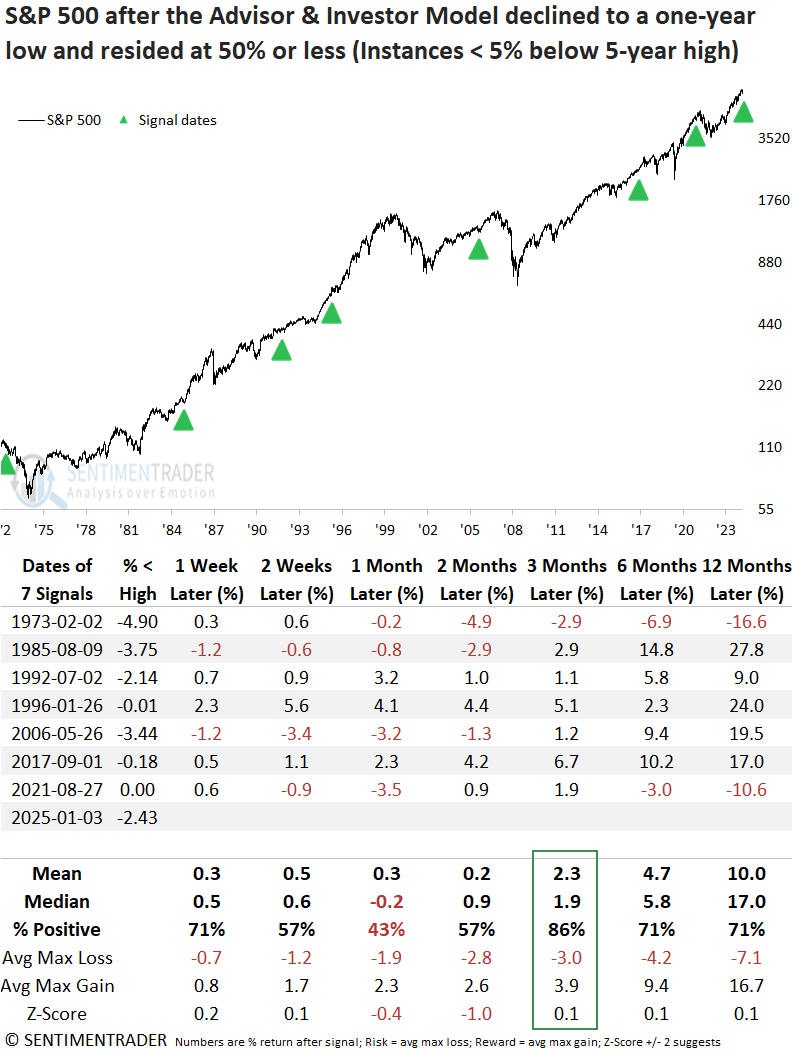
By isolating precedents near a high, a scenario like now, the win rate for the three-month interval rose to 86%, with the sole loss recorded in 1973. However, as indicated by the one-month time frame, some typical backing and filling could occur.
A real-money sentiment composite also suggests less optimism
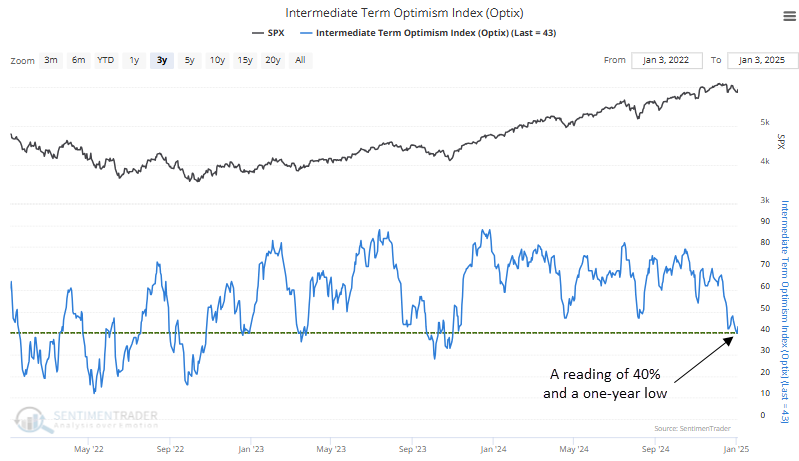
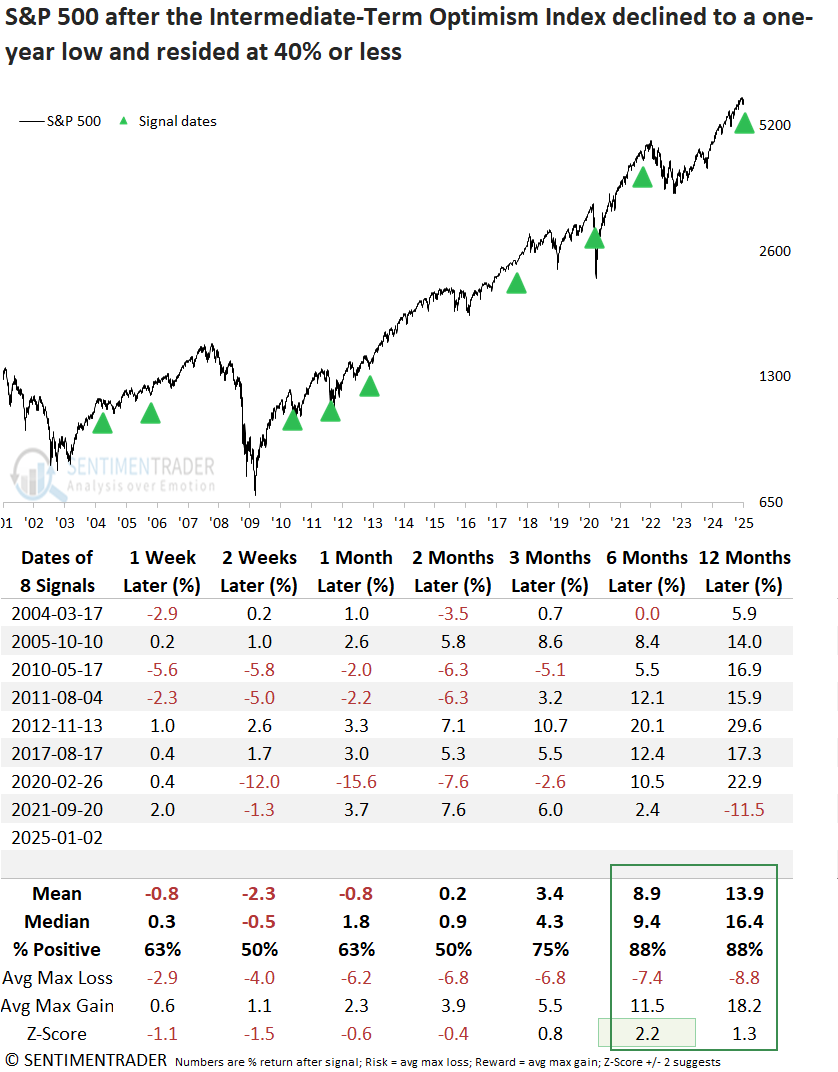
The Intermediate-Term Optimism Index, a composite that measures more real-money indicators like put/call ratios, mutual fund flows, and futures traders' positioning, also declined to a one-year low and a reading of 40%, suggesting far less optimism.
Despite its shorter history compared to the AIM model, when the Intermediate-Term Optimism Index declined to a one-year low, with a reading of 40% or less, the S&P 500 tended to perform well over long-term time frames, achieving an 88% win rate six and twelve months later.
Signals within 5% of a market high occurred in 2017 and 2021. Following the 2017 signal, the S&P 500 experienced a maximum six-month gain of 18%, with a maximum loss of -0.02%. Similarly, the 2021 signal led to a six-month maximum gain of 10% and a maximum loss of -4.3%.
What the research tells us...
Sentiment among investors, whether captured by survey-based indicators in our Advisor and Investor Model or real-money metrics like our Intermediate-Term Optimism Index, has reset to a level historically linked to stock market rallies. Although not the textbook 'fat pitch' scenario that follows deeper corrections, the recent easing in optimism may provide sufficient fuel to reinvigorate the uptrend. That said, I wouldn't entirely dismiss the possibility of some turbulence in the near term.