Products
SentimenTrader Trading Tools
‍
Backtest Engine
My Trading Toolkit
Correlation Analysis
Seasonality
Market Prediction
Indicators & Data API
‍
Proprietary Indicators & Charts
Market Data API
Strategies & Scanner
‍
50+ Trading Strategies
Smart Stock Scanner
Smart Option Scanner
Research Reports
‍
Research Solutions
Reports Library
Free Resources
Simple Backtest Calculator
Simple Seasonality Calculator
The Kelly Criterion Calculator
Sentiment Geo Map
Public Research Reports
Education
Sentiment Indicators
Technical Indicators
Pricing
Company
About
In the News
Testimonials
Client Success Stories
Contact
Log inLoginSign up
< BACK TO ALL REPORTS

On the cusp of a bull market, many stocks still stuck in bear mode

Jason Goepfert
2023-06-06
The S&P 500 is on the cusp of a new bull market, defined by a 20% rally off a 52-week low. But nearly a third of its stocks are still stuck in bear markets, a high level compared to other rallies since 1928. Rallies with a lack of participation like this have tended to under-perform "better" rallies, especially in the short term.

Key points:

  • The S&P 500 has rallied (almost) 20% from its latest 52-week low
  • Despite the recovery, nearly a third of stocks in the index are still in bear markets
  • Similar behavior preceded weak short-term returns, especially compared to "better" rallies

Despite a big rally in the index, many stocks are still in bear markets

The most benchmarked index in the world has embarked on a new bull market, but nearly a third of its stocks are still mired in bear market territory.

A few qualifiers:

  1. We're rounding up a 19.5% or more rally from a 52-week low in the S&P 500 to call it a bull market
  2. It had to have gone at least 6 months without a 20% rally from a low
  3. A bear market is considered at least a 20% decline from a 52-week high
  4. These are accepted definitions regardless of their logic, so semantic police need not complain

The S&P is on the cusp of rallying 20% from its most recent 52-week low, which was more than six months ago. Yet there has only been a slow, steady drip of stocks within the index that have recovered to within 20% of their latest 52-week high. This is a striking change in behavior from other rallies over the past decade when there was broad buying interest and a quick decline in the percentage of stocks stuck in a bear market.
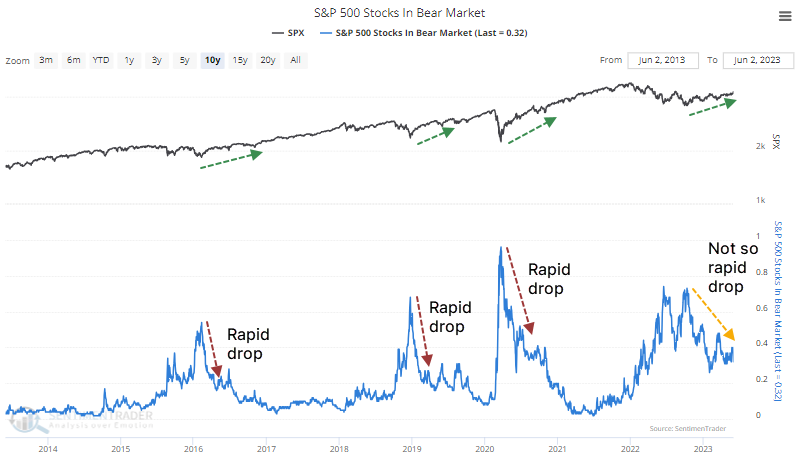
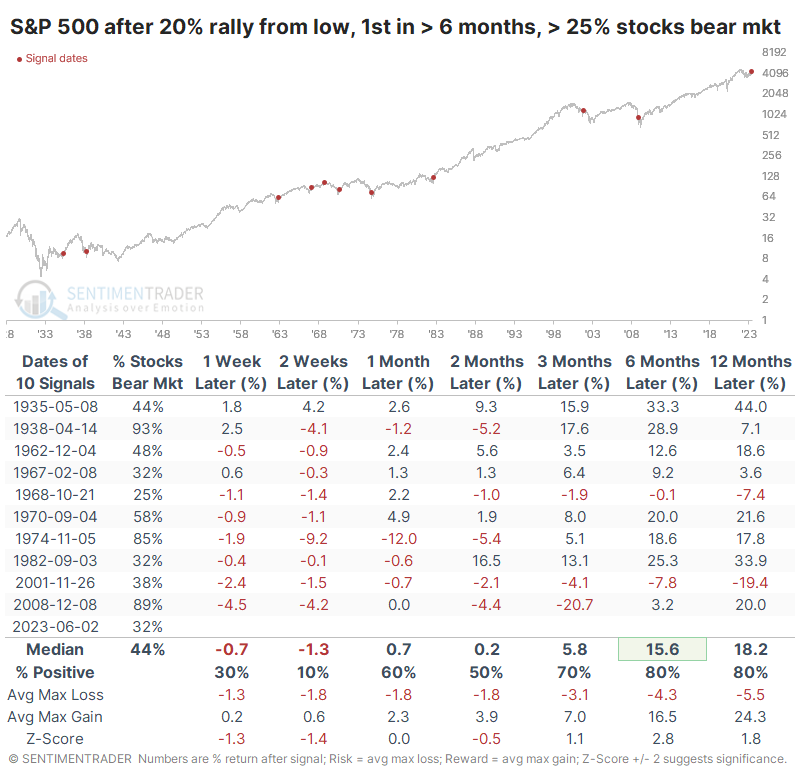
The table below shows similar environments since 1928. These are times when the S&P rallied 20% (okay, 19.5% or more, rounded) from a low, but at least a quarter of its stocks were still in bear markets.

Over the short term, the index declined almost every time. The drag of stocks still mired in bear markets proved too much for the index, at least for a while. But over the next three months, the S&P was higher 7 of the 10 times, and six to twelve months later, 8 times, and with excellent median returns. 

The biggest sustained losses occurred in 1968 when this triggered as the S&P was at a new high (not the case now), and in 2001, which was just a purely failed signal.
We like to look at counter-examples if possible, especially if a study is inconclusive or the sample size is especially small. So, the table below shows the opposite conditions when the S&P entered a new bull market, but fewer than 25% of stocks were in bear markets. These are times when investors pushed up more stocks, and most had recovered to within striking distance of new highs.
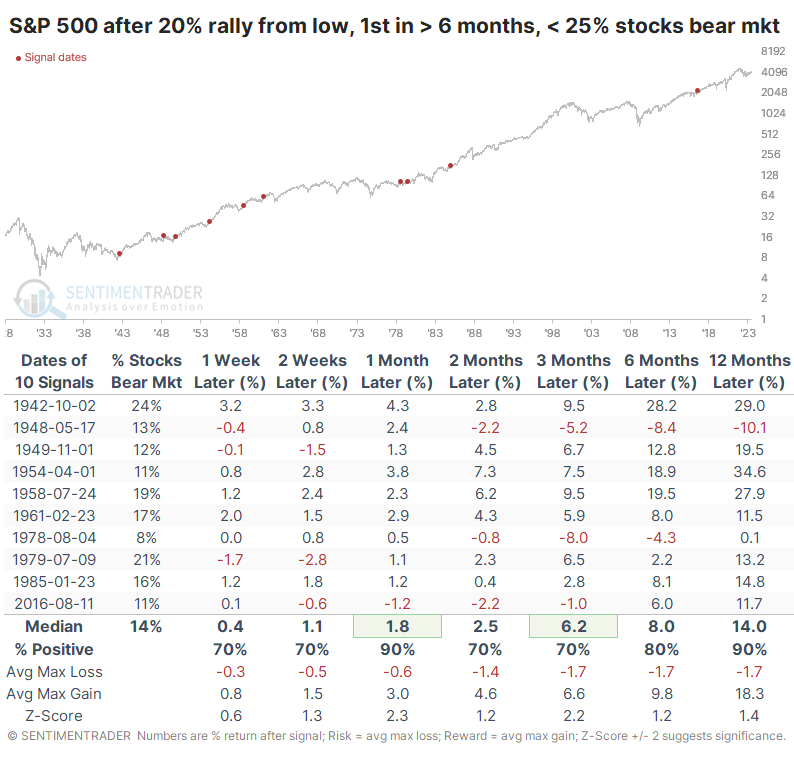
These instances were much better for forward returns, at least shorter-term. Over the next month, the S&P continued higher after 9 of the 10 signals, and the sole loser was small. The index was mostly able to continue higher longer-term as well, with only a single loss over the next year, which was reversed soon afterward.

What the research tells us...

There has been more and more of a chorus boo-hooing a lack of participation in the latest push of this rally. There is some merit to the detractions, as more participation has a lot of historical support, leading to better and more sustained rallies. But it's not quite that simple. There are times when a lack of participation means that there are more stocks for value-seeking investors to buy instead of chasing all of them trading well off their lows. According to this study, the potential new bull market is being led by a handful of powerful large stocks, which seems to be a concern for the short-term at most.

PRODUCTS
SentimenTrader
Trading Tools
Indicators & Data API
‍
Strategies & Scanner
‍
Research Reports
FREE
RESOUrCES
Simple Backtest
Calculator
Simple Seasonality
Calculator
The Kelly Criterion
Calculator
Sentiment Geo Map
‍
Public Research Reports
‍
Education
Sentiment Indicators
‍
Technical Indicators
‍
Pricing
Bundle pricing
‍
FAQ
‍
Announcements
‍
COMPANY
‍
About
‍
In the News
‍
Testimonials
‍
Client Success Stories
CONTACT
‍
General Inquiries
‍
Media Inquiries
‍
Financial Professionals Inquiries
‍
© 2026 Sundial Capital Research Inc. All rights reserved.
Setsail Marketing
TermsPrivacyAffiliate Program
Risk Disclosure: The information and tools provided are for research and analytical purposes only and are not intended as investment advice. Market analysis involves uncertainty, and outcomes may differ from expectations. Users should conduct their own due diligence and consider their individual circumstances before making any financial decisions. Past performance is not necessarily indicative of future results.

Hypothetical Performance Disclosure: Hypothetical performance results have many inherent limitations, some of which are described below. No representation is being made that any account will or is likely to achieve profits or losses similar to those shown; in fact, there are frequently sharp differences between hypothetical performance results and the actual results subsequently achieved by any particular trading program. One of the limitations of hypothetical performance results is that they are generally prepared with the benefit of hindsight. In addition, hypothetical trading does not involve financial risk, and no hypothetical trading record can completely account for the impact of financial risk of actual trading. for example, the ability to withstand losses or to adhere to a particular trading program in spite of trading losses are material points which can also adversely affect actual trading results. There are numerous other factors related to the markets in general or to the implementation of any specific trading program which cannot be fully accounted for in the preparation of hypothetical performance results and all which can adversely affect trading results.

Testimonial Disclosure: Testimonials appearing on this website may not be representative of other clients or customers and is not a guarantee of future performance or success.