Products
SentimenTrader Trading Tools
‍
Backtest Engine
My Trading Toolkit
Correlation Analysis
Seasonality
Market Prediction
Indicators & Data API
‍
Proprietary Indicators & Charts
Market Data API
Strategies & Scanner
‍
50+ Trading Strategies
Smart Stock Scanner
Smart Option Scanner
Research Reports
‍
Research Solutions
Reports Library
Free Resources
Simple Backtest Calculator
Simple Seasonality Calculator
The Kelly Criterion Calculator
Sentiment Geo Map
Public Research Reports
Education
Sentiment Indicators
Technical Indicators
Pricing
Company
About
In the News
Testimonials
Client Success Stories
Contact
Log inLoginSign up
< BACK TO ALL REPORTS

NYSE breadth skews to the negative side

Dean Christians
2023-09-26
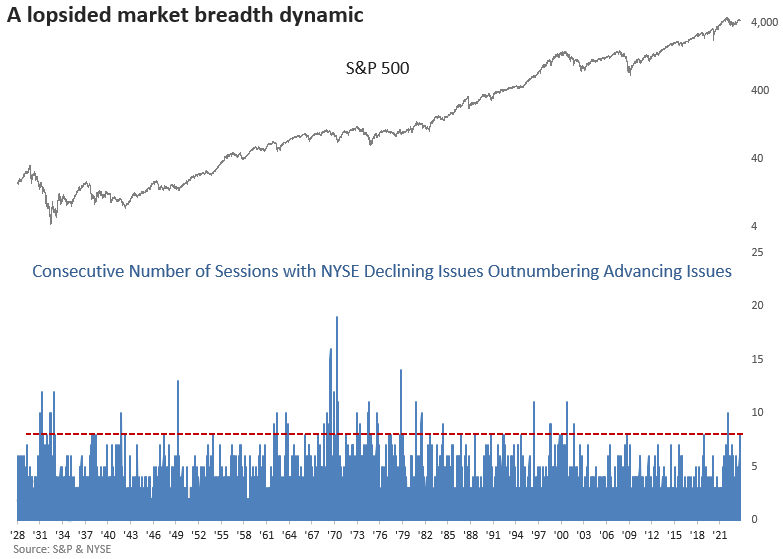
Declining issues on the NYSE outnumbered advancing issues for seven consecutive sessions, a dynamic seen only one percent of the time since 1928. After similar breadth-based conditions, the S&P 500 tends to rally over the next three months. Still, returns are lackluster and underperform relative to any random time over the study period.

Key points:

  • Declining issues on the NYSE outnumbered advancing issues for seven consecutive sessions
  • Similar advance-decline dynamics led to lackluster returns over the subsequent three months
  • When the lopsided streak occurs in an uptrend, the outlook remains stagnant over the same horizon

What, if any, insights can we derive from the skewed NYSE breadth?

When considering breadth-based indicators for exchanges, I prefer the NYSE rather than the Nasdaq. The NYSE contains a more substantial collection of high-quality stocks and bond proxies, thus offering us two market insights.

With bond yields pressed near the upper end of multi-year highs, stocks and bond proxies on the NYSE have come under pressure. In each of the previous seven sessions, declining stocks on the NYSE have outpaced advancing issues. This dynamic has only occurred 1% of the time since 1928.
Comparable stretches of skewed breadth led to uninspiring returns

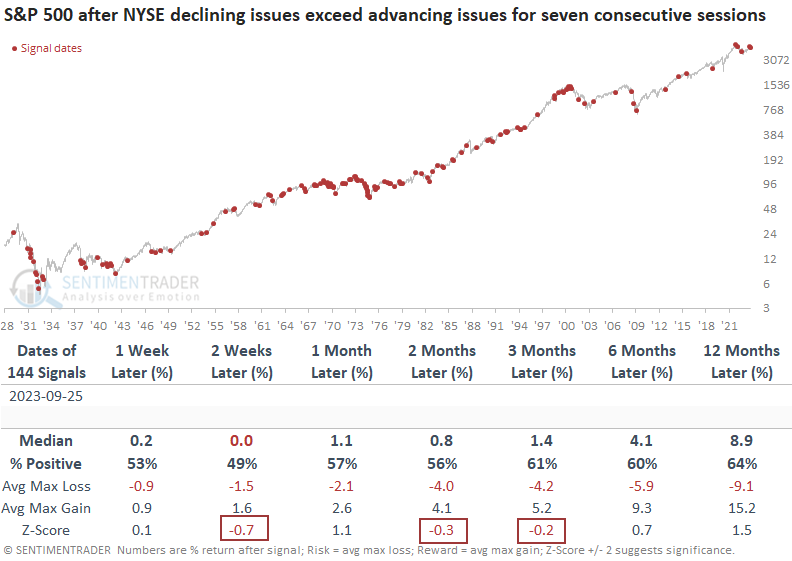
When the number of declining issues on the NYSE exceeds that of advancing issues like now, the S&P 500 shows uninspiring returns over the ensuing three months. During that timeframe, S&P 500 returns were worse than the overall study period returns in 3 out of 5 horizons.
Signals in an uptrend

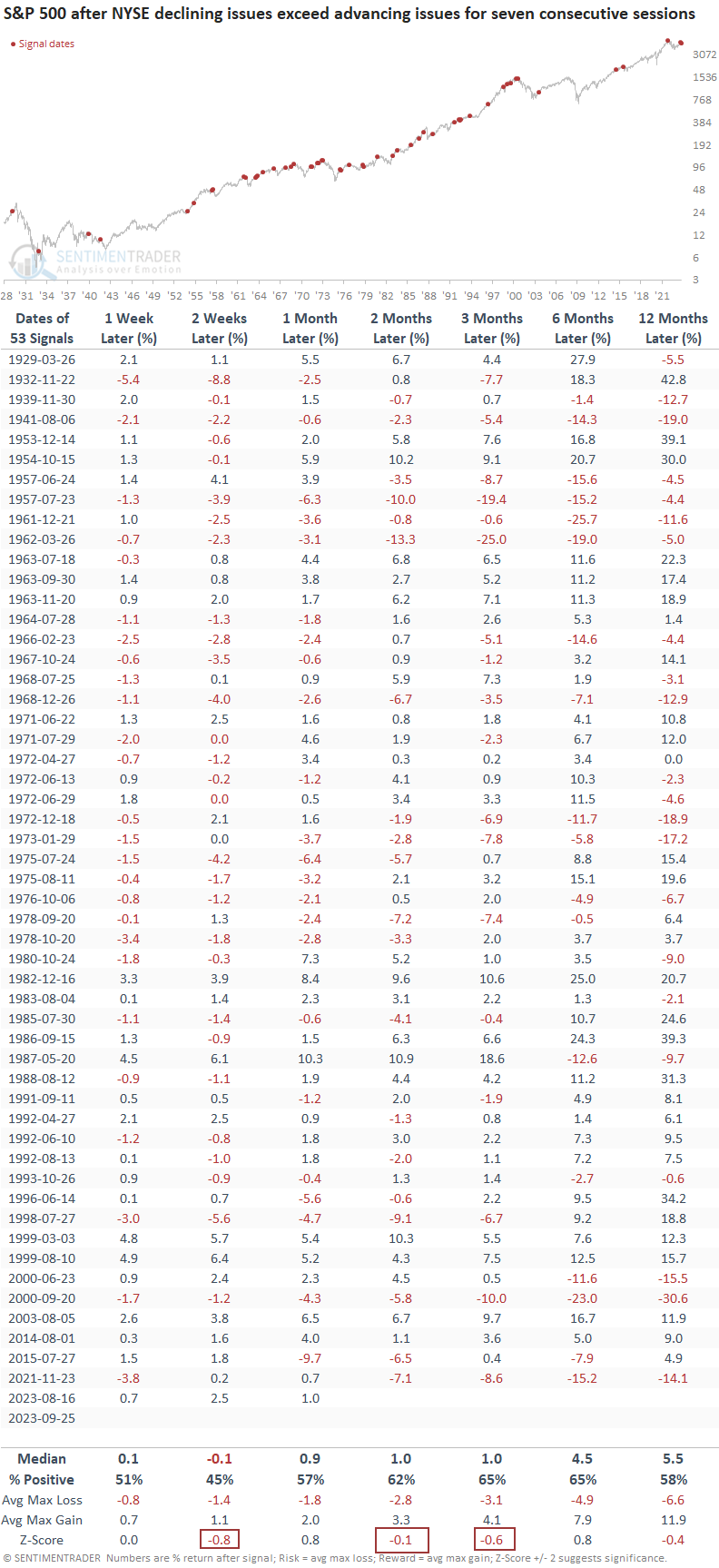
Let's add some context. I will now require the S&P 500 to close above its 200-day average, signifying an uptrend similar to now. When NYSE breadth is negative for seven consecutive sessions, and the S&P 500 is above its long-term average, returns are still lackluster over the subsequent three months. Once again, 3 out of 5 time frames up to three months later underform the median return over the study period.
Interestingly, when I ran a test to identify the consecutive number of negative sessions that was ideal for buying the S&P 500, the optimization returned seven sessions. The optimal holding period was only 12 trading days. 

What the research tells us...

NYSE advance-decline breadth has been skewed in favor of declining issues over the last seven sessions, reaching a point rarely seen in history. Typically, a mean reversion bounce back occurs when participation measures tilt one way for too long. While the S&P 500 tends to rally after seven consecutive sessions with declining issues outweighing advancing issues, forward returns are lackluster over the subsequent three months, and 3 out of 5 instances underperform relative to history. So, the market may need to fall further, creating a more meaningful oversold condition that entices buyers.

PRODUCTS
SentimenTrader
Trading Tools
Indicators & Data API
‍
Strategies & Scanner
‍
Research Reports
FREE
RESOUrCES
Simple Backtest
Calculator
Simple Seasonality
Calculator
The Kelly Criterion
Calculator
Sentiment Geo Map
‍
Public Research Reports
‍
Education
Sentiment Indicators
‍
Technical Indicators
‍
Pricing
Bundle pricing
‍
FAQ
‍
Announcements
‍
COMPANY
‍
About
‍
In the News
‍
Testimonials
‍
Client Success Stories
CONTACT
‍
General Inquiries
‍
Media Inquiries
‍
Financial Professionals Inquiries
‍
© 2026 Sundial Capital Research Inc. All rights reserved.
Setsail Marketing
TermsPrivacyAffiliate Program
Risk Disclosure: The information and tools provided are for research and analytical purposes only and are not intended as investment advice. Market analysis involves uncertainty, and outcomes may differ from expectations. Users should conduct their own due diligence and consider their individual circumstances before making any financial decisions. Past performance is not necessarily indicative of future results.

Hypothetical Performance Disclosure: Hypothetical performance results have many inherent limitations, some of which are described below. No representation is being made that any account will or is likely to achieve profits or losses similar to those shown; in fact, there are frequently sharp differences between hypothetical performance results and the actual results subsequently achieved by any particular trading program. One of the limitations of hypothetical performance results is that they are generally prepared with the benefit of hindsight. In addition, hypothetical trading does not involve financial risk, and no hypothetical trading record can completely account for the impact of financial risk of actual trading. for example, the ability to withstand losses or to adhere to a particular trading program in spite of trading losses are material points which can also adversely affect actual trading results. There are numerous other factors related to the markets in general or to the implementation of any specific trading program which cannot be fully accounted for in the preparation of hypothetical performance results and all which can adversely affect trading results.

Testimonial Disclosure: Testimonials appearing on this website may not be representative of other clients or customers and is not a guarantee of future performance or success.