
More Tech stocks recapture their long-term uptrends

More Technology stocks are recovering
Last week, we saw that Nasdaq stocks had staged a recovery, at least in terms of the percentage of them rising to 52-week highs versus those falling to 52-week lows.
While the Nasdaq is considered a tech index, that's not entirely accurate. Even so, there has been a recovery in long-term trends, specifically among Technology stocks. After fewer than 25% of Technology sector stocks were trading above their 200-day moving averages, enough recovered so that most of them were above their averages.
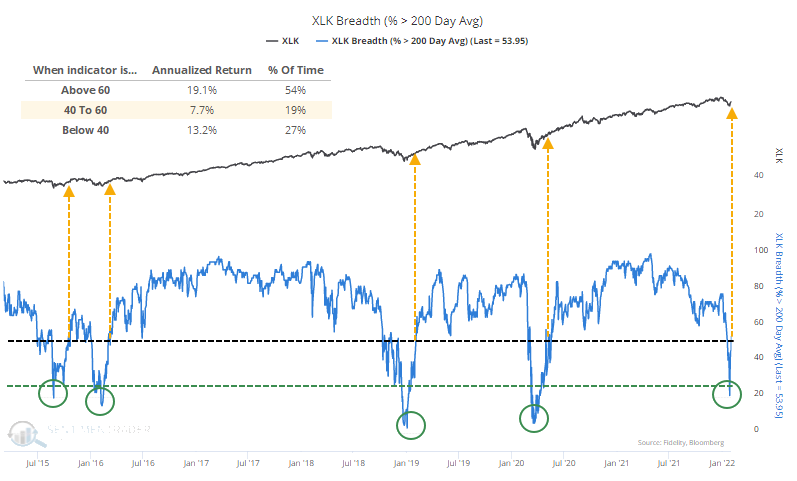
Part of the reason why we've seen a quick change is because so many of the stocks have been hovering right around their 200-day averages. As stocks have gyrated in recent months, those averages have flattened out, and more stocks are popping above and below them as prices whip back and forth.
It's generally better for Tech stocks if we see a thrust with more than 60% of them trading above their 200-day averages. So far, it's been hovering below 60%, which is what an unhealthy market does. We can see from the chart above that the total return on Technology stocks since 1952 was only 7.7% when the percentage of members was neutral, between 40% - 60%.

| Stat box For only the 2nd time in 15 years, 100% of Energy stocks have traded above their 200-day moving averages for 20 consecutive days. The other instance was April 2011. |
Options bets against Financials are reversing
When investors are bullish on stocks, they buy call options to bet on rising prices. Conversely, when they are bearish on stocks, they purchase put options to bet on declining stocks. The put/call ratio can be used as a contrary indicator to identify an environment where sentiment has become too pessimistic on the future direction of stocks. When opinions become too bearish, stocks tend to rally.
Our aggregated put/call ratio indicator measures the summed options data for constituents of the index/ETF. Dean showed that over the past couple of weeks, options data on Financial stocks has reversed from a pessimistic extreme.
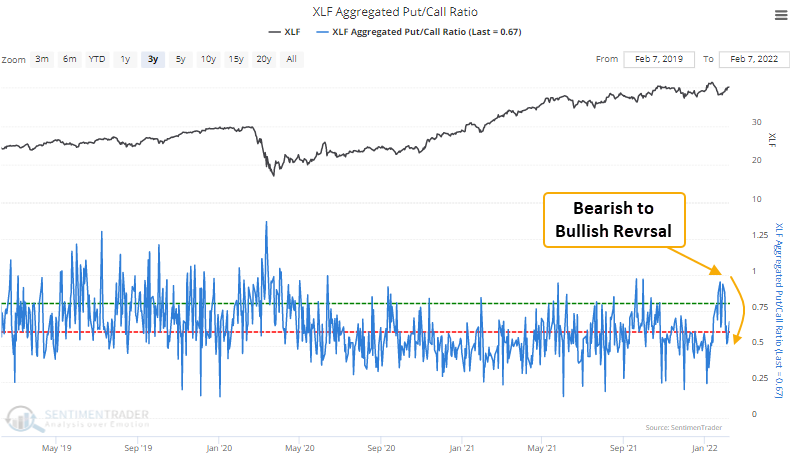
A model designed to capture reverses in sentiment in the sector has triggered about a dozen other times over the past decade.
