
More breadth thrust signals for S&P 500 and Nasdaq 100

Key points
- Spikes in the McClellan Summation Index, more often than not, suggest a powerful breadth thrust
- Breadth thrusts typically signal the type of momentum that can follow through for up to a year
- Both the S&P 500 and Nasdaq 100 indexes experienced an important reading from their respective McClellan Summation Indexes on 2023-12-28.
S&P 500 McClellan Summation Index spikes
The S&P 500 McClellan Summation Index is calculated by adding each day's S&P 500 McClellan Oscillator value to the index. The chart below highlights all dates when the S&P 500 McClellan Summation Index crossed above 1,000 for the first time in six months. The latest signal occurred on 2023-12-28.
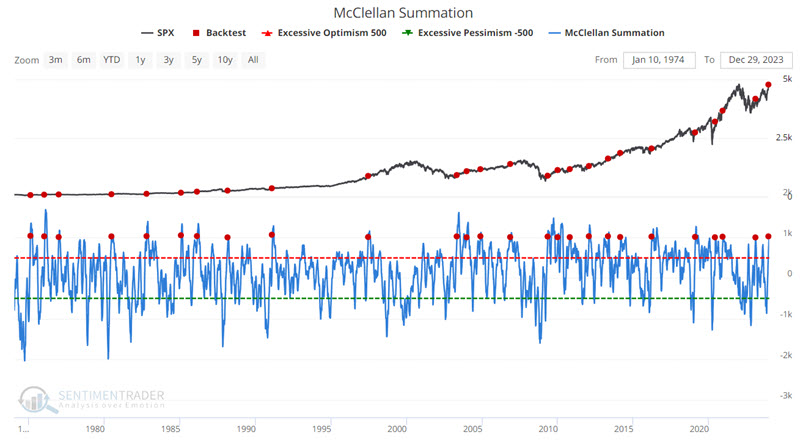
Intuitively, most investors will consider such a reading as a sign of an "overbought" market. This is understandable since the only way to achieve such a reading is for the market to stage an extremely powerful rally with broad participation. History is clear that this type of "straight line" advance can only continue for so long. However, history also makes it clear that the broad-based buying required to trigger this signal often signals the momentum that tends to see the market follow through for many months.
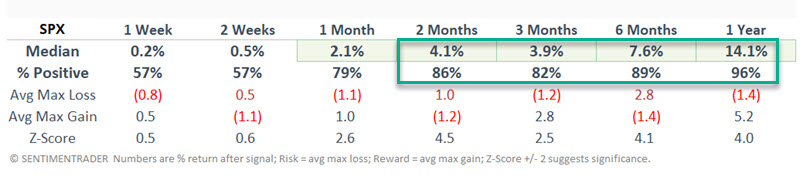
The table below summarizes S&P 500 performance following the dates highlighted in the chart above.
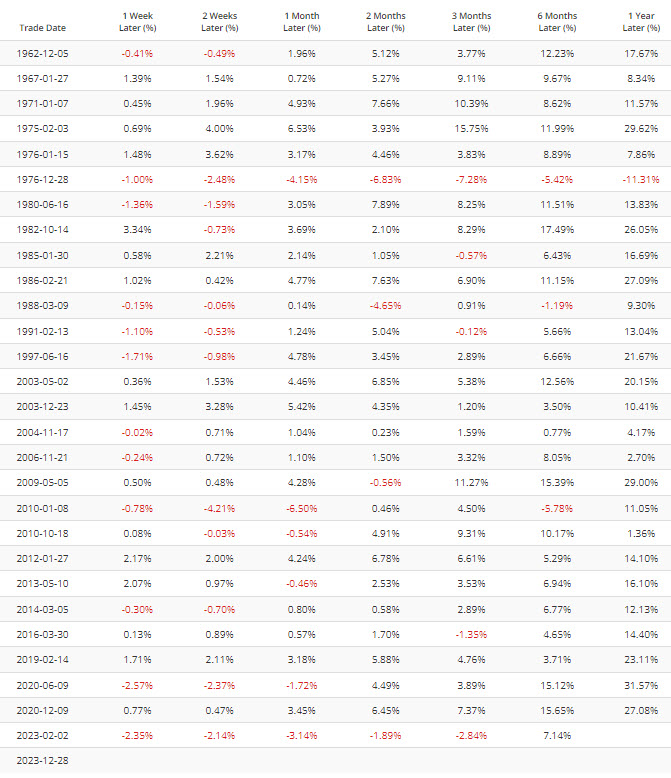
The table below shows signal-by-signal results.
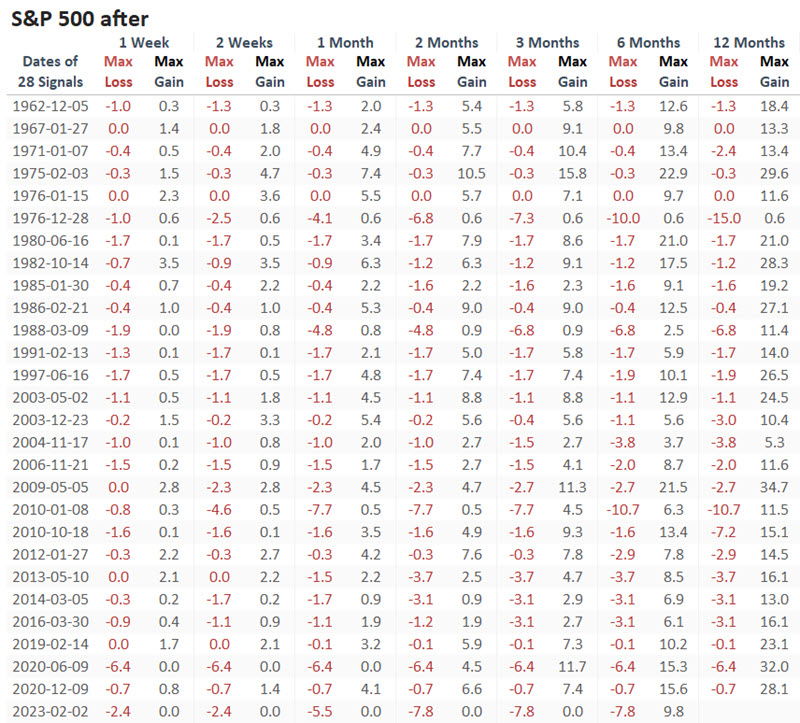
The table below highlights the maximum gains and losses experienced following previous signals. Note that only the 1976 and 2010 signals experienced a drawdown of over -10%.
The Nasdaq 100 McClellan Summation Index also spikes
The Nasdaq 100 McClellan Summation Index is calculated by adding each day's Nasdaq 100 McClellan Oscillator value to the index. The chart below highlights all dates when the Nasdaq 100 McClellan Summation Index crossed above 450 for the furst time in six months. The latest signal occurred on 2023-12-28.
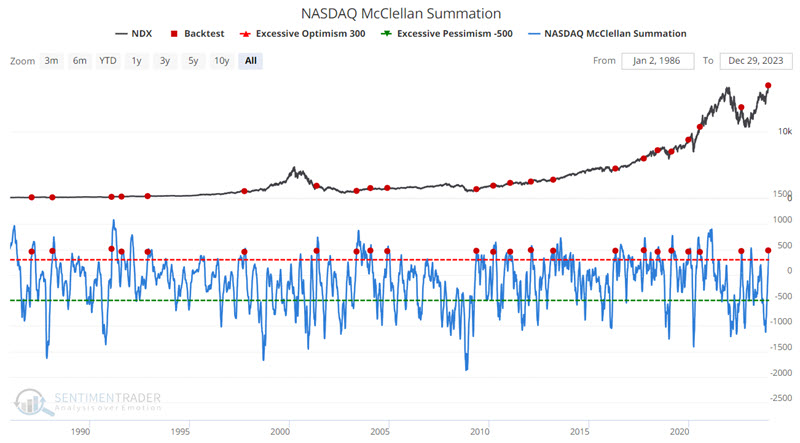
The table below summarizes Nasdaq 100 performance following the dates highlighted in the chart above.

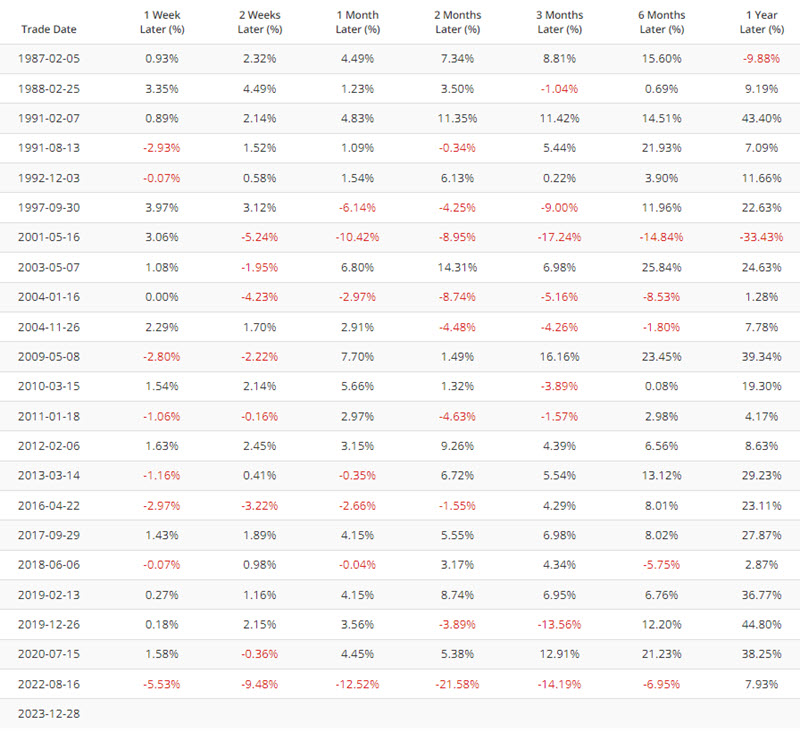
The table below displays Nasdaq 100 performance on a signal-by-signal basis. Note that the 1987 signal saw a +15.6% gain six months later but a 12-month loss of -9.88% due to the Crash of '87. Also, the 2001-05-16 signal was followed by a devastating 12-month decline of -33.43% as the Nasdaq bubble burst during the 2000-2002 bear market - which saw the Nasdaq lose -83% peak-to-valley.
What the research tells us…
As always, there are no sure things in the financial markets. The 2001 signal above for the Nasdaq 100 is proof of that. One helpful approach is looking at indicators as the "weight of the evidence, " not necessarily as standalone trading models. Given the overall favorable history following previous signals, the new dueling favorable signals for the S&P 500 and Nasdaq 100 indexes lend significant weight to the favorable side of the ledger.