
Money moves the market: Stocks - Part I

Key points
- It is said that "money moves the market"
- Real M2 offers a useful way to track the trend in the size of the money supply
- Our research reveals that changes and trends in Real M2 can exert a great deal of influence over a variety of financial markets, including stocks, gold, and Bitcoin
- In this piece, we look to use this information as a stock market indicator
What is M2 and why does it matter?
One old adage about the stock market states, "Money moves the market." Theoretically, this is hard to argue against. When money pours into stocks, rising demand tends to push prices higher. Conversely, when buyers go on strike and less money comes into the market, stock prices tend to be weaker. So, how do we measure the trend of "money?" One well-known measure is M2.
M2 is the U.S. Federal Reserve's estimate of the total money supply, including all the cash people have on hand, plus all the money deposited in checking accounts, savings accounts, and other short-term savings vehicles such as certificates of deposit (CDs). Retirement account balances and time deposits above $100,000 are omitted from M2.
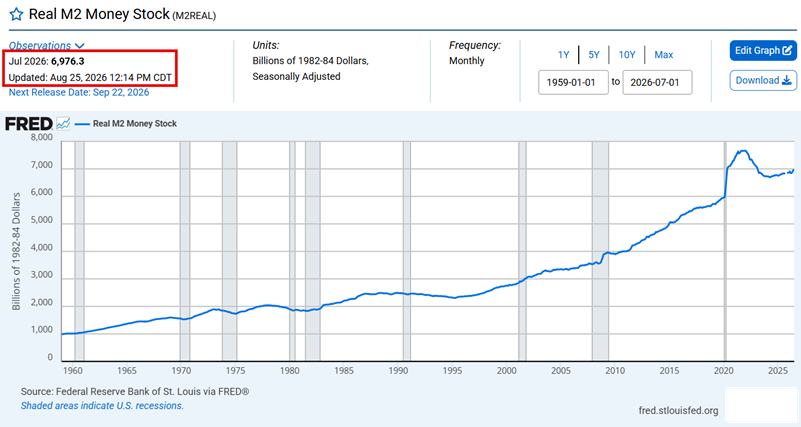
For our purposes, we will use "Real M2", which is M2 deflated by inflation. This series deflates the M2 money stock (https://fred.stlouisfed.or