
Low odds, ugly tails, worse together

Key points
- The NYSE Hindenburg Omen has a 33% win rate one month later across 69 signals going back to 1965, the lowest of any version
- The NASDAQ Hindenburg Omen looks okay on average but hides a bimodal distribution, the worst one-year loss was 48%, the best gain was 46%
- When both trigger simultaneously, as they just did on May 13, the win rate drops to 39% through five months across 19 signals
- Cross-asset data after simultaneous triggers shows the dollar strengthening and every major equity index negative on average, the opposite of a capitulation pattern
The Hindenburg Omen triggers
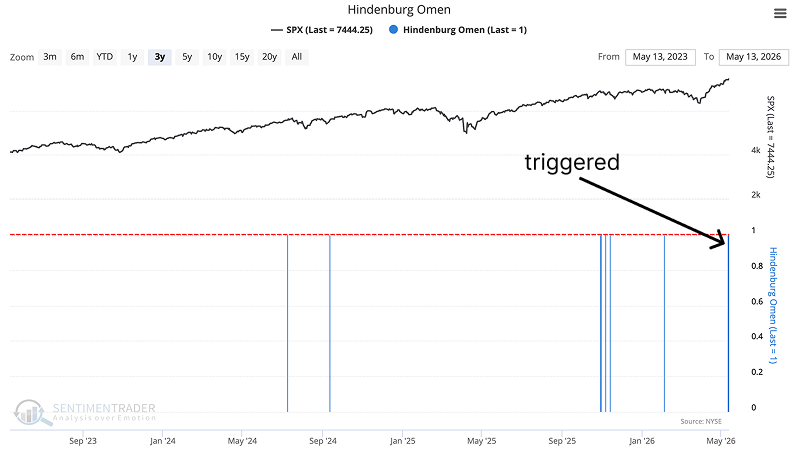
When a large number of stocks hit new highs and new lows at the same time, signaling fractured participation beneath the surface. On May 13, it fired on both the NYSE and the NASDAQ. But the signal is not one thing. What it means depends entirely on which version you are looking at, and each layer adds a different kind of bad news.
Low odds, then noise
The NYSE Hindenburg Omen alone has triggered 69 times since 1965. Related backtest click here.
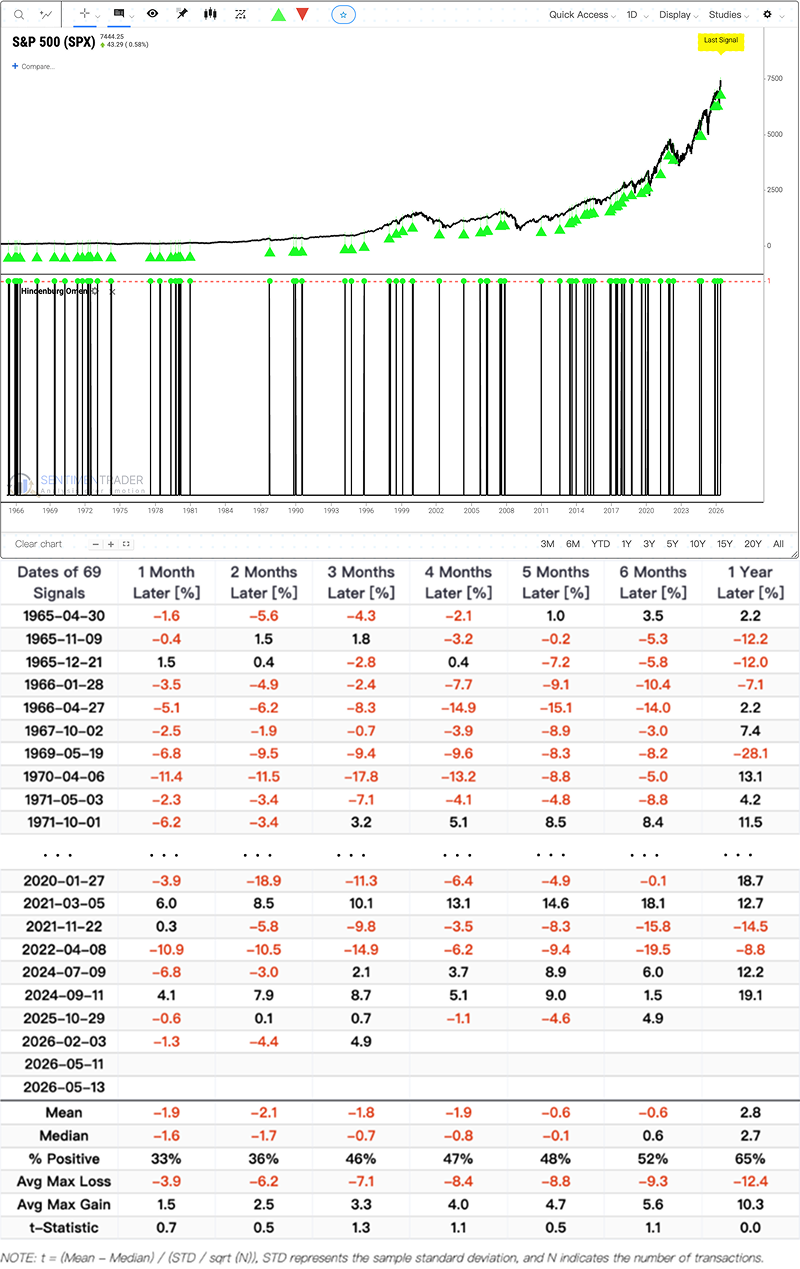
The short-term record is poor. One month later, the S&P 500 was higher just 33% of the time. Two months, 36%. Three months, 46%. The average return is negative through four months, and the win rate does not cross 50% until the six-month mark. A year out, the index was higher 65% of the time with a modest 2.8% average gain. The signal hurts early, then fades. It is not a death sentence, but the first few months are a rough ride.
Averages lie, tails do not
The NASDAQ version looks better on the surface. Related backtest click here.
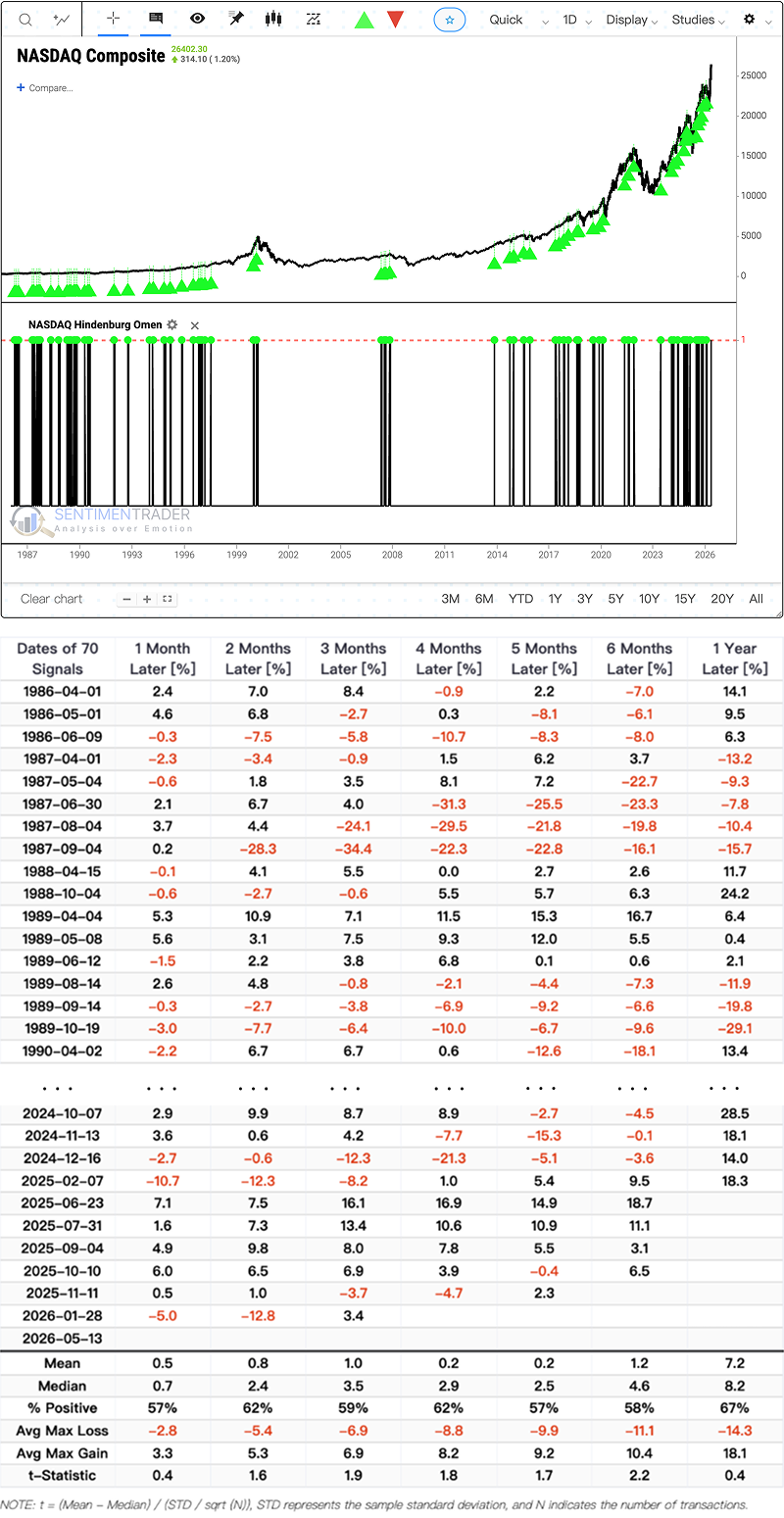
Across 70 signals, QQQ was higher a month later 57% of the time and a year later 67%, averaging a 7.2% gain. The six-month t-statistic hits 2.2, the highest significance reading across any version and any horizon.
But the max loss/gain profile tells a different story. The worst one-month outcome was a 13.8% loss. The best was a 15.2% gain. Three months out, the range widens to a 34.6% loss versus a 40.7% gain. A year later, the spread is staggering, the worst outcome was a 48.1% loss, the best was a 46.6% gain.
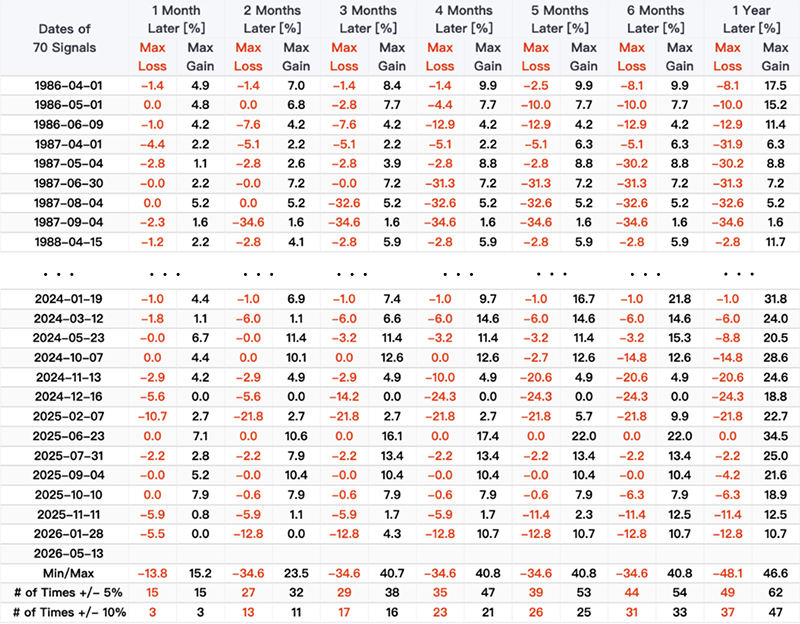
That is not a normal distribution. Some signals preceded some of the worst drawdowns in modern history. The February 2000 trigger came just before the Nasdaq lost nearly half its value. October 2007 preceded a 41% peak-to-trough decline. November 2021 led to a 34% loss. Other signals preceded rallies of 40% or more. The 71% one-year win rate looks comfortable until you realize that the 29% of the time it was wrong, the losses were catastrophic.
Both fire, odds drop further
On May 13, the signal triggered on both exchanges at once.
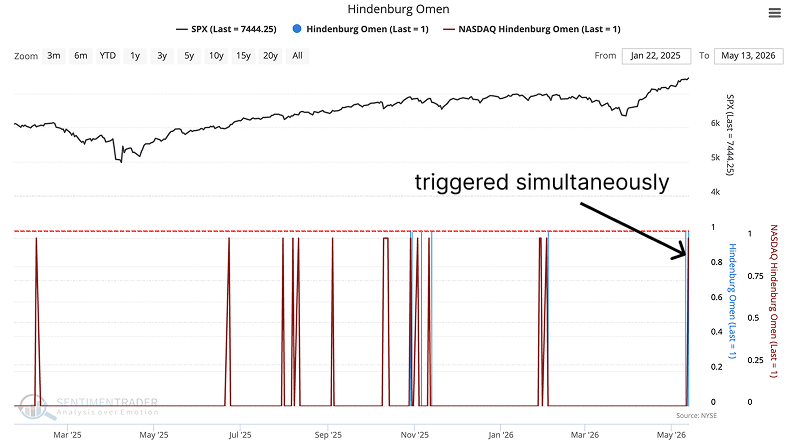
That simultaneous trigger has happened only 19 times, and it is the worst variant. Related backtest click here.
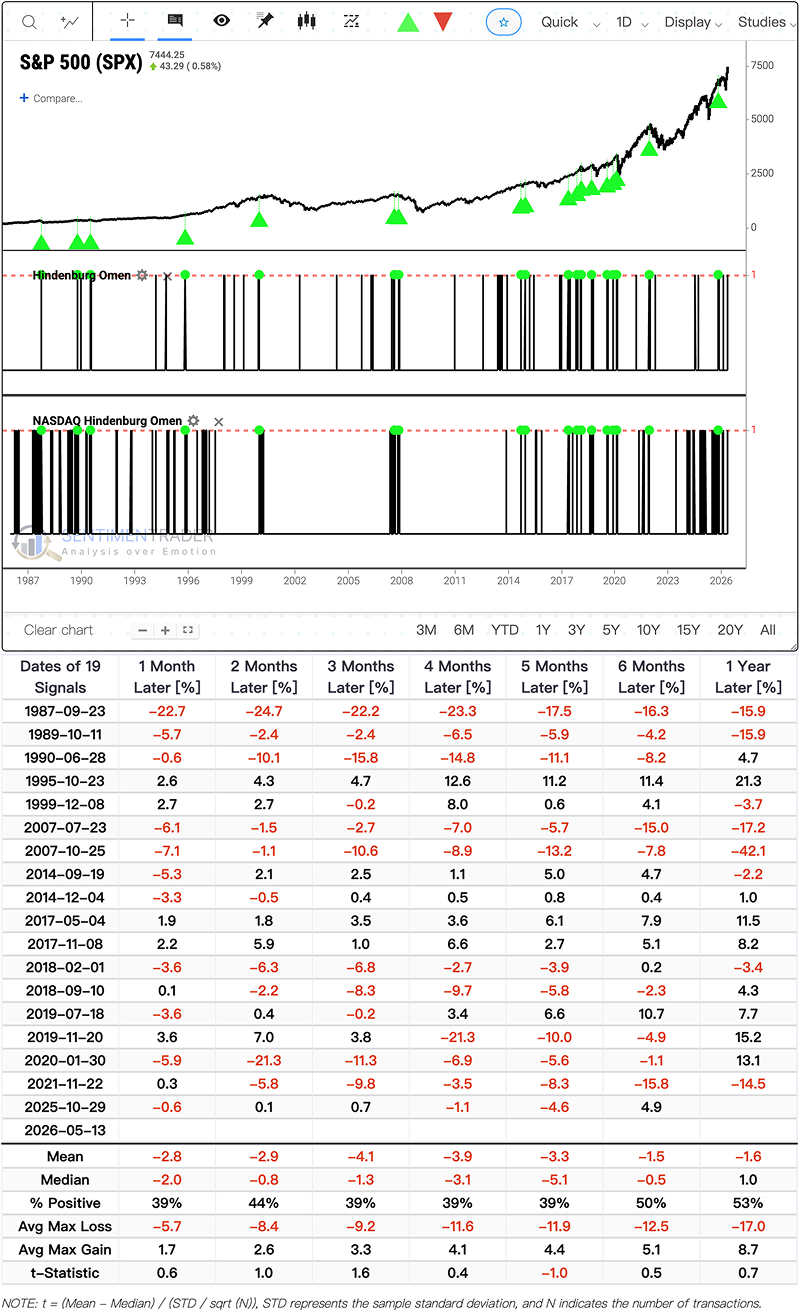
The S&P 500 was higher a month later just 39% of the time, averaging a loss of nearly 3%. Three months out, the average decline deepens past 4%, and the win rate stays locked at 39% through five months. Even at one year, the average return is still negative at minus 1.6%.
The two worst outcomes bookended major crashes, the October 2007 signal preceded a 42% one-year decline, and the September 1987 signal came weeks before Black Monday. Even removing those, the win rate through five months is still only 39%. The signal earns its ominous name when both exchanges fire together.
No escape across assets
The cross-asset picture after simultaneous triggers offers little refuge. Every major U.S. equity index is negative on average from one month through one year. The Russell 2000 fares worst across the board, down 3.9% a month later and 3.3% a year later. The Dow Jones has the weakest one-year win rate at just 41%. The Nasdaq Composite starts with the worst one-month win rate of only 22%, though it recovers best by the one-year mark with a 59% hit rate.
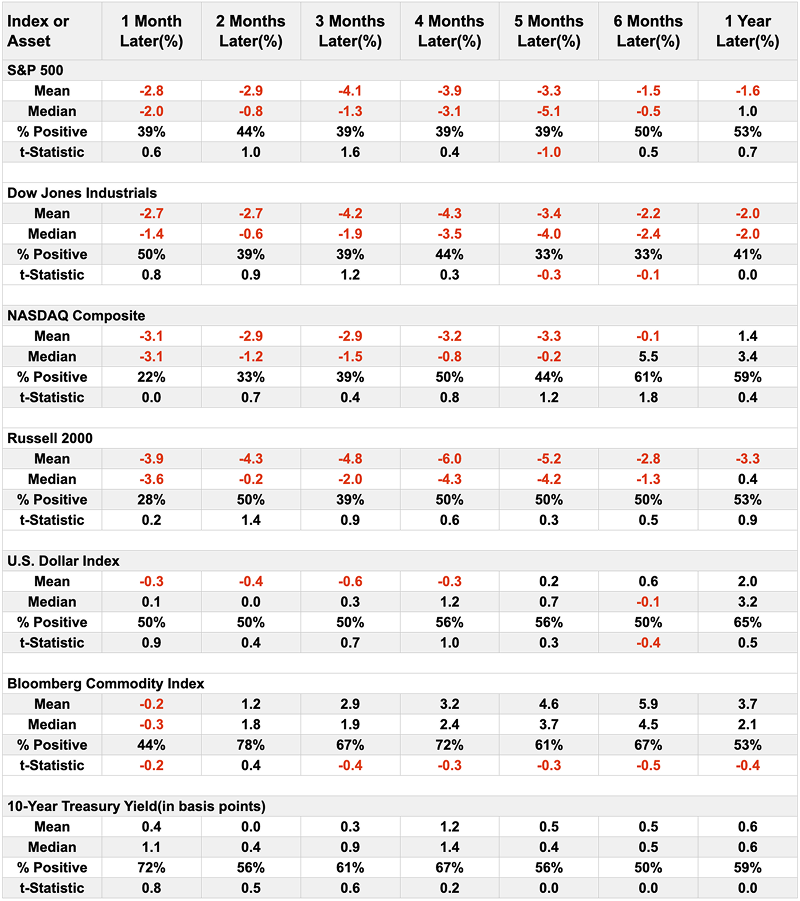
The dollar does the opposite of what it did after Titanicburg extremes. It strengthens, up 2.0% on average a year later with a 65% win rate. Yields edge higher, not lower, with the 10-year gaining 0.6 basis points over a year. Commodities are the only asset class with a meaningful positive signal, averaging 2.9% at three months with a 78% win rate, but the one-year gain is a modest 3.7%.
That relationship, weak equities plus a stronger dollar plus rising yields, is the hallmark of risk-off positioning. It is the mirror image of the capitulation pattern where breadth collapse so severe that selling exhausts itself. The simultaneous Hindenburg trigger captures something different: disagreement so widespread that new highs and new lows coexist, a slower and more corrosive dynamic than outright panic.
What the research tells us...
Each layer of the Hindenburg Omen adds a different kind of warning. The NYSE version alone gives you low odds early, 33% positive a month later, but the signal eventually fades. The NASDAQ version looks fine on average but conceals a bimodal distribution where crashes and rallies sit side by side. When both fire together, the win rate drops to 39% through five months, the cross-asset data shows risk-off positioning across the board, and the dollar strengthens rather than weakens. The 19-signal sample is thin, and two of those signals preceded historic crashes that skew the averages. Whether this time follows the pattern or lands in the tail depends on whether the current breadth fracture is structural or temporary. The weight of the historical evidence leans negative, but 19 signals is not enough to call it with certainty.