Products
SentimenTrader Trading Tools
‍
Backtest Engine
My Trading Toolkit
Correlation Analysis
Seasonality
Indicators & Data API
‍
Proprietary Indicators & Charts
Market Data API
Strategies & Scanner
‍
50+ Trading Strategies
Smart Stock Scanner
Research Reports
‍
Research Solutions
Reports Library
Free Resources
Simple Backtest Calculator
Simple Seasonality Calculator
The Kelly Criterion Calculator
Sentiment Geo Map
Public Research Reports
Education
Sentiment Indicators
Technical Indicators
Pricing
Company
About
In the News
Testimonials
Client Success Stories
Contact
Log inLoginSign up
< BACK TO ALL REPORTS

Leading indicators continue to contract

Dean Christians
2022-10-04
The Institute for Supply Management released the latest manufacturing data, and the surveys continued to deteriorate, especially the new orders and employment indexes. After similar multi-month readings in contraction territory from the two sub-components, stocks struggled.

Key points:

  • The ISM new orders index has closed in contraction territory in 3 out of 4 months
  • The ISM employment index has fared worse, with a contraction in 4 out of 5 months
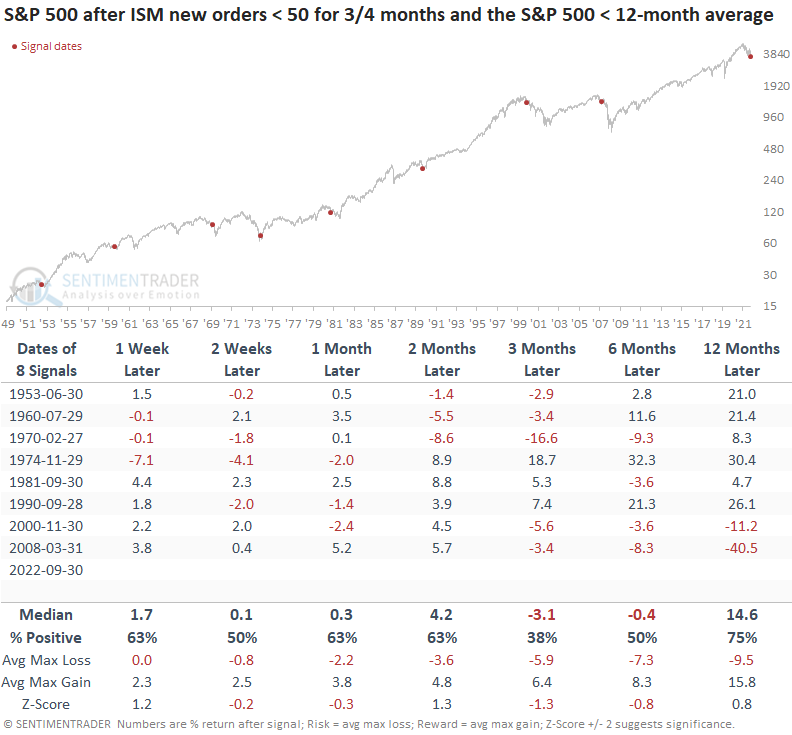
  • After similar conditions, the S&P 500 struggled up to 6 months later

The contraction in two key ISM manufacturing sub-components suggests caution 

The latest survey from manufacturing executives does not bode well for a potential turn in the business cycle.

The Institute for Supply Management released the latest manufacturing data this week. While the overall survey remains slightly above 50 - suggesting expansion - two key sub-components have continued to hover below the critical level.

For the first time since March 2008, the new orders index closed in contraction territory in 3 of 4 months, with the S&P 500 trading below its 12-month average. 
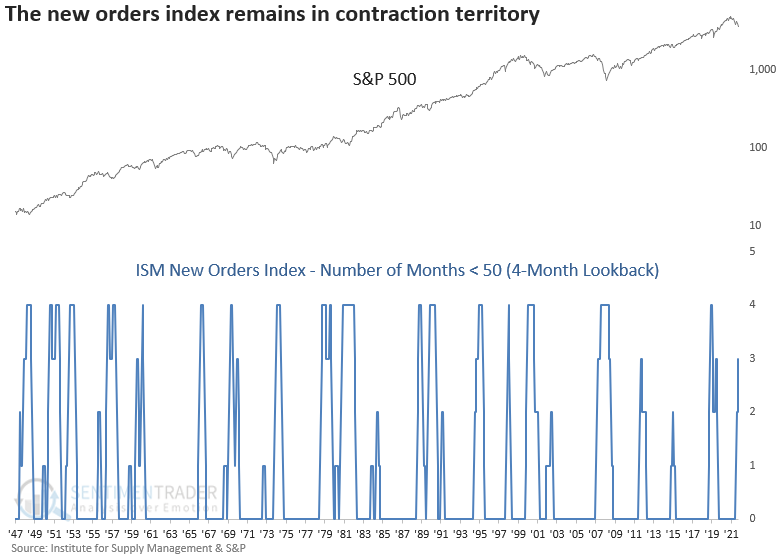
A persistent contraction in the new orders survey preceded negative returns for stocks

When the new orders index is in contraction mode and the S&P 500 is below its 12-month average, stocks tend to struggle up to 6 months later. The signal shows a negative return at some point in every case in the first six months. A year later, the results look solid except for 2000 and 2008. 
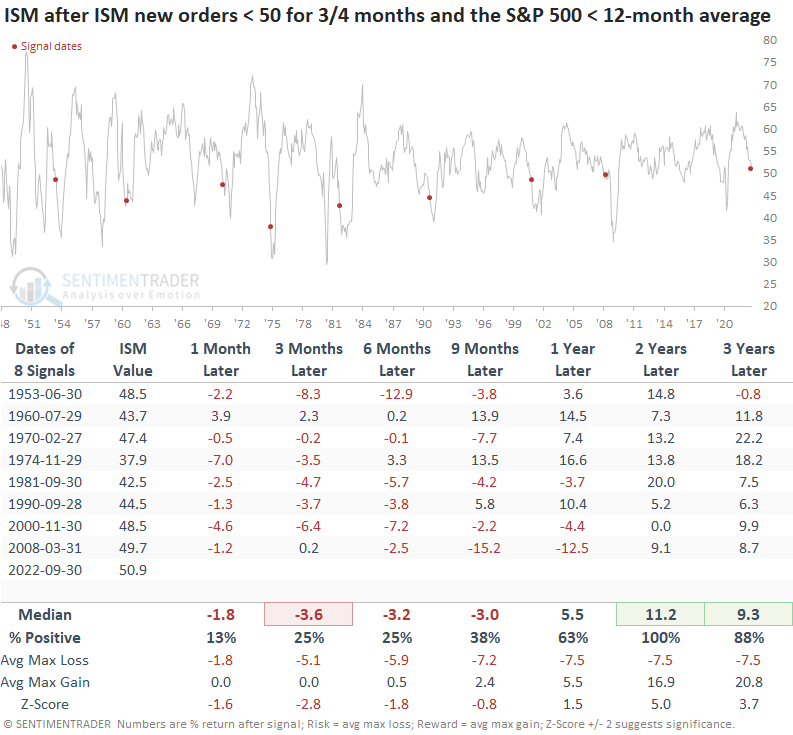
While the overall ISM survey remains in expansion territory, the new orders signal suggests it will likely fall below 50. Most of the ISM values were well below the contraction level at the time of an alert, with March 2008 being the most similar.
The employment picture doesn't provide much comfort either

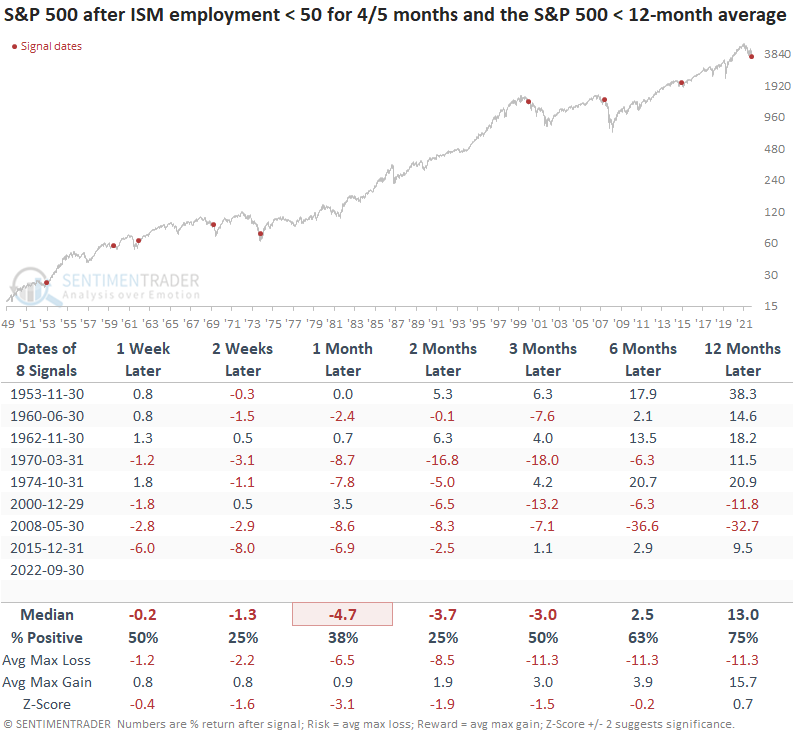
The ISM employment index looks slightly worse than the new orders index, with a contraction in 4 of 5 months. 
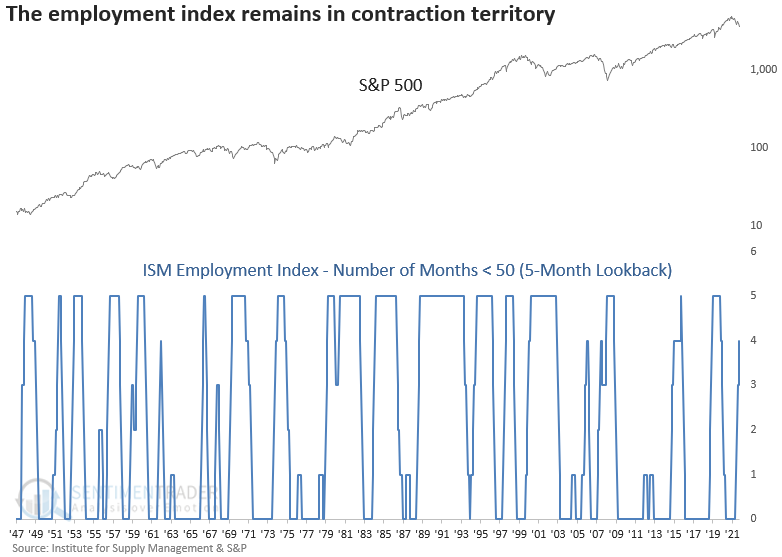
After a persistent contraction in the employment index, stocks struggled, especially up to 3 months later. Once again, a year later looks constructive except for the dot-com bust and the global financial crisis.
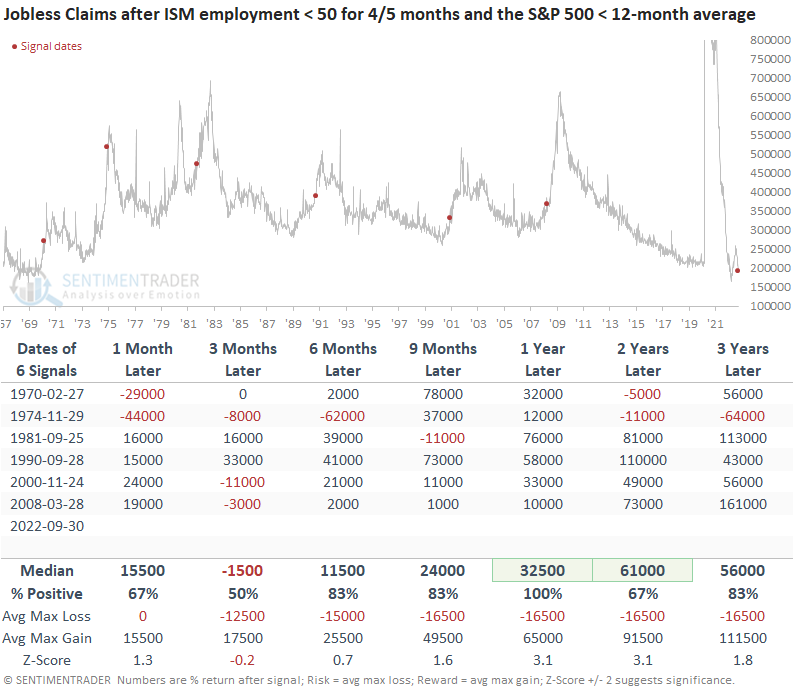
One of the arguments against an imminent recession in the U.S. has been the healthy employment backdrop. Applying the ISM employment signals to jobless claims suggests people filing to receive unemployment insurance benefits could rise in the next year. 

However, I would note that claims are not currently in an uptrend, which was the case in previous instances. So, maybe this time is different.
What the research tells us...

With economic data across various pockets of the economy continuing to soften within the context of a stock market downtrend, one must monitor new data closely for clues of a potential trough in the business cycle. While the most recent update from the Institute for Supply Management doesn't bode well for stocks on a medium-term basis, eventually, the cycle will turn, and the market will pivot accordingly.

Sorry, you don't have access to this report

Upgrade your subscription plan to get access
Go to Dasboard
PRODUCTS
SentimenTrader
Trading Tools
Indicators & Data API
‍
Strategies & Scanner
‍
Research Reports
FREE
RESOUrCES
Simple Backtest
Calculator
Simple Seasonality
Calculator
The Kelly Criterion
Calculator
Sentiment Geo Map
‍
Public Research Reports
‍
Education
Sentiment Indicators
‍
Technical Indicators
‍
Pricing
Bundle pricing
‍
FAQ
‍
Announcements
‍
COMPANY
‍
About
‍
In the News
‍
Testimonials
‍
Client Success Stories
CONTACT
‍
General Inquiries
‍
Media Inquiries
‍
Financial Professionals Inquiries
‍
© 2026 Sundial Capital Research Inc. All rights reserved.
Setsail Marketing
TermsPrivacyAffiliate Program
Risk Disclosure: Futures and forex trading contains substantial risk and is not for every investor. An investor could potentially lose all or more than the initial investment. Risk capital is money that can be lost without jeopardizing ones’ financial security or life style. Only risk capital should be used for trading and only those with sufficient risk capital should consider trading. Past performance is not necessarily indicative of future results.

Hypothetical Performance Disclosure: Hypothetical performance results have many inherent limitations, some of which are described below. No representation is being made that any account will or is likely to achieve profits or losses similar to those shown; in fact, there are frequently sharp differences between hypothetical performance results and the actual results subsequently achieved by any particular trading program. One of the limitations of hypothetical performance results is that they are generally prepared with the benefit of hindsight. In addition, hypothetical trading does not involve financial risk, and no hypothetical trading record can completely account for the impact of financial risk of actual trading. for example, the ability to withstand losses or to adhere to a particular trading program in spite of trading losses are material points which can also adversely affect actual trading results. There are numerous other factors related to the markets in general or to the implementation of any specific trading program which cannot be fully accounted for in the preparation of hypothetical performance results and all which can adversely affect trading results.

Testimonial Disclosure: Testimonials appearing on this website may not be representative of other clients or customers and is not a guarantee of future performance or success.