
Korea's crash was the test but the repair was the signal

Key points:
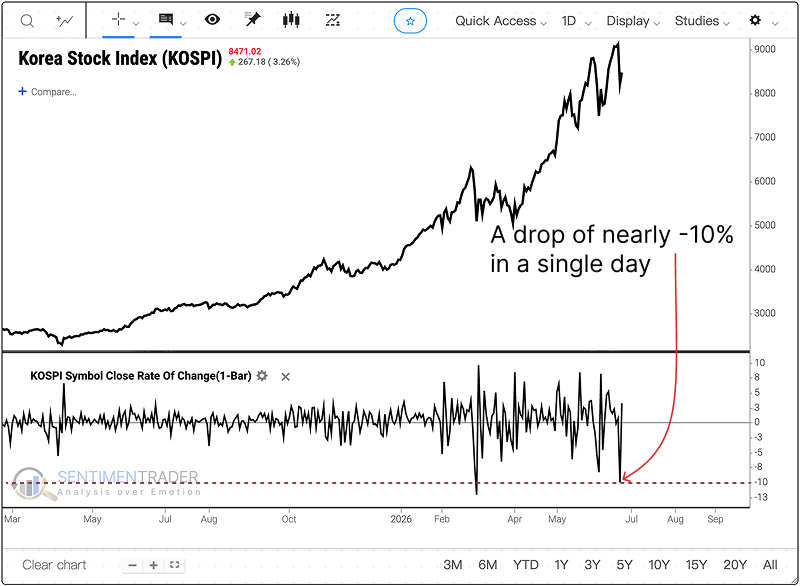
- KOSPI fell nearly 10% in a single day this week, one of only 15 such declines on record
- The simple crash signal is not a clean directional indicator. Twelve-month outcomes ranged from a 26.4% loss to a 176.7% gain.
- Strong-trend selloffs and fast repair produced a more useful read, and the transmission to US tech was positive in the short term
Korea is no longer a local story
KOSPI dropped nearly 10% in a single session this week. A move of that size is extreme in any market, and the index had roughly tripled from its 2025 lows. The question that matters is whether pressure on a market that has been a bellwether for global semiconductor and AI demand travels beyond Korea.
I screened for every instance when KOSPI fell more than 7% in a single day. The search returned 15 signals, spanning more than four decades. That is a small sample, and it ranges from the Asian Financial Crisis through the COVID shock, alongside strong-trend corrections like 1993 and 2024.
A year after a single-day KOSPI crash of more than 7%, the index was higher 62% of the time with a median return of 31.7%. The range is extreme, spanning from severe losses to triple-digit gains. The 1-month and 6-month