
It's time to watch closely for coffee jitters

Key points
- Coffee has entered the weakest seasonal period of the year
- So far, the price of coffee futures is rallying hard
- Alert traders should note that any sign of a downside price reversal may highlight a trading opportunity on the short side
Coffee is rallying
Coffee futures advanced roughly 36% from mid-March 2024 to mid-April. After a 20% pullback into early May, coffee has again been "off to the races" and threatens to retest the mid-April highs.
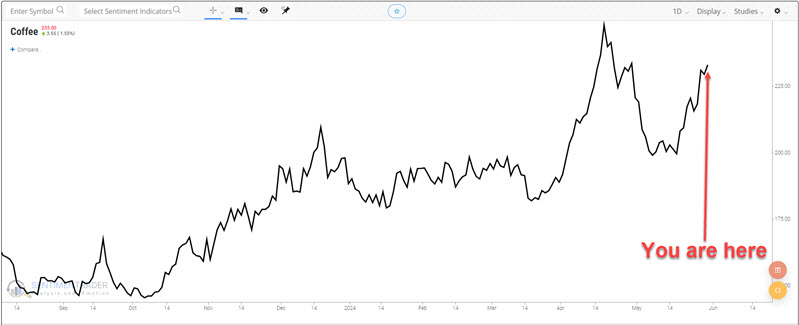
Alert traders should watch closely to see how this rally plays out. If coffee fails to regain new highs - or if it tests the previous high but then fails and reverses lower - the potential for a swift plunge exists. Please note that what follows is not a "prediction" of what will happen but instead as "be prepared" information. If coffee were to continue to rally, break out to new highs, and stay there, there would be no compelling reason to play the short side of this volatile market.
A period of significant seasonal weakness has begun (badly for the bears)
The chart below displays the annual seasonal trend for coffee futures. Note that this market has entered a relatively brief - but often significant - unfavorable seasonal period that extends from TDY #103 through TDY #117. For 2024, this period began at the close on 2024-05-29 through 2024-06-18.
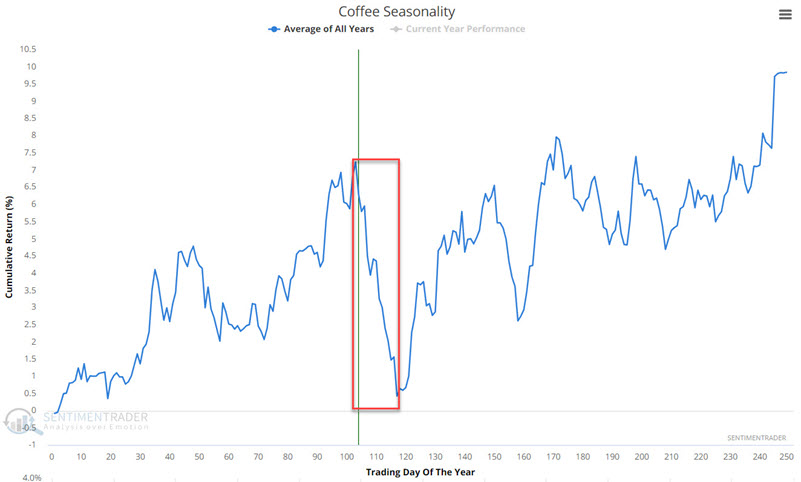
So far, during this purportedly bearish period, coffee futures have:
- Gained +3.55 on 2024-05-30
- Gained +3.70 on 2024-05-31 (based on pre-market hours trading)
This action is a reminder of why trading based solely on seasonality is rarely a good idea. The best times to act based on seasonality are:
- If price action is in agreement with the direction of the seasonal trend (i.e., if the price is trending lower within a supposedly unfavorable seasonal period)
- If the price experiences an extreme (in the opposite direction of the expected seasonal trend) and then a significant reversal
In the case of coffee futures, recent price action clearly does not agree with an unfavorable seasonal trend. However, the jury is still out on the possibility of the second scenario. Why bother?
The chart below displays the hypothetical cumulative $ +(-) achieved by holding a long position in coffee futures only during the end of TDY #103 through the end of TDY #117 every year since 1973.
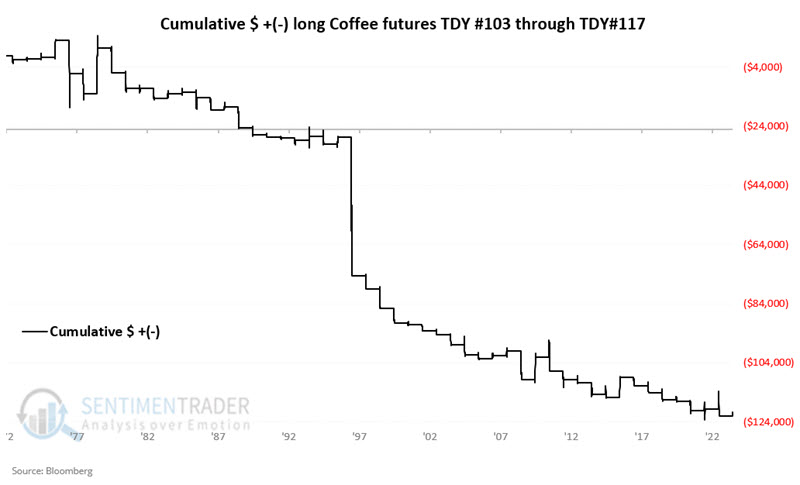
The chart above demonstrates the long-term downside bias during this period. However, as with any seasonal trend, price weakness during this period is not guaranteed in any given year.
The table below summarizes coffee futures' performance during this seasonal period.
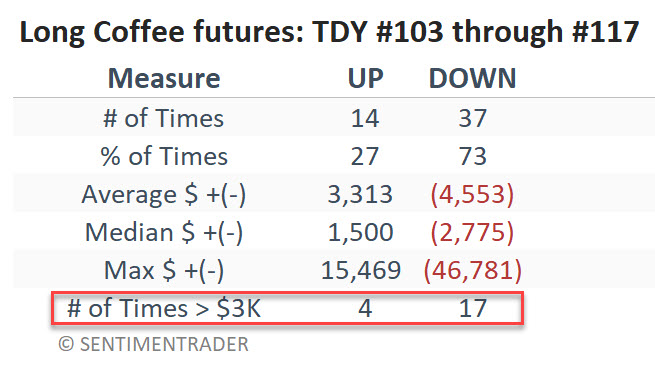
The results above highlight the potential benefits - and pitfalls - of incorporating seasonal trends. There has clearly been a historical downside bias during this period. Also note that of periods that have shown a net move during this period over $3,000 in contract value (each one point in price is worth $375 in contract value), four have been to the upside, and seventeen have been to the downside. All that said, the reality remains that coffee has shown a gain 27% of the time during this period.
What the research tells us…
Over the past half-century, coffee futures have demonstrated a persistent tendency to decline during the late May to mid-June period. But there is absolutely no guarantee on a year-to-year basis that this tendency will play out as expected, and traders are never encouraged to blindly risk money based solely on a seasonal tendency. As long as coffee futures continue to trend higher, there is no reason to fight the trend. That said, coffee has historically experienced significant price weakness during this period. If - and only if - price action reverses, there is the potential (though not specifically the expectation) that coffee could decline quickly into mid-June. Aggressive futures traders should remain alert for a potential opportunity.