
Its time to keep an eye on wheat

Key points
- Wheat is one of the most highly cyclical commodities
- On a price action basis, wheat seems to be trying to form a long-term base
- In the meantime, wheat is entering one of the seasonally weakest periods of the year
Wheat is trying to form a long-term base
In the long-term charts below, we see that wheat has a long history of making significant advances followed by equally major declines. We also see that this market has been in a significant downtrend for over three years now.
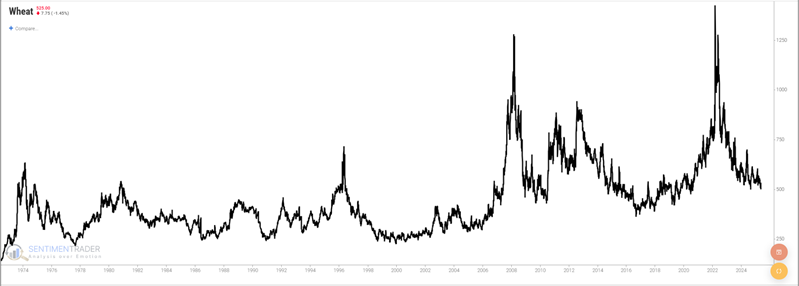
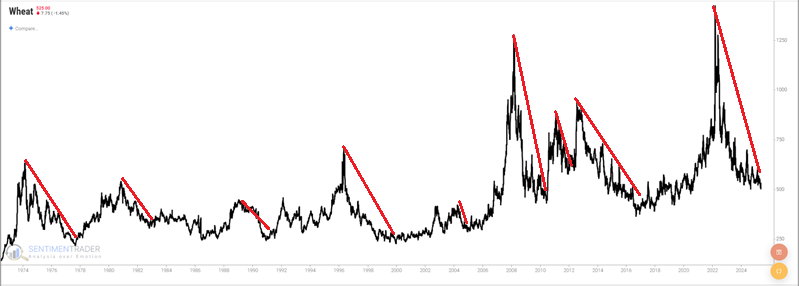
The chart below zooms in on the last several years and adds a 70-day exponential moving average to filter for trend. On a subjective basis, one can argue that wheat is trying to form a base following a multi-year decline. On an objective basis, for now, price remains below the moving average - i.e., in a downtrend.
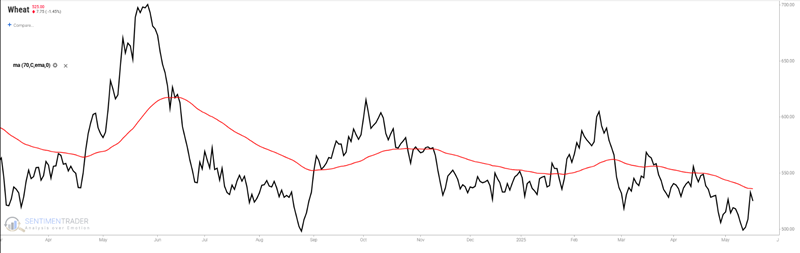
So, is it time for futures traders to start looking for a buying opportunity in wheat futures? Should non-futures traders start looking at the Tecrium Wheat ETF (ticker WEAT)?
Seasonality suggests that the answer is "No", or at the very least, "Not yet."
A key time of year for wheat
The wheat futures contract is for "Soft Red Winter" wheat, one of the most highly cyclical markets. Much of this cyclicality is due to the planting cycle, which essentially never changes. Soft red winter wheat is planted in late fall and harvested the following summer.
The chart below displays the annual seasonal trend for Chicago Board of Trade wheat futures. As you can see, this market is entering arguably its weakest time of year, from Trading Day of Year (TDY) #94 through TDY #126. For 2025, this period extends from the close on 2025-05-16 through 2025-07-02.
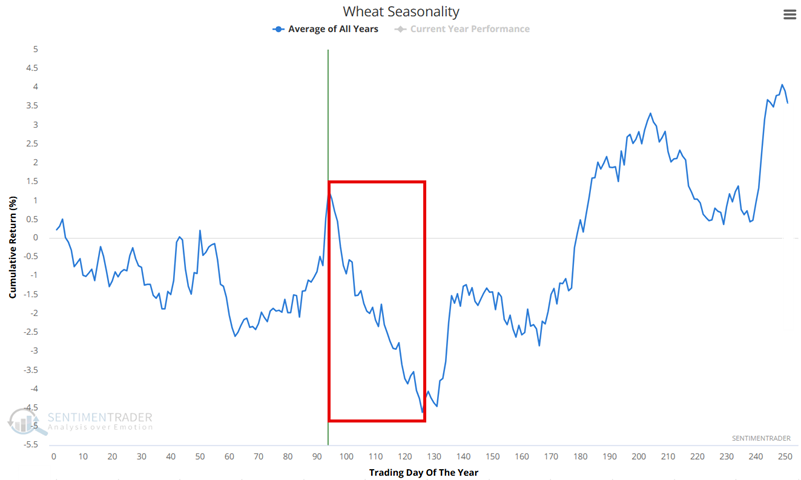
The chart below displays the hypothetical cumulative $ +(-) from holding a long position in wheat futures only during this period every year since 1937.
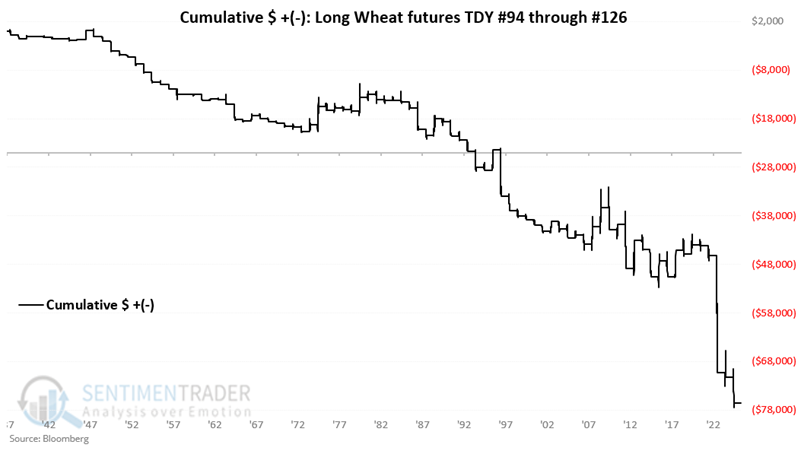
The long-term trend (upper left to lower right) is unmistakable. The caveat, of course - and as always with seasonality - is that there is no guarantee that the current year will adhere to the long-term seasonal trend.
The table below summarizes the performance of wheat futures for the TDY #94 through #126 since 1937.
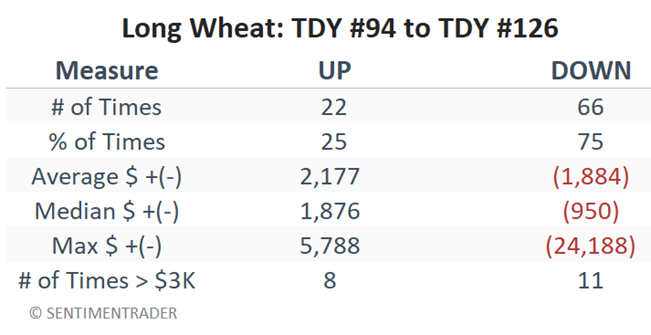
The bottom line is that wheat futures have consistently fallen in three out of every four years for the last 88 years. So mid-Spring is an excellent time to look for an opportunity to play the short side of this market. The caveats include the fact that a) Wheat futures have twice rallied for than $5,000 in value during this period, b) the median decline per contract during losing years is not huge (-$950), c) this period has seen a decline in wheat during each of the last five years (due to an "Up year?") and d) there is simply no guarantee from year-to-year.
What the research tells us…
The good news is that because wheat only grows during certain times of year, it is one of the most reliably cyclical markets. The bad news is that there is a critical difference between "reliably cyclical" and "sure to follow the seasonal pattern this year." When trading based on seasonality, the best opportunities tend to play out when seasonality and price action agree, i.e., both favorable or unfavorable. Wheat futures currently fill this bill on the unfavorable side. Wheat is also extremely beaten down, so a countertrend rally is a distinct possibility. The exact entry timing for any trader looking to play the short side is up to each trader. The most crucial element is managing risk. A stop-loss order - presumably somewhere north of the 70-day EMA - is essential.