
Its time to keep an eye on silver (and be patient) - Part II

Key Points
- In Part I, we highlighted three cycles in silver (months of the year, the eight-year cycle, and the 30-year cycle for commodities).
- In Part II, we will combine the three cycles into one Model labeled the JK Seasonal Silver Model
- The purpose of the Model is not necessarily to generate automatic buy and sell signals as a standalone model but to point traders in the direction with the most opportunity
A review of three cycles
We highlighted three distinct cycles that may apply to silver in Part I. For full details, see here. For now, a recap:
- Six favorable months of the year for silver: Six months are deemed favorable, and the rest unfavorable
- The 8-year cycle: The first four years of each cycle are deemed favorable, the second four years unfavorable
- The 30-year cycle for commodities: The first 15 years of the cycle are deemed favorable for commodities in general
Creating a Model
To arrive at a model reading, we will assign points to each of the three cycles above, as detailed below.
Cycle #1. Months of the Year
Variable A = If the current month of the year is January, February, July, August, November or December, then A = +4 else, A = 0
Cycle #2. Eight-Year Cycle
Starting at the end of 1952, the first four years of each subsequent 8-year period are deemed "favorable" for silver. The most recent favorable period was 2017 through 2020. The current unfavorable period will extend through 2024-12-31. The next favorable period will extend from 2025-01-01 through 2028-12-31.
Variable B = If this cycle is in a favorable period, then B = +2 else, B = 0
Cycle #3. 30-year cycle for commodities
Starting at the end of June 1933, the first fifteen years of each cycle are deemed favorable for commodities as an asset class. The most recent favorable period began at the close on 2023-06-30 and will extend through 2038-06-30.
Variable C = If this cycle is in a favorable period, then C = +1 else, C = 0
Putting the cycles together
The model reading is arrived at by adding the values for Variables A, B, and C. Let's look at the current status of each cycle and where the JK Seasonal Silver Model stands now.
Months of the Year: November and December of 2023 and January and February 2024 are all deemed favorable.
Variable A = +4 (and will remain +4 through the end of February 2024)
Eight-Year Cycle: A new favorable four-year cycle will begin on 2025-01-01. So, until then:
Variable B = 0
30-year cycle for commodities: This cycle will remain favorable until 2038-06-30:
Variable C = +1
When we add up the variable values, we find:
JK Seasonal Silver Model = Variable A + Variable B + Variable C = 4 + 0 + 1 >>>> = +5
Applying Model Variables to Silver
The critical thing to note is whether the Model is reading above +4 or not:
- Readings of +5 or more are favorable for silver
- Readings of +4 or less are unfavorable for silver
The bottom line is this: As long as either the Eight-year silver cycle and/or the 30-year commodities cycle is favorable (i.e., if Variable B = +2 and/or if Variable A = +1) then the months of January, February, July, August, November, and December will be deemed favorable for silver (because the Model will be at +5, +6 or +7).
Since the 30-year commodities cycle is now favorable through June 2038, the practical application is that the six months mentioned above will be deemed favorable for silver every year for the next 15 years. Does that mean that these months will always show a gain? Certainly not. It simply means that those are the times when traders looking to play the long side of silver should consider pressing their bets.
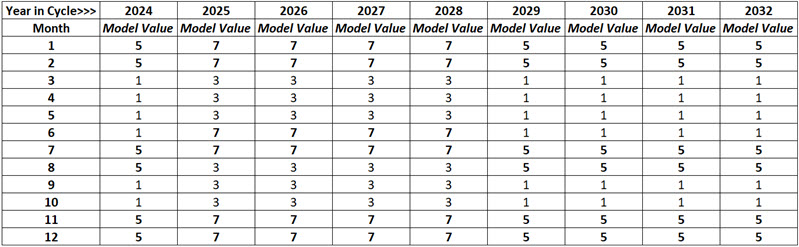
The table below displays the monthly Model readings for the next nine years.
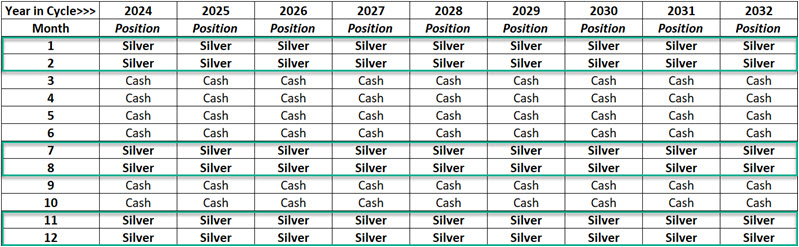
The table below replaces any Model reading of +5 or higher with the word "Silver." All other months display the word "Cash." According to the Model, traders looking to play the short side of silver should stick to doing so during the months labeled "Cash."
A look at historical performance
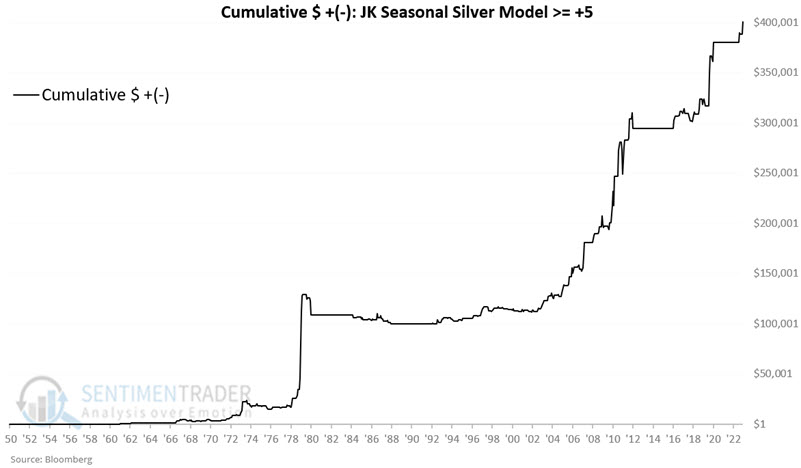
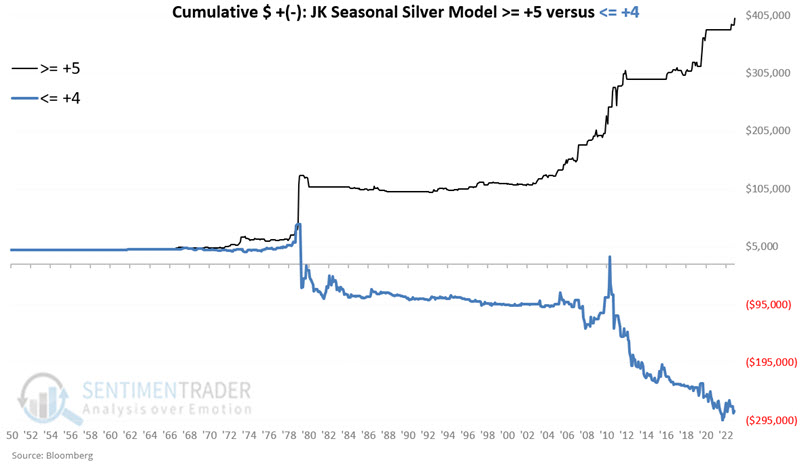
The chart below displays the hypothetical cumulative $ +(-) from holding a long position in silver futures only during months when the JK Seasonal Silver Model was at +5 or higher.
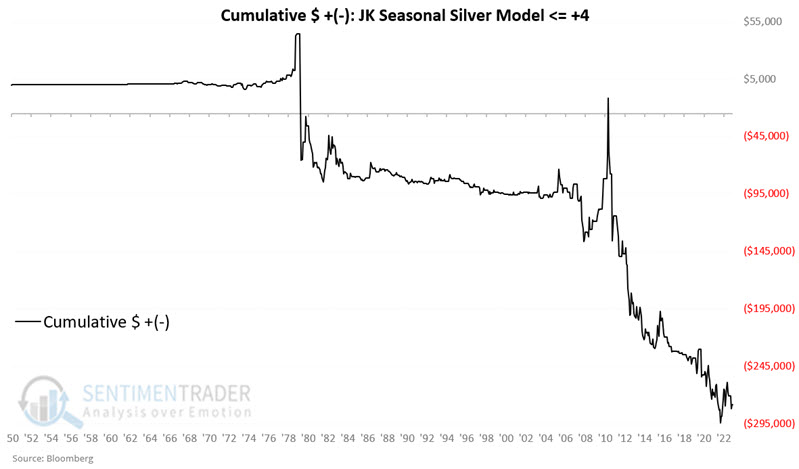
The chart below displays the hypothetical cumulative $ +(-) from holding a long position in silver futures only during months when the JK Seasonal Silver Model was at +4 or lower.
The chart below displays both equity curves above on one chart to highlight the distinct difference in silver performance.
What the research tells us…
Because the three cycles are all calendar-based, the favorable and/or unfavorable status of the JK Seasonal Silver Model can be determined in advance (see the tables above). Likewise, the equity curves displayed above are compelling. However, do not make the mistake of thinking that there is any "easy money" to be made by simply buying silver when the Model is favorable and selling short silver or holding cash when the Model is unfavorable. The future is unknowable, and markets can be highly volatile and unpredictable (especially markets like silver). During those months when the Model favors silver, traders are encouraged to consider other preferred confirming indicators before taking a position. However, questions of capital allocation and risk control (i.e., stop-loss orders) are separate questions that each trader must address every time they enter a position.
The information above does not relieve the trader of those responsibilities and decisions.